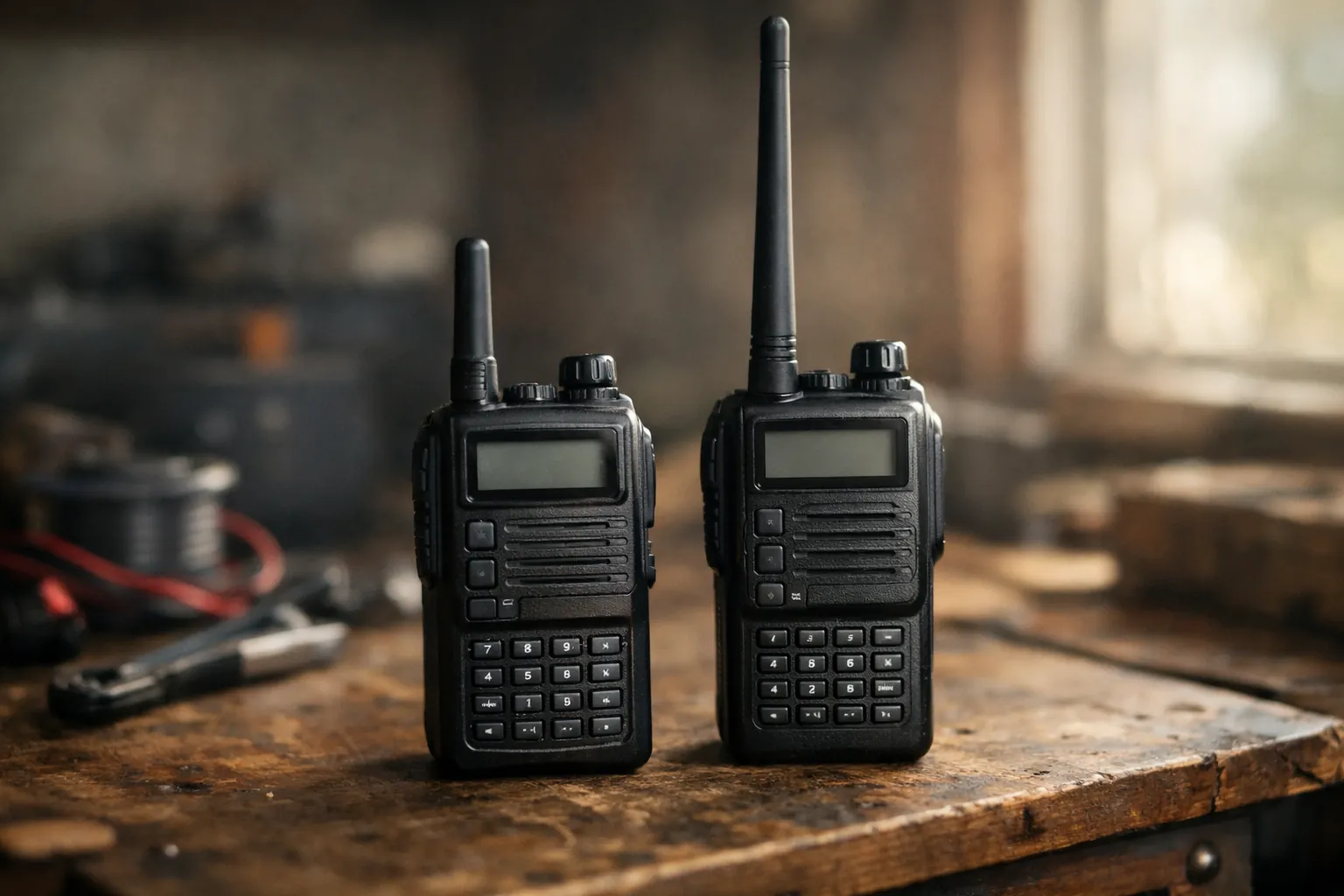
In the Quansheng vs Baofeng matchup, buy the Quansheng UV-K5(8). In the same price class, its FCC receiver grant covers 50 to 600 MHz, which takes in AM airband and NOAA weather, and it charges from USB-C. Buy the Baofeng UV-5R only if you care more about the biggest owner base, with all the accessories and tutorials that come with it. Both are amateur radios for licensed hams, and neither is legal for GMRS. If you're still choosing a model, our Baofeng radio buying guide sorts the whole current lineup by license.
How we compared them
On October 3, 2026 we compared the current Amazon listings for the Baofeng UV-5R and the Quansheng UV-K5(8), plus Amazon sales and ratings that day: the UV-5R sold 2,000+ last month with 10,000+ ratings; the UV-K5(8) listing had 260+ ratings at 4.6 stars. On November 16, 2026 we added the Quansheng UV-K5's FCC equipment grant (read through the fccid.io mirror of the FCC database) and BTECH's UV-5R spec page (BTECH is Baofeng's US distributor). Licensing facts come from 47 CFR Part 97 and 95.1761. Both radios are sold by many sellers in many variants, so check the listing you buy. How we research.
Certification and license check
| Baofeng UV-5R | Quansheng UV-K5(8) | |
|---|---|---|
| What the maker says | "Legal for use on amateur frequencies" (BTECH, Baofeng's US distributor) | Sold as an amateur handheld; US version transmits 144-148 and 420-450 MHz (listing) |
| FCC grant | Not used here | XBPUV-K5, filed as model UV-K5, March 9, 2023: Part 15B scanning receiver, 50-600 MHz, and no transmitter grant |
| Transmit range as listed | 136-174 and 400-520 MHz (BTECH spec page) | 144-148 and 420-450 MHz (US version listing) |
| GMRS (Part 95E) certification | No | No |
| License to transmit on 2 m and 70 cm | Amateur, Technician or higher | Amateur, Technician or higher |
FCC grant and BTECH page read November 16, 2026. Retail listings for the UV-K5(8) give this same FCC ID. Amateur transmitters don't need an FCC equipment grant, which is why a ham radio can have a receiver grant and no transmitter grant (95.1761(c) names the Amateur Radio Service as a service without equipment certification). The Technician exam is 35 questions with 26 needed to pass (97.503), and the US 2 m and 70 cm bands are 144-148 and 420-450 MHz (97.301); eCFR up to date as of November 12, 2026.
Spec comparison
| Baofeng UV-5R | Quansheng UV-K5(8) | |
|---|---|---|
| Transmit | 144-148 / 420-450 MHz (this listing) | 144-148 / 420-450 MHz (US version) |
| Receive | 136-174 and 400-520 MHz, plus FM broadcast (BTECH spec page) | 50-600 MHz incl. AM airband, FM broadcast, 10 NOAA channels |
| Power | High/low; BTECH's spec table says 5 W/1 W, its notes on the 2012 original say 4 W/1 W | High/medium/low, up to 5 W |
| Memories | 128 | 200 |
| Tones | 50 CTCSS, 104 DCS | CTCSS/DCS, plus frequency and tone copy |
| Charging | Desktop charger; 1,500 mAh battery (BTECH spec page) | Desktop charger + USB-C emergency charging |
| Programming | Keypad or cable | Keypad or cable |
| Extras | Dual standby, VOX, flashlight | Dual watch, VOX, flashlight, DTMF, voice prompts |
| Amazon ratings | 10,000+ (4.5★) | 260+ (4.6★) |
From each product's Amazon listing, October 3, 2026, UV-5R cells that name BTECH's spec page were checked there on November 16, 2026. The UV-K5(8)'s 50-600 MHz receive range matches its FCC receiver grant.
Who wins what
Baofeng UV-5R: the classic
Sales are the UV-5R's real strength. It's one of Amazon's best-selling ham handhelds, so whatever accessory or cable you need exists, and someone on YouTube has explained it. The listing we checked transmits only on the 2 m and 70 cm ham bands. It has 128 channels with 50 CTCSS and 104 DCS tones, plus dual standby and VOX (and a flashlight). As a learning radio or a cheap spare, it's fine. The weak spot is the keypad menu system, which almost everyone replaces with a cable and CHIRP. Baofeng's newer 5RM now sells alongside it; our AR-5RM review covers what changed.
If you want the same family with a better kit and US support, the BTECH BF-F8HP is the upgraded "3rd gen" version, with 15,000+ ratings. Our review of the BF-F8HP compares it with the UV-5R and the newer BF-F8HP Pro, and checks the 8-watt claim against bench numbers.
Quansheng UV-K5(8): the modern budget pick
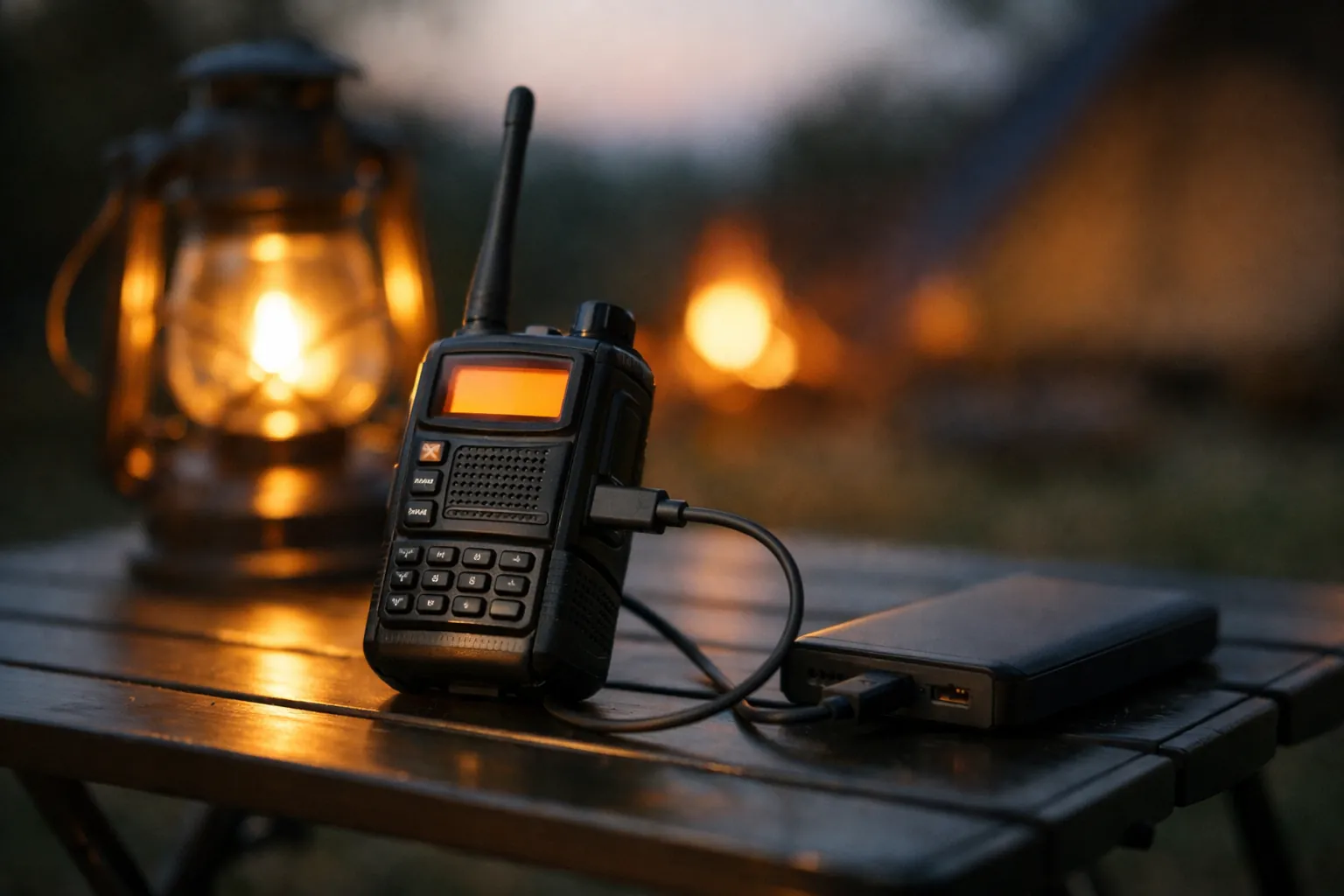
Same price bracket as the UV-5R, newer inside. Its FCC receiver grant covers 50 to 600 MHz, and its listing describes FM broadcast and AM airband in that span, with 10 NOAA weather channels on top. Before you're licensed, that makes it a useful listening radio. It charges from a desktop charger or a USB-C port and stores 200 channels. There's also a frequency meter that can detect a nearby radio's frequency and tone and copy them. The US version transmits on 144-148 and 420-450 MHz at up to 5 W.
It's also popular with tinkerers because of community firmware. That's at your own risk, and no firmware changes what you're licensed to transmit on.
What they're like to live with
On paper the differences are receive coverage and charging. Day to day, other things matter more.
Repeater setup is the first one. Each repeater needs a frequency and an offset, plus a tone. The UV-K5(8)'s copy feature helps when a friend's radio is already set up. Otherwise, use a cable and CHIRP on either radio and save yourself the keypad. Our CHIRP walkthrough for the UV-5R covers the steps, and Baofeng programming software compares the other options.
Both ship with short, compromise antennas. A better dual-band antenna for your radio's connector is the cheapest improvement for either one. The ham antenna guide lists the upgrades.
Batteries vary by seller and variant, so check the capacity in the listing you buy. A spare is worth having for nets and long days out.
Speaker mics and earpieces are cheap for both, but confirm compatibility with your exact model in the accessory's listing before you buy.
Neither one is a GMRS radio
Some cheap dual-band radio listings mention GMRS, and many such radios can be programmed to 462-467 MHz. That doesn't make them legal there. GMRS transmitters must be certified for GMRS (95.1761). The FCC refuses that certification to any radio that can transmit on amateur bands. Operating non-certified equipment in the Personal Radio Services is prohibited (95.335). If your family needs GMRS, Baofeng's GMRS models such as the UV-5G Plus are the ones to buy. See the best GMRS radios for beginners, or read the longer answer in can you use a Baofeng on GMRS.
Which should you buy?
| If you… | Choose |
|---|---|
| Want to listen to airband and weather while studying | UV-K5(8) |
| Want USB-C charging in a go-bag | UV-K5(8) |
| Want the most tutorials and accessories | UV-5R |
| Want a better-supported version of the UV-5R | BTECH BF-F8HP |
| Want to buy once and skip the budget radios | Yaesu FT-65R |
| Need radios for family GMRS | Neither: buy GMRS-certified radios |
What to buy with either radio
A programming cable comes first. The BTECH PC03 FTDI cable fits Kenwood-style K1 jacks; confirm it supports your exact radio and software. Then a better dual-band antenna made for your radio's connector. If you're not licensed yet, add the ARRL Ham Radio License Manual.
Which one to order
Get the Quansheng UV-K5(8). The receiver alone justifies it, and USB-C charging is a real advantage in a go-bag. Keep the Baofeng UV-5R in mind as a second radio for the glovebox, where its weak points don't matter.
One thing doesn't change between them: you need a ham license to transmit on either, and neither belongs on GMRS. If neither feels right, our guide to the best handheld ham radios for beginners has six more options. Baofeng's DMR radio is a different animal, with digital voice, GPS and APRS; see the DM-32UV (DM32) review.
Specs from each product's Amazon listing and sales figures from Amazon search results, checked October 3, 2026. FCC grant XBPUV-K5 and BTECH's UV-5R spec page, checked November 16, 2026. Rules: 47 CFR Part 97 · Part 95 Subpart E (eCFR up to date as of November 12, 2026). How we research · Affiliate disclosure