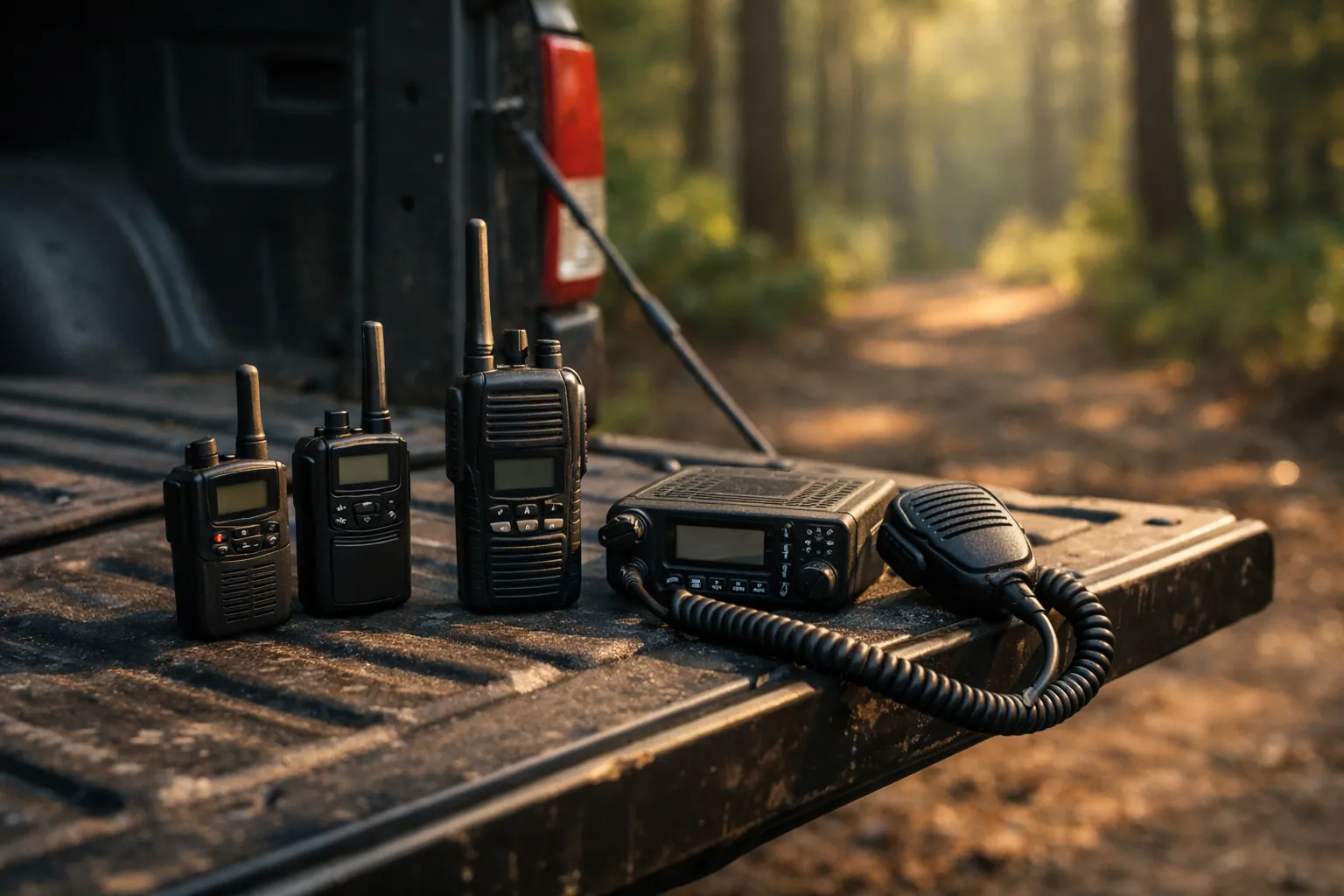
Use FRS for license-free family walkie-talkies, GMRS when you want more power, vehicle radios and repeaters for a $35 license, CB if you need to talk to truckers or an older club, and ham radio when you want the most capability and are willing to pass an exam. GMRS is the sweet spot for most families and off-road groups. The table below puts all five services, including MURS, side by side.
How we compared them
We read the current FCC rules for each service in the eCFR on October 3, 2026: FRS (Part 95B), CB (Part 95D), GMRS (Part 95E), MURS (Part 95J) and amateur radio (Part 97). Fees come from 47 CFR 1.1102. Range comments are practical expectations, not test results. How we research.
The five services compared
| FRS | GMRS | CB | MURS | Ham (amateur) | |
|---|---|---|---|---|---|
| License | None | $35, no exam, 10 yr, covers immediate family | None | None | Exam required; $35 FCC fee, 10 yr |
| Frequencies | 462/467 MHz UHF | 462/467 MHz UHF | 26.965-27.405 MHz | 151-154 MHz VHF | Many bands, HF to microwave |
| Channels | 22 | 30 (22 shared with FRS + 8 repeater inputs) | 40 | 5 | Frequency ranges, not channels |
| Max power | 2 W ERP (0.5 W on 8-14) | Up to 50 W (mobile/base, main channels) | 4 W AM/FM, 12 W PEP SSB | 2 W | Up to 1,500 W PEP |
| Repeaters | No | Yes | No | No | Yes, thousands |
| Detachable antenna | No (built in) | Yes on most radios | Yes | Allowed (height limits apply) | Yes |
| Best for | Kids, theme parks, campsites | Families, off-road groups, rural property | Truckers, legacy clubs | Farms, businesses, hunters | Hobbyists, emergency comms, long distance |
| Rule | 95.567 | 95.1767 | 95.967 | 95.2767 | 97.313 |
Which one should you use?
FRS: license-free walkie-talkies
FRS radios are the bubble-pack walkie-talkies anyone can use. They have 22 channels, a fixed antenna and a 2-watt ERP cap (0.5 watt on channels 8-14). They're perfect for kids, ski trips and keeping a campsite connected. Sets like the Midland LXT600VP3 are sold as license-free FRS radios. The limit is range: no repeaters and no external antennas. Details in GMRS vs FRS.
GMRS: the family and off-road upgrade
GMRS shares FRS's 22 channels, adds 8 repeater channels, and allows up to 50 watts from mobile and base radios on the main channels (95.1767). The license is $35, takes no exam, lasts 10 years and lets your immediate family use your radios (95.1705). That combination is why Jeep clubs and rural families have moved to it. A compact mobile like the Midland MXT275 is a typical first install. Start with how to get a GMRS license.

CB: still alive on the highway
Citizens Band radio is license-free and has 40 channels between 26.965 and 27.405 MHz (95.963). Power is capped at 4 watts for AM and FM and 12 watts PEP for single sideband (95.967), and channel 9 is reserved for emergencies and traveler assistance (95.931). CB's strengths are its user base among truckers and the occasional long-distance "skip" when conditions are right. Its weaknesses are noise, low power and the long antenna it needs to work well.
MURS: the overlooked VHF option
MURS has five VHF channels (151.820, 151.880, 151.940, 154.570 and 154.600 MHz) and a 2-watt limit, with no license required (95.2763, 95.2767). VHF can carry a little better through foliage and over rolling terrain than UHF, and the channels are usually quiet. The catch is that few people own MURS radios, so it's mostly used by farms, small businesses and hunting groups who buy a matched set.
Ham radio: the most capable, with an exam
Amateur radio requires passing a written exam (35 questions for the entry-level Technician license, no Morse code). In return you get far more frequencies, up to 1,500 watts PEP (97.313), thousands of repeaters, digital modes, satellites and, with a General license, worldwide HF contacts. Every licensee needs their own license and call sign, unlike GMRS. See ham radio license levels and ham radio for beginners.
Can different services talk to each other?
| Pair | Can they talk? |
|---|---|
| FRS ↔ GMRS | Yes, on shared channels 1-22 (95.531) |
| GMRS ↔ ham | No, except emergency messages (95.1733); different frequencies anyway |
| CB ↔ anything else | No, different band |
| MURS ↔ anything else | No, different channels |
One common trap: cheap dual-band ham handhelds can often be programmed to GMRS frequencies, but that doesn't make them legal there. GMRS transmitters must be FCC-certified for GMRS, and the FCC won't certify a radio for GMRS if it can transmit on amateur bands (95.1761). Buy a radio certified for each service you plan to transmit on.
The bottom line
For most families and off-road groups, GMRS is the best balance: $35, no exam, one license for the family, real power and repeaters. Keep FRS for the kids, CB only if your crowd uses it, MURS for a quiet private set, and step up to ham radio when you want the full toolbox.
Rules checked against 47 CFR Parts 95 and 97 and 47 CFR 1.1102 (eCFR, current through October 1, 2026) on October 3, 2026. FCC GMRS · 47 CFR Part 95 · 47 CFR Part 97. How we research · Affiliate disclosure