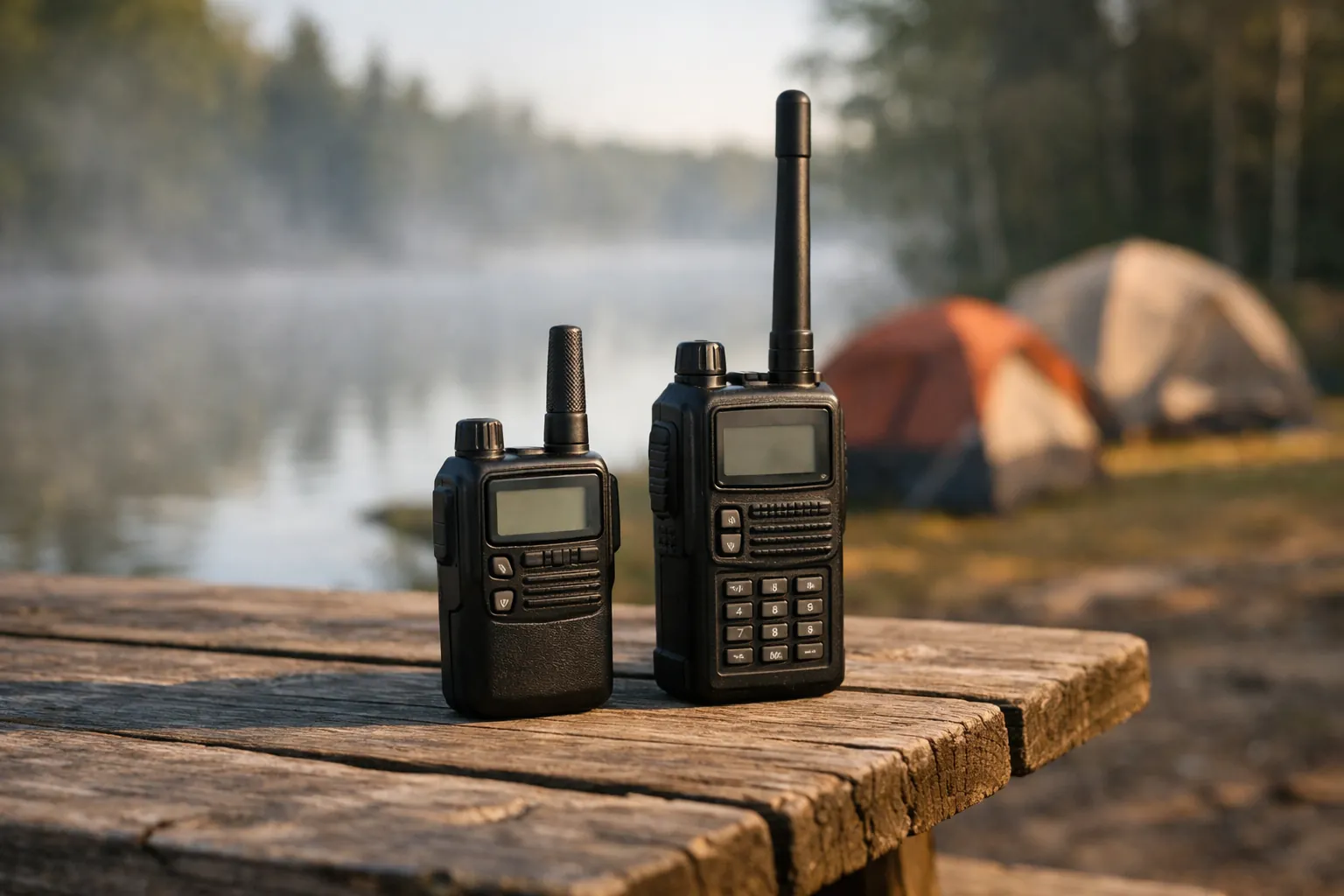
FRS (Family Radio Service) is license-free and capped at 2 watts; GMRS (General Mobile Radio Service) uses the same 22 channels plus 8 repeater channels, allows up to 50 watts from mobile and base radios, and needs a $35 FCC license. If your group stays within a campground or a neighborhood, FRS is fine. If you want range from a vehicle, a better antenna or access to repeaters, GMRS is the upgrade, and the license covers your immediate family.
How we checked this
Every channel, power and licensing fact on this page comes from the regulations themselves, read on October 3, 2026: 47 CFR Part 95 Subpart B for FRS and Subpart E for GMRS, plus the FCC's GMRS page. Radio examples are current Amazon best-sellers whose listings identify them as FRS or GMRS radios. How we research.
GMRS vs FRS at a glance
| FRS | GMRS | |
|---|---|---|
| License | None (licensed by rule) | Individual FCC license, $35, 10 years (95.1705) |
| Who can use it | Anyone | Licensee and immediate family; anyone in an emergency |
| Channels | 22 (95.563) | 30: the same 22 plus 8 repeater input channels (95.1763) |
| Max power, channels 1-7 | 2 W ERP | 5 W ERP |
| Max power, channels 8-14 | 0.5 W ERP | 0.5 W ERP, handhelds only |
| Max power, channels 15-22 | 2 W ERP | 50 W output for mobile and base stations (95.1767) |
| Repeaters | No | Yes |
| Antenna | Must be fixed, built into the radio (95.587) | Removable and external antennas allowed on most GMRS radios |
| Radio types | Handhelds only | Handhelds, mobiles, base stations, repeaters |
| Call sign | Not used | Required at the end of transmissions and every 15 min (95.1751) |
ERP (effective radiated power) includes antenna gain; the 50 W GMRS figure is transmitter output power. The FCC rules don't set a separate main-channel output limit for GMRS handhelds; most certified GMRS handhelds are rated around 5 watts, so check the listing.
How the channels overlap
This is the part that makes the two services confusing: FRS isn't a separate band. Every FRS channel is also a GMRS channel, and radios label them with the same numbers 1-22 that the FCC uses in the FRS rules. GMRS adds eight more frequencies, 5 MHz above the main channels, that radios transmit on only when talking through a repeater.
For the full list of frequencies, see our GMRS channels and frequencies chart.
Power: where the real difference is
On channels 8-14, the two services are identical: half a watt, handhelds only. On channels 1-7, a GMRS radio may run 5 watts ERP against FRS's 2. The big gap is channels 15-22, the 462 MHz main channels. There, FRS stays at 2 watts, while a licensed GMRS mobile or base radio can run up to 50 watts into an external antenna. That's the setup Jeep groups and rural families use, and it's why GMRS feels like a different service once you leave the handhelds behind.
More power doesn't mean you should always use it. Personal Radio Service rules ask you to use the minimum power needed for the conversation, except in emergencies (95.367).
Antennas and repeaters: the other two upgrades
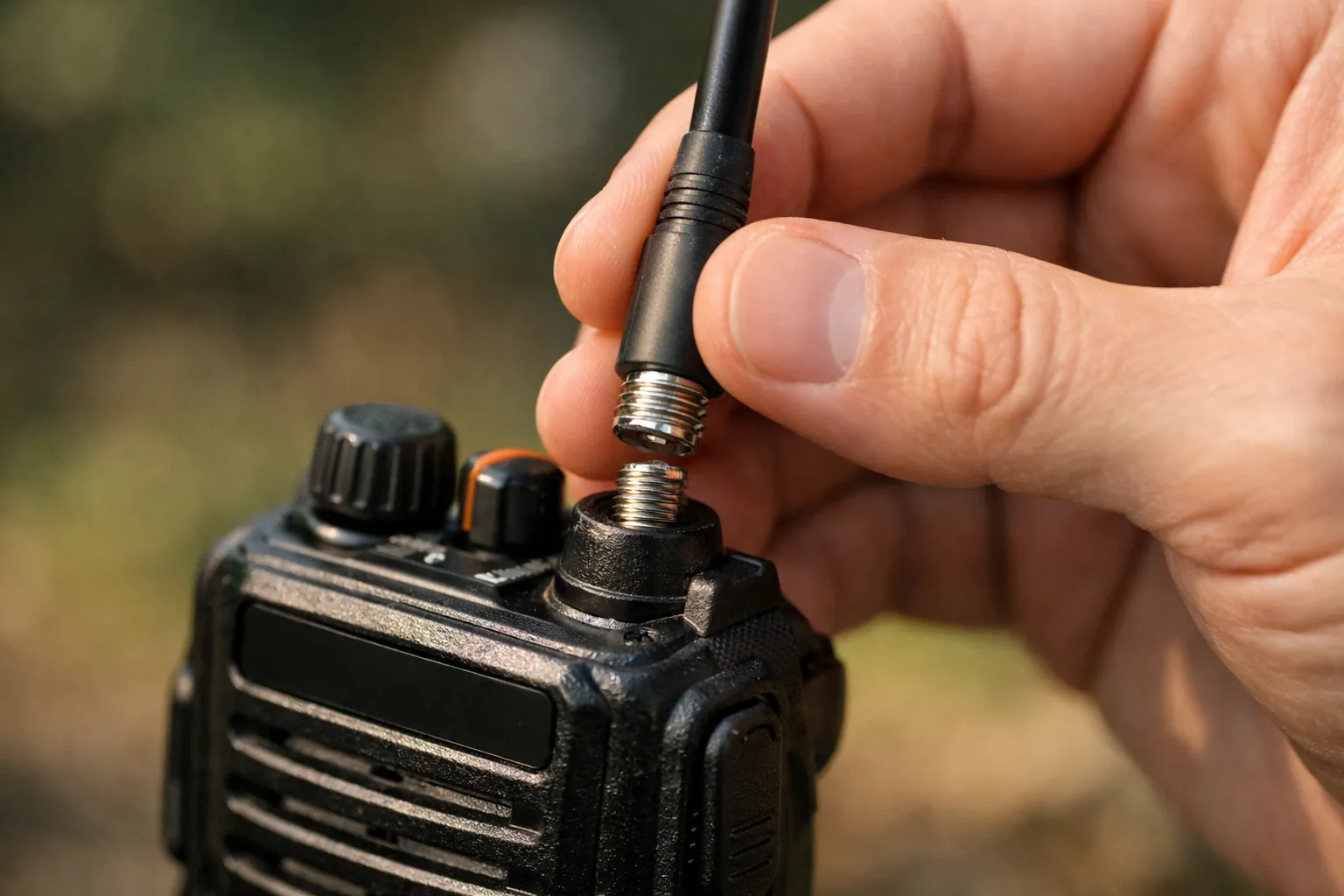
An FRS radio's antenna must be a permanent part of the radio, with no more gain than a half-wave dipole (95.587). GMRS handhelds that can send digital data (location or text) also need a fixed antenna (95.1787), but most voice-only GMRS handhelds and every mobile radio use removable antennas. A better antenna, mounted higher, does more for range than extra watts. Our GMRS antenna guide covers the upgrades.
Repeaters are the other GMRS-only feature. A repeater on a hill or tower receives on a 467 MHz input and retransmits on the paired 462 MHz channel, so two handhelds that can't hear each other can talk through it. Many repeaters are run by clubs or individuals who allow other licensed users. See how to find and use GMRS repeaters.
Which kind of radio are you holding?
Because both services share channels, packaging can be confusing. Two rules help:
- New combination radios are gone. The FCC stopped certifying new handhelds for both services in 2017 and banned the sale of combination FRS/GMRS radios from September 30, 2019 (95.1791). A radio sold today is one or the other.
- Read the listing. License-free radios like the Midland LXT600VP3 are sold as FRS. Bubble-pack sets like the Midland GXT1000VP4 are sold as GMRS radios, which means they need a license to transmit, even though they look like the same kind of walkie-talkie.
| If the listing says… | It's probably | License needed? |
|---|---|---|
| "FRS", "license-free", 22 channels, fixed antenna | An FRS radio | No |
| "GMRS", "repeater capable", detachable antenna | A GMRS handheld | Yes, to transmit |
| "GMRS mobile", 15-50 W, NMO or external antenna | A GMRS mobile radio | Yes |
| "Ham", "dual band", 136-174 / 400-520 MHz | An amateur radio | Ham license; not legal for GMRS or FRS transmit |

Which should you choose?
| Your situation | Pick | Why |
|---|---|---|
| Kids around the neighborhood, theme parks, ski lifts | FRS | Short range is fine and nobody needs a license |
| Family campsite, hiking groups that stay together | FRS, or GMRS handhelds if you want more punch | Terrain often matters more than power |
| Convoys, Jeep trails, overlanding | GMRS mobile | Up to 50 W plus a roof antenna is the big range jump |
| Rural property, farm, home-to-vehicle | GMRS base or mobile | External antennas mounted high |
| Emergency plan with a local repeater nearby | GMRS | Only GMRS radios can use repeaters |
Still deciding? Read is GMRS worth it?, and if you're also weighing CB and ham radio, our four-way comparison covers all of them.

The bottom line
FRS and GMRS share the same 22 channels and can talk to each other. FRS is the no-paperwork option, limited to 2 watts and a fixed antenna. GMRS costs $35 for a 10-year family license and unlocks 5 watts on channels 1-7, up to 50 watts from mobile and base radios, removable antennas and repeaters. For the family on a single campsite, FRS is plenty. For anything involving vehicles, distance or hills, get the GMRS license; our step-by-step license guide shows how.
Rules checked against 47 CFR Part 95 (eCFR, current through October 1, 2026) on October 3, 2026. Sources: Part 95 Subpart B (FRS) · Part 95 Subpart E (GMRS) · FCC GMRS. How we research · Affiliate disclosure