
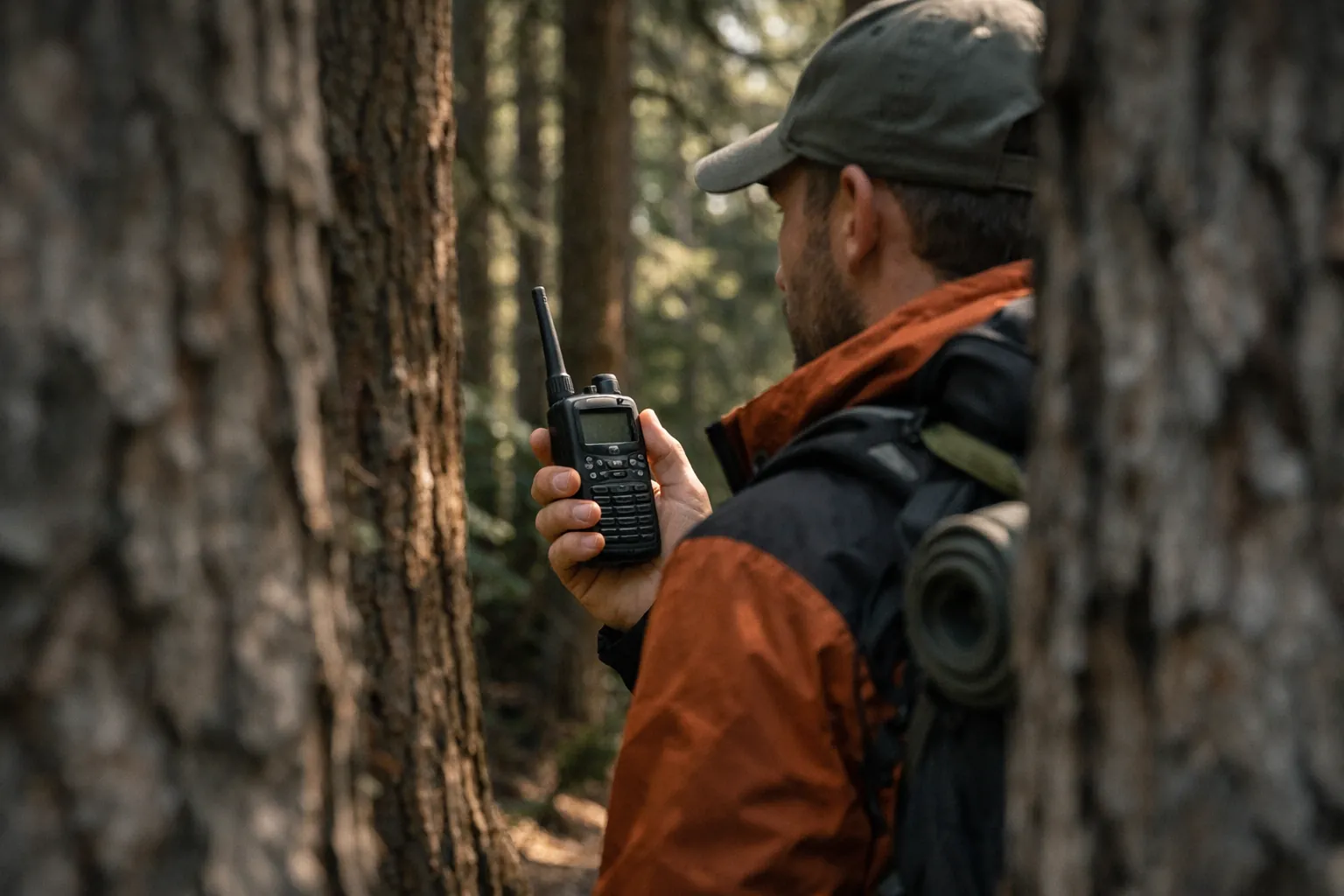
Realistic GMRS range is about 1 to 2 miles handheld-to-handheld in typical terrain, several miles between vehicles with roof antennas, and 20 miles or more through a repeater on a hill. The numbers printed on packaging are best-case figures. What decides your range is mostly how high the antennas are and what's between them, not how many watts the radio puts out.
How we worked this out
There's no honest single answer to "how far does GMRS go," so instead of quoting one we show the physics: GMRS lives on 462-467 MHz (47 CFR 95.1763), a UHF band that travels in straight lines and doesn't bend around hills. That makes line of sight, and therefore antenna height, the main limit. Our range chart uses the standard radio-horizon approximation (distance in miles ≈ 1.41 × √height in feet, for each antenna), which assumes flat ground and no obstructions. Real-world numbers are lower. Power limits come from 95.1767. How we research.
Range chart: the line-of-sight limit by antenna height
This is the farthest two antennas can "see" each other over flat ground before the earth's curve gets in the way. Treat it as a ceiling, not a promise.
What to actually expect
| Setup | Dense woods, hills, town | Open country, water, high ground |
|---|---|---|
| FRS or GMRS handheld ↔ handheld | Under a mile to about 2 miles | A few miles; more from a hilltop |
| GMRS mobile ↔ mobile (roof antennas) | A few miles | Up to the line-of-sight limit, often more from ridges |
| Base station with a mast antenna | Several miles | 10+ miles to other high antennas |
| Anything through a hilltop repeater | Wherever the repeater can "see" | 20+ miles is common |
These are ranges of expectation, not test results. Your terrain will move them a lot in either direction.
The five things that decide range (in order)
1. Terrain and obstacles
UHF signals reflect off buildings and pass through some walls, but hills and ridges stop them. Two radios a mile apart on opposite sides of a ridge may hear nothing; two radios 20 miles apart on two peaks may be crystal clear.
2. Antenna height
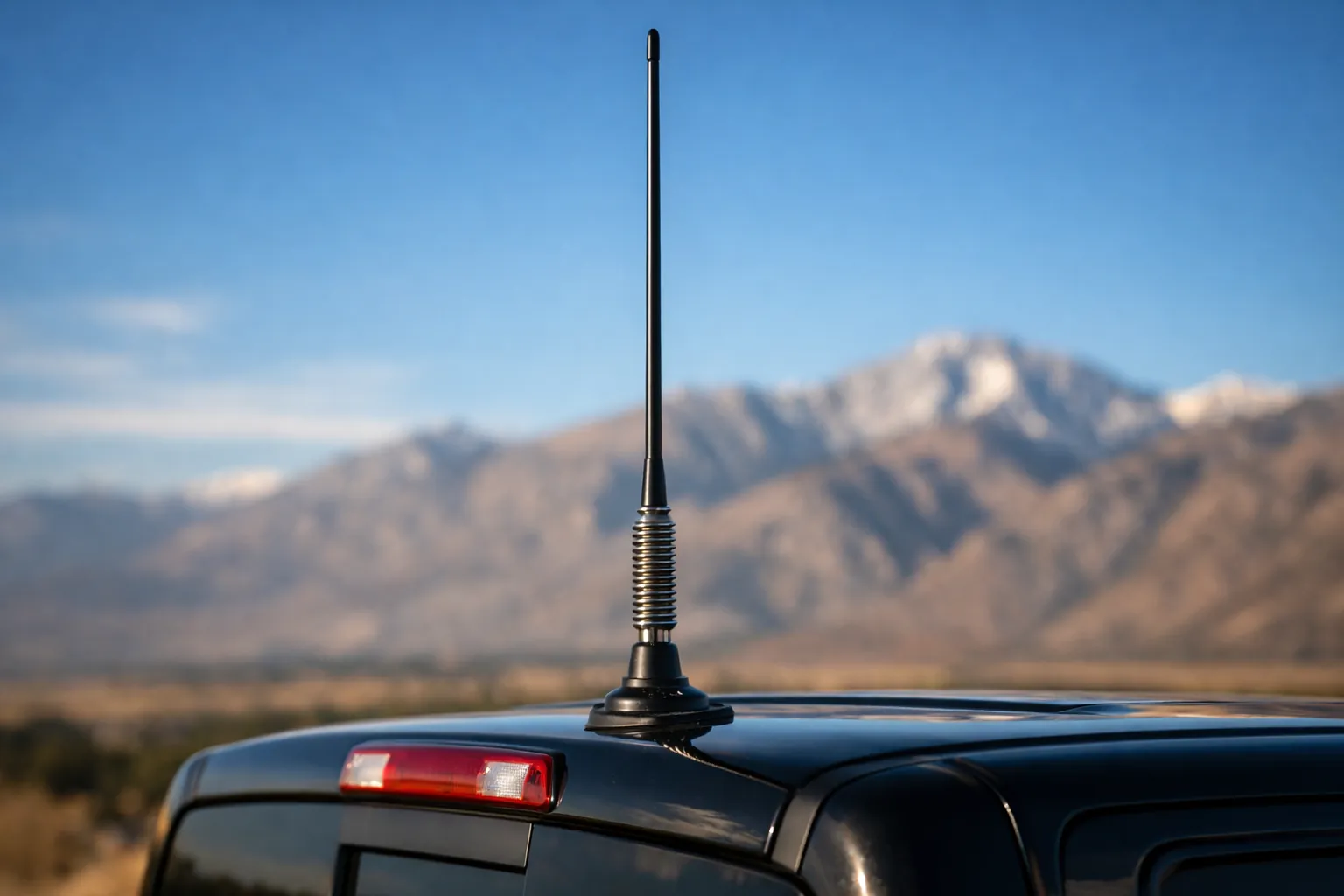
See the chart. Standing on a picnic table helps. A roof antenna beats a handheld inside the cab. A base antenna on a 30-foot mast beats both.
3. The antenna itself
FRS radios must keep their built-in antenna (95.587). Many GMRS handhelds accept a longer, tuned antenna, and mobile radios connect to an external roof antenna. Moving from a handheld inside a vehicle to an outside antenna is one of the biggest jumps you can make. Our GMRS antenna guide covers the options.
4. Repeaters
A repeater solves the height problem for you: it sits on a tower or hill, receives your signal on a 467 MHz input and rebroadcasts it on the paired 462 MHz channel. Only licensed GMRS radios can use them. See how to find and use GMRS repeaters, or put up your own.
5. Power
Power matters, but with diminishing returns. FRS handhelds max out at 2 watts ERP (95.567). GMRS handhelds are typically rated around 5 watts, and GMRS mobile and base radios may run up to 50 watts on the main channels (15-22). Ten times the power does help in fringe areas, but it doesn't let you talk through a mountain.
About those "36 mile" claims
Packaging range figures come from ideal conditions, typically a radio on high ground talking to another with nothing in between. For example, a listing for the popular Midland GXT1000VP4 advertises "up to 36 mile range." The radio isn't lying about what's physically possible from a mountaintop, but at ground level two handhelds are capped near 6 to 7 miles by the earth's curve alone. Plan around the realistic table above, not the box.

The best range upgrades, ranked by value
| Upgrade | Effect | What it takes |
|---|---|---|
| Use a repeater | Largest | A GMRS license and a repeater-capable radio |
| Get the antenna higher | Large | Hilltop, mast, roof; free to cheap |
| Handheld → mobile with roof antenna | Large | A mobile radio like the Midland MXT275 and an external antenna |
| Better handheld antenna | Moderate | A GMRS radio with a removable antenna |
| More watts | Modest | A higher-power GMRS mobile (up to 50 W) |
If you're shopping, start with our best GMRS radios and, for vehicles, the best GMRS radios for Jeeps.
The bottom line
GMRS range is a height problem more than a power problem. Expect a mile or two between handhelds in rough country, several miles between vehicles with roof antennas and 20-plus miles through a good repeater. If you need more range, raise or improve the antenna and find a repeater before you pay for more watts.
Frequencies and power limits from 47 CFR Part 95 (eCFR), checked October 3, 2026: 95.1763 · 95.1767 · 95.567. Range figures are calculated line-of-sight limits and typical expectations, not test results. How we research · Affiliate disclosure