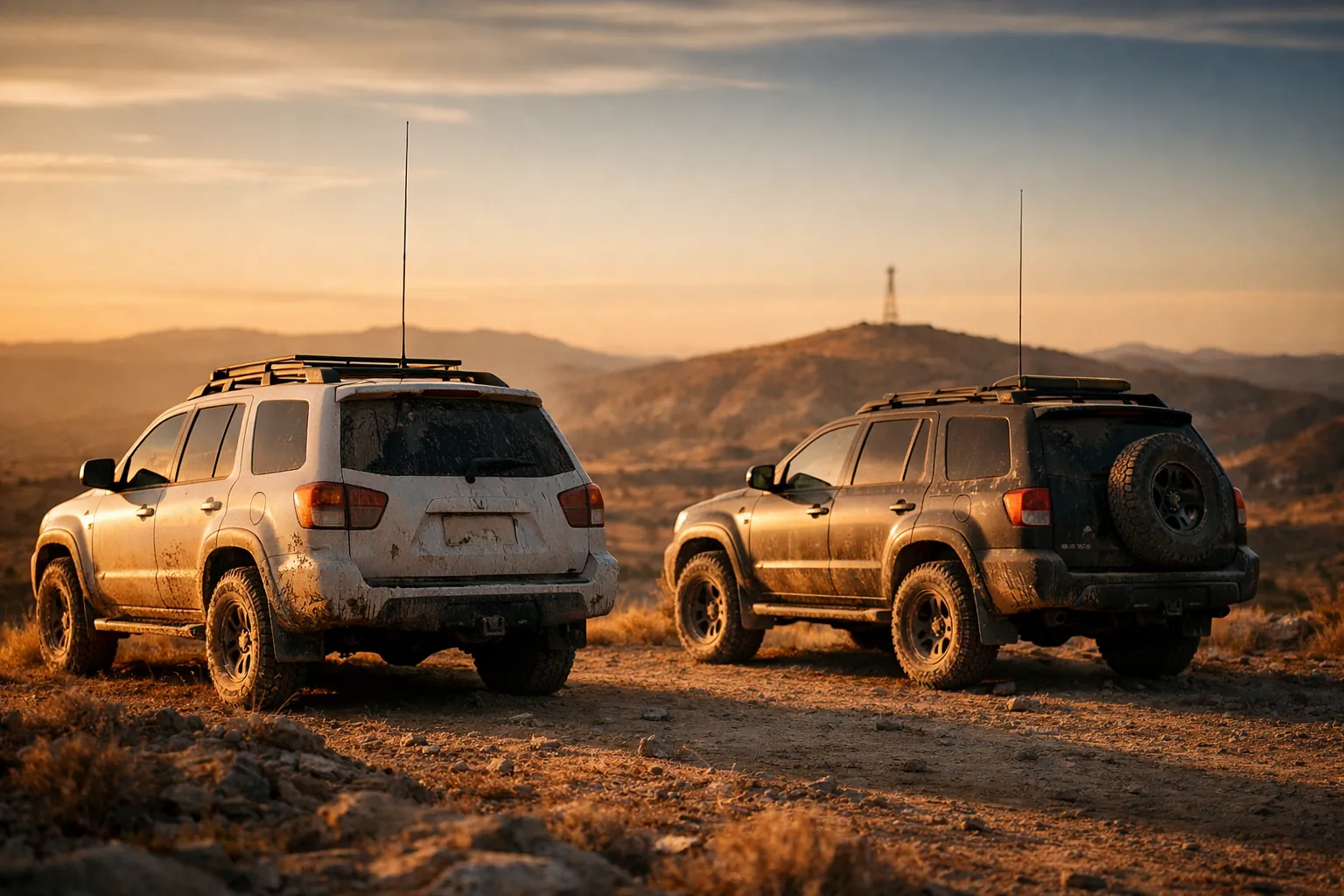
Enter the height of each antenna and the calculator gives the farthest two GMRS radios can see each other over smooth ground. GMRS sits on 462 to 467 MHz (47 CFR 95.1763), where line of sight sets the ceiling, so height matters far more than watts. The result is a theoretical maximum. Real range is almost always shorter.
Preset buttons fill in typical example heights, not measurements. Use height above the terrain between the two stations, not elevation above sea level.
Theoretical maximum, real range is usually less. This is the line-of-sight limit over smooth earth with a clear path. Hills, buildings, trees, vehicle bodies and your own body cut real range, often to a fraction of this number. Power (watts) does not move the horizon. Height does.
Advanced: Fresnel zone clearance
No map or terrain data is used. Results are rounded to 0.1; the "Check the math" section below shows two decimals.
How the calculator works
UHF signals at 462 MHz travel in nearly straight lines. Each antenna can "see" out to its own horizon, and two radios can talk on a clear path as long as their horizons touch. So the limit is the sum of two horizons:
Horizon (miles) = 1.414 × √(antenna height in feet), worked out separately for each antenna, then added. In metric it's 4.1218 × √(height in meters), giving kilometers.
The constant comes from the earth's mean radius, 6,371.0 km (NASA's Earth fact sheet), scaled by 4/3. The lower atmosphere bends radio waves slightly back toward the ground, and radio engineers model that by pretending the earth is a third larger than it is. ITU-R Recommendation P.834 gives 4/3 as the median effective earth-radius factor. The calculator also shows the value with no bending at all (1.2246 × √h), so you can see how much the 4/3 assumption adds: about 15%.
Through a repeater, the two legs are separate. Your radio only has to reach the repeater's antenna, which is high up, and the repeater retransmits to everyone in its own coverage. The repeater inputs are on 467 MHz, 5 MHz above the 462 MHz outputs listed in 95.1763, but the horizon math is the same at both frequencies.
Worked example
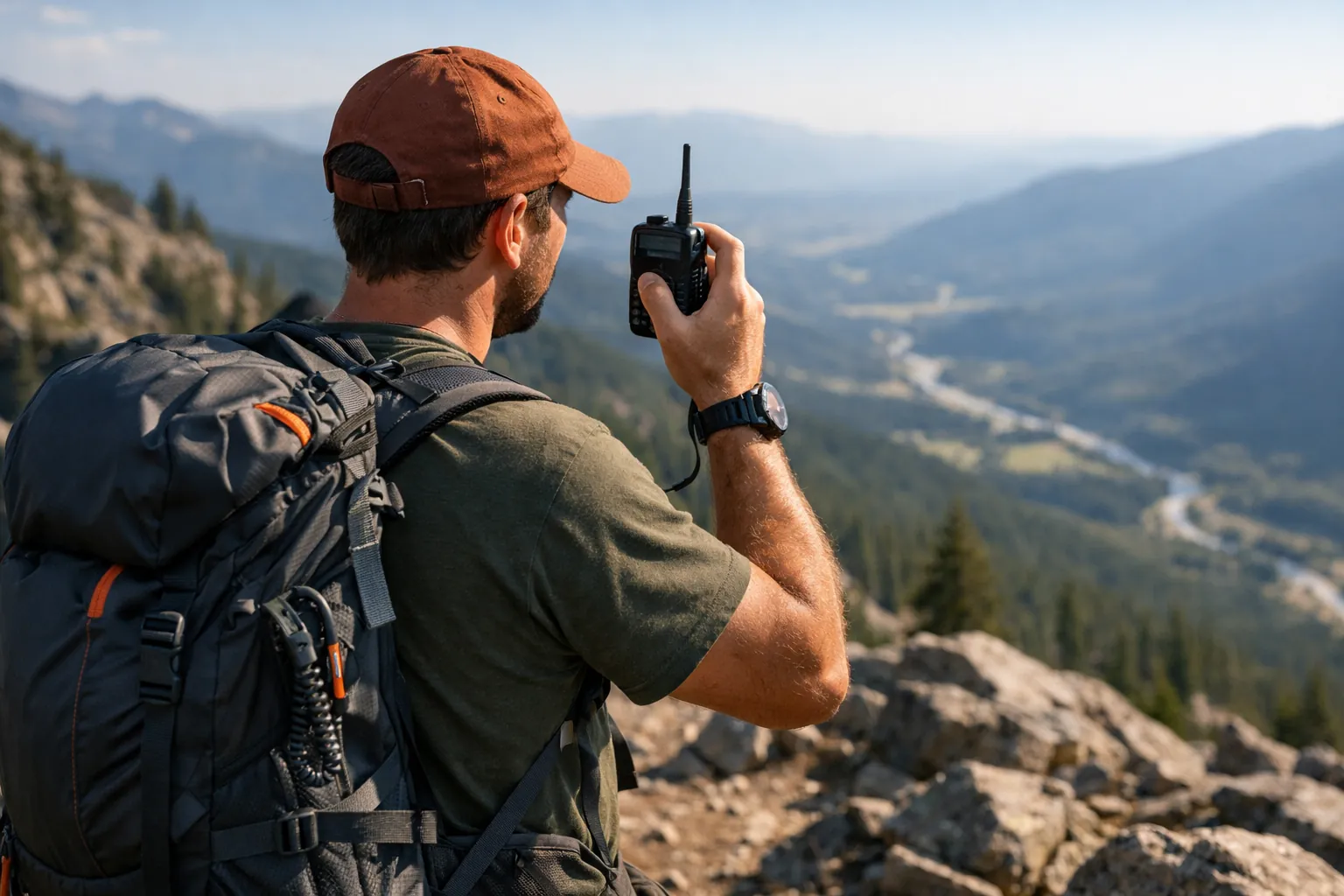
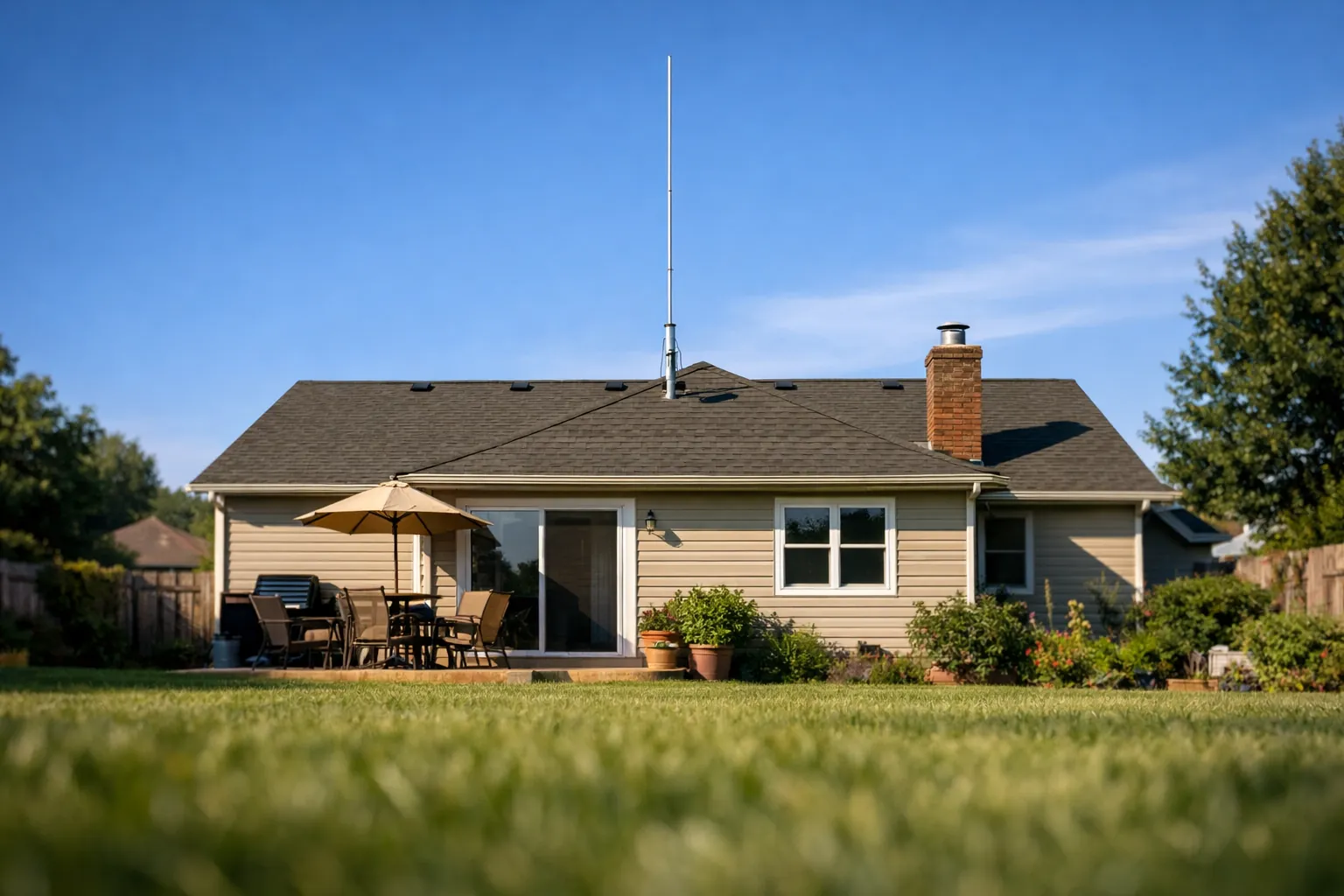
Two people holding handhelds at about 5 ft have a theoretical line-of-sight limit of about 6.3 miles over perfectly flat, open ground: 1.414 × √5 = 3.16 miles each, so 6.32 miles together. Put one antenna on a 30-ft mast and the limit grows to about 10.9 miles. Going from 5 W to 50 W changes neither number.
Check the math: the calculator's own test cases
These rows use the same JavaScript as the calculator, run when the page loads. "Expected" comes from the formula worked by hand with the 1.4140 constant.
| A (ft) | B or repeater (ft) | Setup | Expected | Calculator says | Result |
|---|---|---|---|---|---|
| 5 | 5 | Handheld to handheld | 6.32 mi / 10.18 km / geometric 5.48 mi | (needs JavaScript) | |
| 7 | 7 | Vehicle to vehicle | 7.48 mi / 12.04 km / geometric 6.48 mi | (needs JavaScript) | |
| 5 | 30 | Handheld to house mast | 10.91 mi / 17.55 km / geometric 9.45 mi | (needs JavaScript) | |
| 30 | 30 | Mast to mast | 15.49 mi / 24.93 km / geometric 13.41 mi | (needs JavaScript) | |
| 7 | 150 | Vehicle to repeater | 21.06 mi / 33.89 km / geometric 18.24 mi | (needs JavaScript) | |
| 5 | 150 | Handheld to repeater | 20.48 mi / 32.96 km / geometric 17.74 mi | (needs JavaScript) | |
| 0 | 0 | Both on the ground | 0 mi / 0 km / geometric 0 mi | (needs JavaScript) |
Where the constant comes from: √(2 × 4/3 × 3,958.8 mi ÷ 5,280 ft per mile) = 1.4140. Metric: √(2 × 4/3 × 6,371.0 km ÷ 1,000 m per km) = 4.1218. Without refraction (k = 1) the mile constant is 1.2246. Fresnel check: a 10 km path at 0.4626 GHz has a midpoint first-Fresnel radius of 8.656 × √(10 ÷ 0.4626) = 40.2 m.
Why watts don't change the answer
This is the argument behind half the forum threads about the Midland MXT275 versus the MXT575. 47 CFR 95.1767 allows up to 50 watts of transmitter output for mobile, base and repeater stations on the main channels, 5 watts ERP on the 462 MHz interstitials and 0.5 watt ERP on the 467 MHz interstitials. Those limits decide how strong your signal is. They don't decide where the horizon is.
More power does help in the fuzzy zone near the edge: through wet leaves, into a building, past a noisy truck. Going from 5 W to 50 W is ten times the power, a 10 dB gain. That's real, but it won't get UHF over a ridge. If you want more distance, raise the antenna, swap a rubber duck for a better one, or use a repeater. Our MXT275 vs MXT575 comparison walks through the trade-off for vehicle radios.
What the calculator can't tell you
It has no idea where you are. A hill between you and your friend ends the conversation no matter what the number says, and so can a few hundred yards of wet pine forest. There's no "realistic range" multiplier here, because no single factor holds across terrain. A tool that offered one would be guessing.
- Your body, the car roof and the cab all block or soak up signal. A handheld inside a vehicle does far worse than the same radio with a roof antenna.
- The Fresnel zone (in the advanced box) explains why a path that looks clear can still be weak: the radio wave needs a fat, football-shaped clearance around the straight line, not just a sight line.
- Occasionally you'll do better than the horizon. Temperature inversions can bend UHF farther than the 4/3 model assumes. Don't plan around it.
For a specific path between two places, use a terrain-aware path profile tool, and treat our number as the ceiling. Our GMRS radio range guide covers what people get in woods, towns and open country.
Getting more range
In order of value for money: get the antenna higher, get it outside the vehicle, then improve the antenna itself. A better GMRS antenna on the roof is the single biggest upgrade most drivers can make, and Midland micromobile owners can start with our MXT275 antenna upgrade guide. For the vehicle radio itself, see the best GMRS radio for a Jeep.
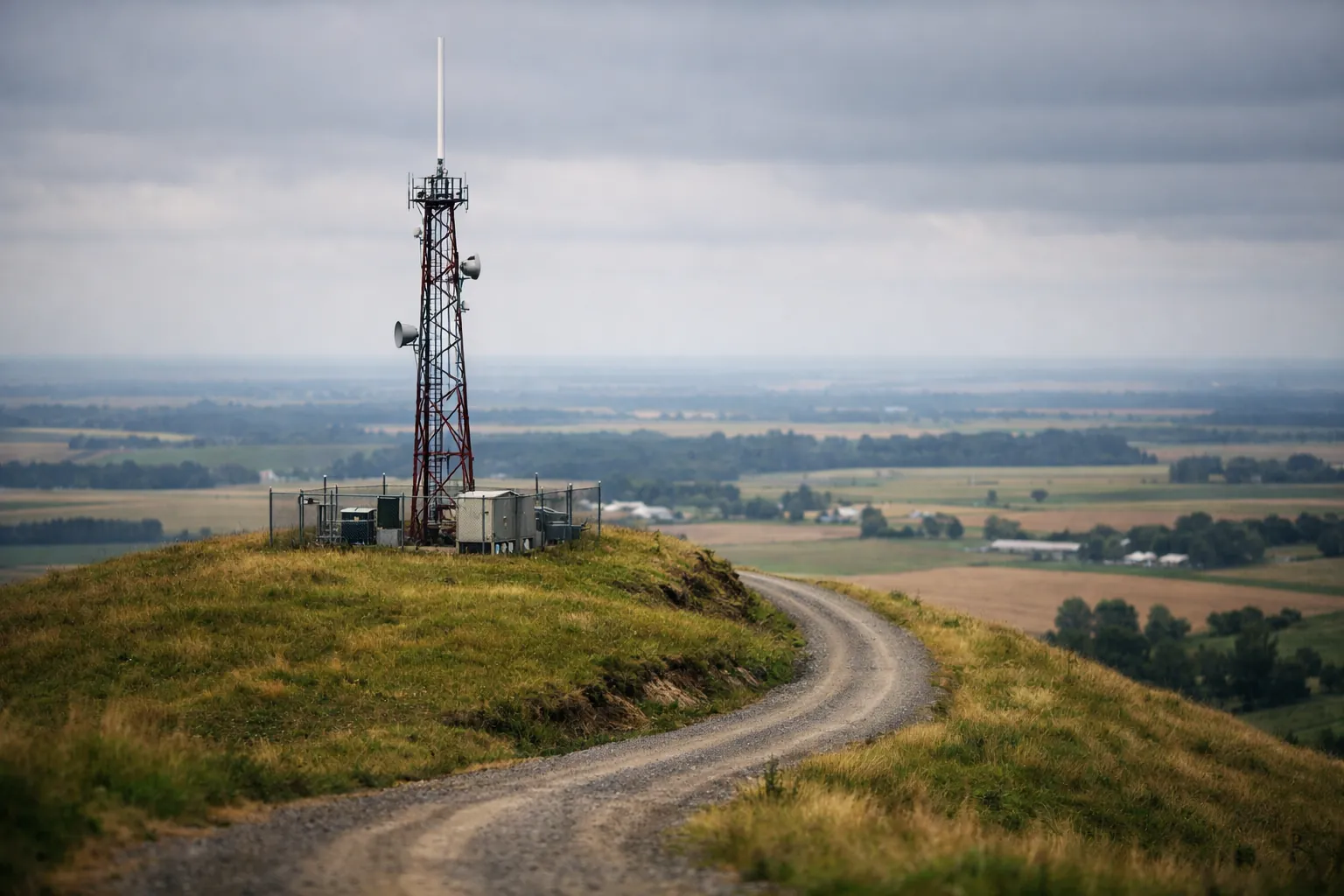
When even a good antenna can't see far enough, a repeater can. Check for an open one near you with our guide to finding and using GMRS repeaters, or look at putting up your own if your family or club needs coverage over a hill.
Sources: ITU-R P.834-9 (effective earth radius, k = 4/3); ITU-R P.530-19 (Fresnel clearance on line-of-sight paths, itu.int); NASA Earth fact sheet (mean radius 6,371.0 km); 47 CFR 95.1763 and 95.1767, eCFR up to date as of October 1, 2026. Checked October 3, 2026. How we research · Affiliate disclosure