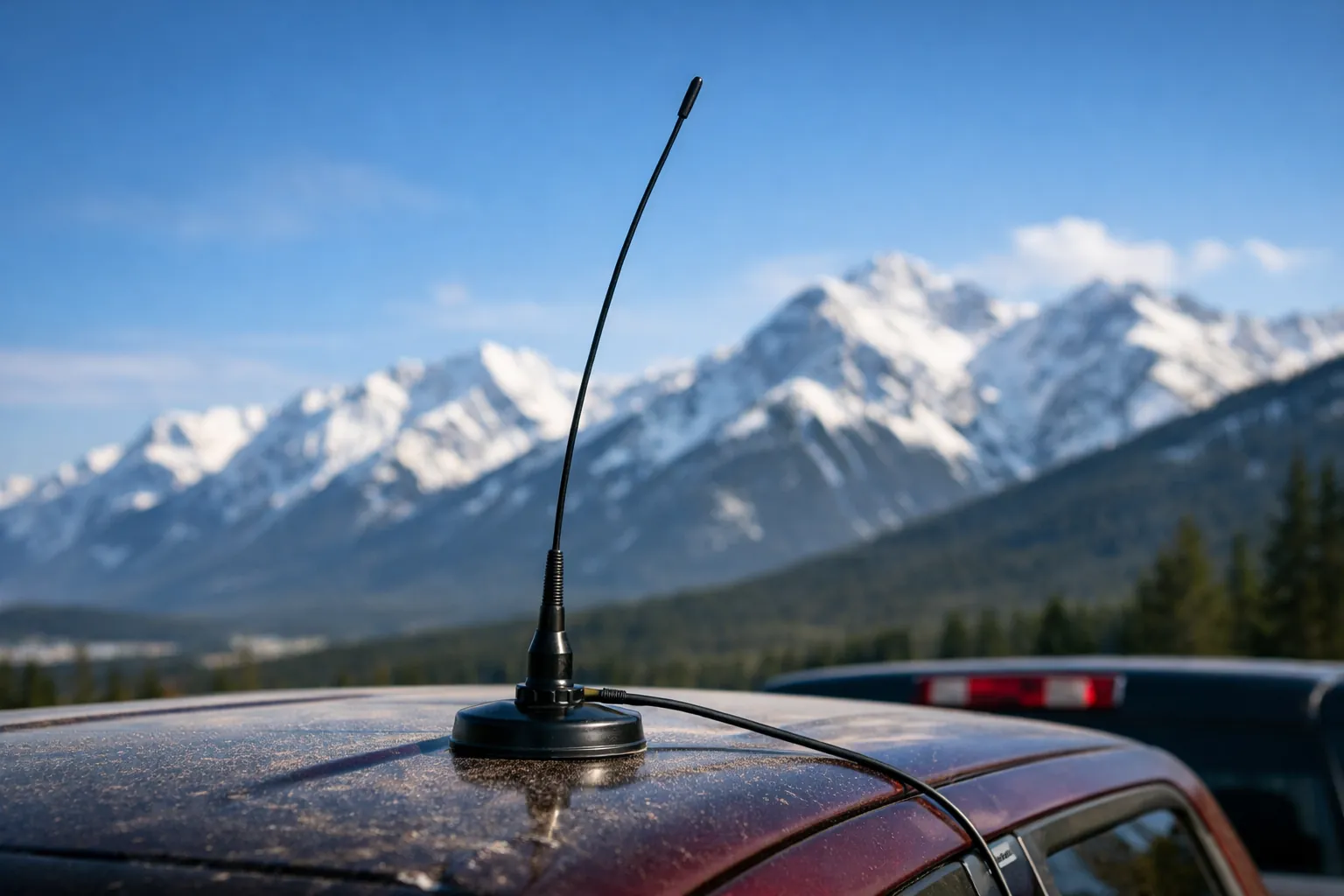
The best budget GMRS whip antenna on Amazon is the Nagoya NA-771G. BTECH's spec page lists it as a 15.6-inch half-wave whip centered on 462 MHz, up to 3 dBi, with an SMA-female connector for radios that have an SMA-male jack. On a vehicle, the right GMRS antenna depends on terrain. Where obstructions are heavy, as in mountains or a city, Midland recommends 2.1 to 3 dB of gain. On open plains and highways it recommends 6.6 to 7.5 dB. Midland MicroMobile owners should stay with Midland's MXTA26 or MXTA25. Any other mobile wants a GMRS-tuned NMO whip on a roof mount, and a home base wants a fiberglass base antenna mounted high.
An antenna is the cheapest real range upgrade in GMRS. It only pays off if the connector fits your radio and the antenna is tuned for 462-467 MHz. Shopping for 2 m and 70 cm instead? See best ham radio antennas. Putting one on a vehicle? The Jeep Wrangler GMRS install shows an NMO mount in place.
Quick picks
| Best handheld upgrade | Nagoya NA-771G | Amazon |
|---|---|---|
| Best handheld-in-the-car fix | Nagoya UT-72G mag mount | Amazon |
| Best for Midland MicroMobiles | Midland MXTA26 6 dB whip | Amazon |
| Best low-profile | Midland MXTA25 3 dB 'ghost' antenna | Amazon |
| Best no-drill NMO kit | HYS GMRS NMO magnet mount kit | Amazon |
| Best NMO whip for permanent installs | Browning BR-176-S | Amazon |
| Best base antenna | FMUSER GR100 base antenna | Amazon |
| Best budget base antenna | UAYESOK fiberglass antenna with ground plane kit | Amazon |
What we checked
Every listing here covers 462-467 MHz, the GMRS frequencies set out in 47 CFR 95.1763. We wrote down each antenna's connector type from its listing too, since a connector that doesn't fit is the most common antenna mistake.
Demand numbers come from Amazon on October 3, 2026. On November 16, 2026 we checked the NA-771G against BTECH's product page and the terrain advice against Midland's support articles. Midland's MXTA26 had 1,600+ ratings and 400+ sales last month, and the Nagoya NA-771G had 1,100+ ratings. Specs (gain, length, power rating, connector) come only from the listings. When a listing leaves out gain, so do we.
"How we pick" means a spec and sales review, not range testing. How we research.
Which gain for which terrain
| Terrain | Gain Midland recommends | Why, in Midland's words | Antennas on this page |
|---|---|---|---|
| Cities, dense forest, mountains | 2.1 to 3 dB | "A lower dB casts a taller signal" | Midland MXTA25 (3 dB); Nagoya NA-771G (up to 3 dBi) for handhelds |
| Hills and scattered trees | 3 to 6 dB | Medium gain for "some obstructions" | Midland MXTA26 (6 dB); HYS NMO kit (3.5 dBi) |
| Open plains, highways | 6.6 to 7.5 dB | "Higher dB casts a longer signal" | FMUSER GR100 (7.5 dBi) for a base station |
Source: Midland, GMRS Antennas and Understand Decibel (updated July 19, 2024) and Antenna Mounting Tips (MXTA25 3 dB, MXTA26 6 dB), checked November 16, 2026. Midland states gain in dB, while the other makers' listings here use dBi.
For the best GMRS antenna for mountains, that table points to low gain: the 3 dB MXTA25 on a Midland, or a 3 dB class whip on any other mobile. Height still beats gain. Midland's mobile FAQ puts 3 dB of extra gain at about 1.4 times the range and 6 dB at about 2 times, under the best conditions, and a ridge between you cancels both.
Antenna gain in one picture
Gain isn't extra power. A higher-gain antenna squashes its pattern flat, sending more signal toward the horizon and less of it upward. On flat ground or open water, that's what you want. In steep country, pick the lower-gain antenna.
Which type fits your radio
| Your radio | Antenna type | Check this first |
|---|---|---|
| Handheld with removable antenna | Longer GMRS whip, or a mag-mount for the car | SMA-male vs SMA-female jack |
| Handheld with fixed antenna (all FRS radios) | None possible | FRS antennas must be built in (95.587) |
| Midland MicroMobile | Midland MXTA series | Midland's mount style |
| Other GMRS mobile | NMO whip + NMO mount | Radio's port (usually SO-239/UHF) |
| Base station or repeater | Fiberglass base antenna on a mast | Connector, mast height, coax length |
The 8 best GMRS antennas
Nagoya NA-771G
Nagoya took a classic handheld antenna and made a GMRS version, and the listing leaves little to guess. It's a half-wave whip centered at 462 MHz. At 15.6 inches it's long for a handheld, and the SMA-female connector fits radios with an SMA-male jack. The listing even warns that it is "not the NA-771 dual-band amateur model," so you won't order the wrong one.
If your GMRS handheld shipped with a short stub, start here.
- Type1/2-wave flexible whip
- Length15.6 in (39.6 cm)
- Tuned462 MHz center, 462-468 MHz
- Gainup to 3 dBi
- ConnectorSMA-female
- Max input10 W
- SourceBTECH spec page, Nov 16, 2026
Why it stands out
- Tuned specifically for GMRS
- Flexible whip survives packs and pockets
- 1,100+ Amazon ratings
Think twice if
- Your radio has an SMA-female jack or a fixed antenna
Nagoya UT-72G mag mount
A handheld used inside a car is fighting the metal cab around it. Put the antenna on the roof and most of that problem goes away. The UT-72G does it without drilling: a 19-inch GMRS antenna on a strong magnetic base, with a cable that runs inside to the radio. Both SMA adapter genders come in the box. Nagoya's listing says it needs metal underneath to work well.
- Typeloading-coil whip on magnetic base
- Length19 in
- TunedGMRS 462 MHz
- Includedmagnet base, heavy-duty cable, both SMA adapters
- Needsmetal ground plane
Why it stands out
- Gets a handheld's signal outside the vehicle
- Both SMA adapters included, no drilling
Think twice if
- Your vehicle has a non-metal roof

Midland MXTA26 6 dB whip
With 1,600+ Amazon ratings and 400+ sales last month, this is the most popular antenna upgrade for Midland's MXT radios. It's a 6 dB gain whip about 31.6 inches tall, made for Midland's MicroMobile mounts. Six dB gives a flatter pattern. Expect it to shine on highways and open country and to give a little back deep in canyons.
- Gain6 dB
- Heightabout 31.6 in
- Base diameter1.5 in
- Impedance50 ohm
- Works withMidland MicroMobile radios
Why it stands out
- Designed for Midland mounts
- High gain for open-country range
- Very large owner base
Think twice if
- You drive in steep, tight terrain or need low clearance (see the MXTA25)
Midland MXTA25 3 dB 'ghost' antenna
At 3.5 inches tall, it stops garage doors and car washes from being a worry, and branches have nothing to grab. The 3 dB gain makes a rounder pattern, which helps in hills and woods. It sells nearly as well as its tall sibling: 1,200+ ratings and 400+ sales last month.
- Gain3 dB
- Length3.5 in
- Impedance50 ohm
- Works withMidland MicroMobile radios
Why it stands out
- Nearly invisible, nothing to snag
- Rounder pattern for hilly terrain
Think twice if
- You want maximum range on open ground
HYS GMRS NMO magnet mount kit
This kit is the shortcut to a proper GMRS-tuned NMO antenna on a mobile, with no drill involved. Per the listing, you get a 5/8-wave whip pre-tuned for 462-467 MHz on a strong 3.54-inch magnetic base with a rubber boot. The 16.4 feet of RG58 coax ends in a PL-259 plug for radios with an SO-239 port. Midland and Wouxun are among the radios the listing names.
Since the mount is NMO, you can screw on a different whip later and keep everything else.
- Type5/8-wave NMO whip
- Tuned462-467 MHz
- Gain3.5 dBi
- VSWRunder 1.5 (per listing)
- Mount3.54-in magnet
- Cable16.4 ft RG58 to PL-259
Why it stands out
- No drilling or tuning
- Standard NMO, so whips are swappable
- Long cable for under-seat radios
Think twice if
- Your radio uses Midland's mount or a different connector; check first
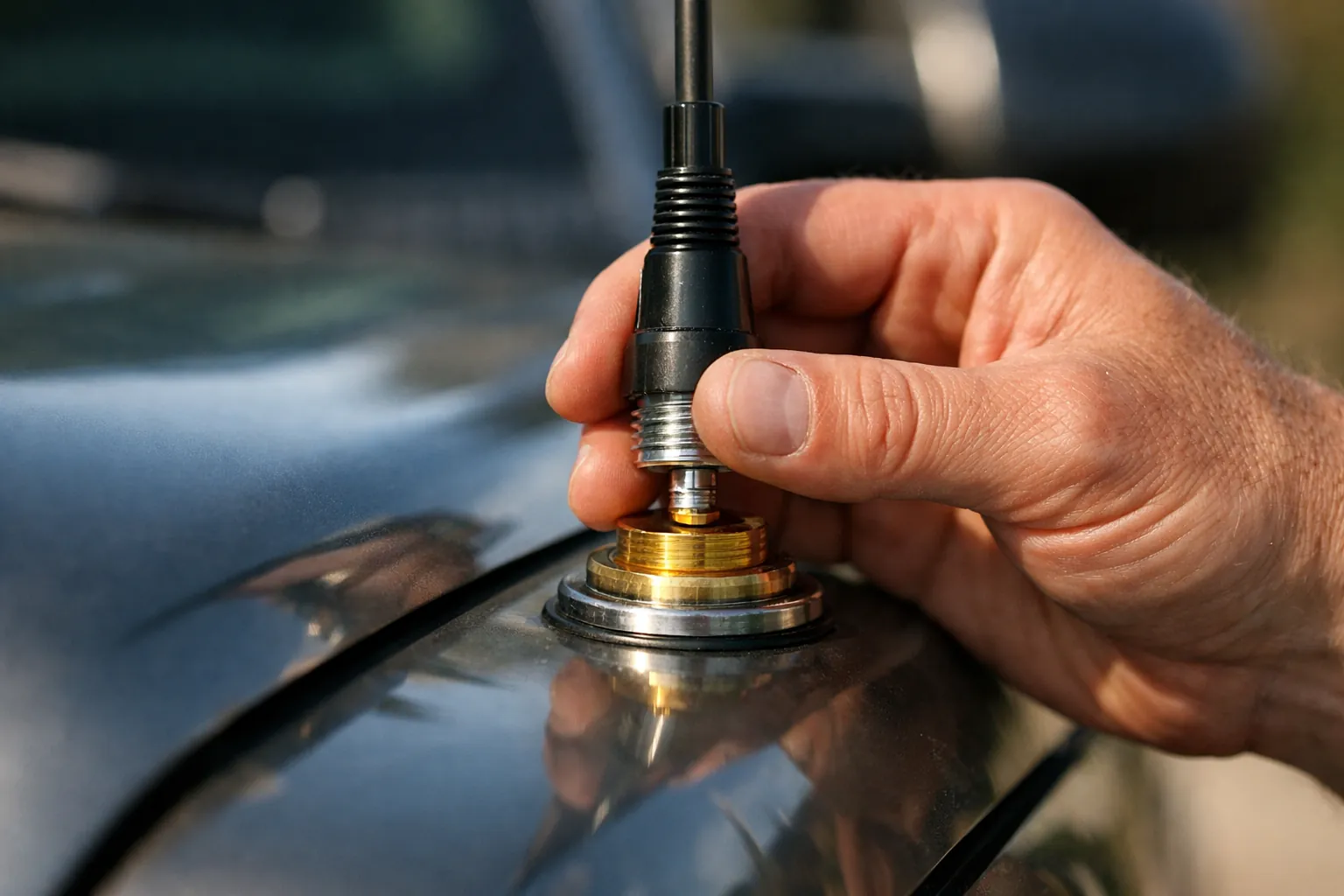
Browning BR-176-S
Buy this one if you've drilled for an NMO mount or plan to. It's a commercial-style UHF whip rated 450-470 MHz, so every GMRS frequency is covered. It is listed at 3 dBd gain and a 200-watt rating, per Browning. The 13-inch stainless whip is a 5/8-wave design with a spring to take trail strikes.
The mount is sold separately. A drilled mount, lip mount or bracket will all do.
- Type5/8-wave with spring
- Frequency450-470 MHz
- Gain3 dBd
- Power200 W
- Whip13 in stainless steel
- MountNMO (sold separately)
Why it stands out
- Commercial-style build with spring
- Covers all GMRS frequencies
Think twice if
- You want a complete kit; the mount and cable are separate
FMUSER GR100 base antenna
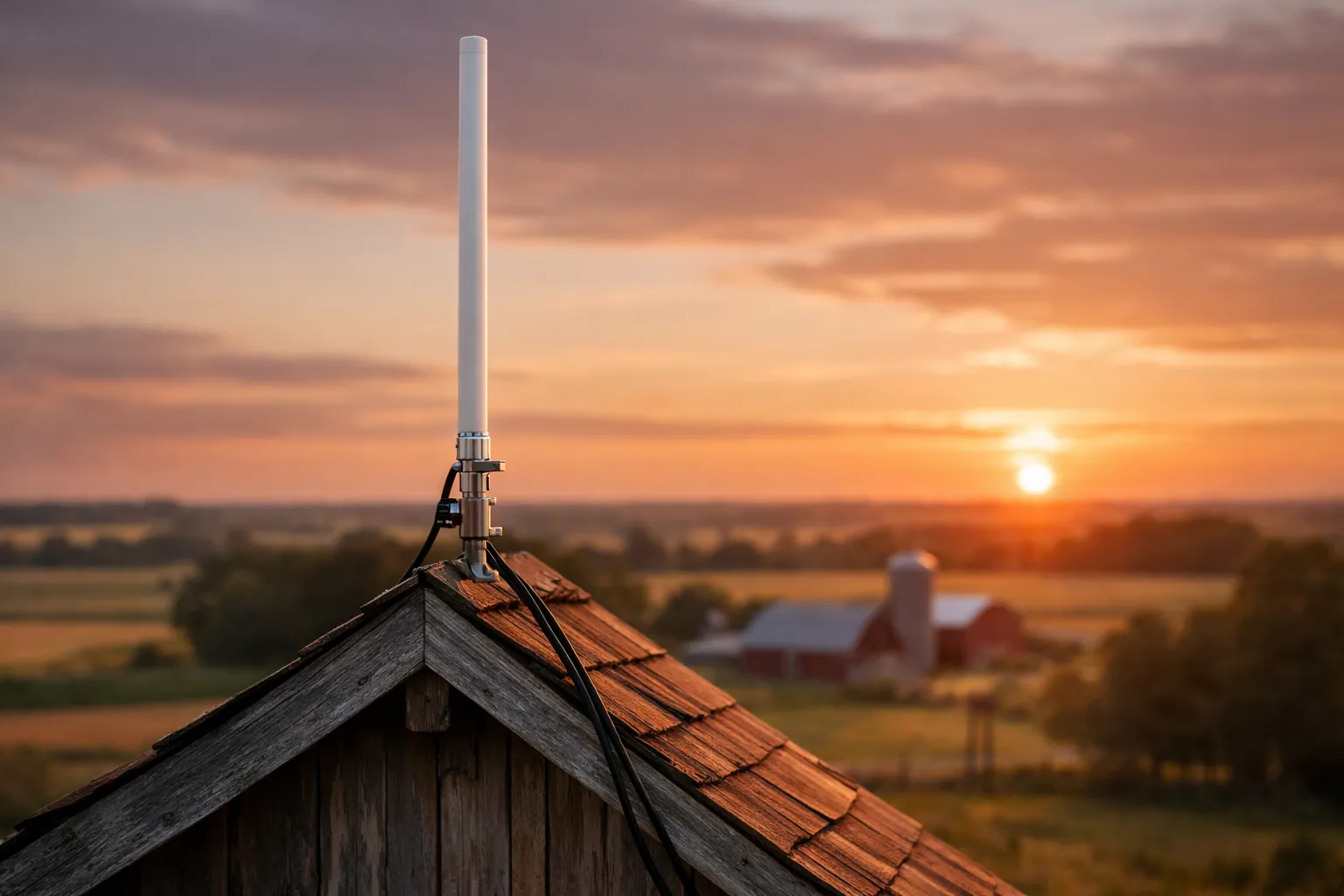
On a home or farm base, start with this GMRS-tuned fiberglass antenna and its listed 7.5 dBi gain. The listing describes low-angle radiation that suits shorter masts and pitches it for base stations and small repeaters. Height still counts for more than the antenna, so get it above the roofline if you can do that safely.
- Typefiberglass ground-plane base antenna
- Tuned462-467 MHz
- Gain7.5 dBi
- VSWRunder 1.3 (per listing)
- Heightabout 41 in
- ConnectorPL-259
Why it stands out
- GMRS-tuned fiberglass base antenna
- High gain for flat or open areas
Think twice if
- You need a well-reviewed brand; it has fewer ratings (60+)
UAYESOK fiberglass antenna with ground plane kit
Small and inexpensive, this antenna can go in an attic or outside on a wall or roof, and its 400-470 MHz range covers GMRS. A mounting bracket and ground-plane radials come with it. The 4.8-star average on 60+ ratings is a good early sign.
Gain is low, so the pattern is round. That's fine for nearby coverage and wrong for distance.
- Frequency400-470 MHz
- Gain2.5 dBi
- Length17 in
- ConnectorSO-239
- Max power100 W
- Includedbracket, VHF/UHF ground plane kit
Why it stands out
- Cheap and compact
- Bracket and radials included
- Works indoors or out
Think twice if
- You need maximum distance; choose a higher-gain base antenna
Side-by-side comparison
| Antenna | For | Gain | Connector / mount | Length |
|---|---|---|---|---|
| Nagoya NA-771G | Handheld | Up to 3 dBi | SMA-female | 15.6 in |
| Nagoya UT-72G | Handheld in vehicle | Check listing | Mag mount, SMA | 19 in |
| Midland MXTA26 | Midland mobile | 6 dB | Midland mount | ~31.6 in |
| Midland MXTA25 | Midland mobile | 3 dB | Midland mount | 3.5 in |
| HYS NMO mag kit | Any mobile | 3.5 dBi | NMO, PL-259 | Check listing |
| Browning BR-176-S | Any mobile | 3 dBd | NMO | 13 in whip |
| FMUSER GR100 | Base | 7.5 dBi | PL-259 | ~41 in |
| UAYESOK base kit | Base | 2.5 dBi | SO-239 | 17 in |
dBi and dBd aren't the same unit (dBd figures are about 2.15 dB higher when expressed in dBi), so compare gain within the same unit. "Check listing" means the listing didn't confirm it.
How to choose a GMRS antenna
Match the connector
On a handheld, SMA-male and SMA-female look almost identical. Compare the center pin. Most non-Midland mobiles have an SO-239 (UHF) port that takes a PL-259 plug. Midland MicroMobiles use their own mount system, which makes the MXTA line the easy answer; the MXT275 antenna swap page walks through it. Earpieces and speaker mics have the same trap, so match the plug with our earpiece picks.
Match the frequency
The listing should say 462-467 MHz, or give a UHF range like 450-470 MHz that includes it. A CB antenna (27 MHz) will not work. Running CB too? Our CB antenna guide covers mounts and coax for 27 MHz, and once it's on the truck, tune the CB antenna on channels 1 and 40.
Mount on metal, mount high
Mobile antennas need a metal ground plane under them unless the listing says otherwise. Midland's mobile FAQ asks for a conductive steel or aluminum surface about 12 inches across, and its mounting tips call for bare metal without powder coat or paint. The center of a steel roof is best, with a fender, hood or lip mount as the fallback. After mounting, check SWR: Midland calls 1.0 to 1.5 ideal and up to 2.0 acceptable, and our SWR guide shows how to measure it. Non-metal tops get their own section in our Jeep guide.
Keep the coax short
Every foot of thin coax loses a little signal at UHF. A base station with a long run deserves thicker, lower-loss cable. For the house antenna, coax and power supply together, see our GMRS base station guide.
Check that your radio can take one
It needs a removable antenna. FRS radios must have built-in antennas (95.587), and GMRS handhelds that transmit digital location or text data must too (95.1787).
Mounts and cables
- The Midland MXTA24 NMO cable is 20 ft of low-profile cable with a removable UHF connector, for MicroMobiles.
- For a hood or trunk edge with no drilling, use the Midland MXTA27 lip mount (NMO, 20 ft cable).
- Midland MXTA12 mag mount: a drill-free magnetic base for MicroMobile antennas.
- On a tight budget, the ABBREE AR-771C GMRS whip is a two-pack of 15.3-inch SMA-female handheld antennas listed for 462 MHz.
Height rules come from 47 CFR 95.317. An antenna structure more than 200 feet above ground may need FAA notice and FCC registration (Part 17, 17.7, has the criteria). The one a house mast can hit is the airport rule: near a military or public-use airport, an antenna structure more than 20 feet high "may have to obey additional restrictions," and its top must not exceed one meter above airport elevation for every 100 meters from the nearest runway. On level ground, a 30-foot mast needs to be roughly 900 meters (a bit over half a mile) from the runway. If you live near an airfield, the FCC's TOWAIR tool gives your maximum height.
Look at the jack, then buy one antenna
Go check your radio's antenna connector before you click anything. Then:
- GMRS handheld with an SMA-male jack: the Nagoya NA-771G. If that handheld mostly rides in the car, buy the UT-72G first, because it gets the signal outside the metal.
- Midland MicroMobile: the MXTA26. Park in a garage? Get the MXTA25 instead.
- Any other mobile: a GMRS-tuned NMO whip like the HYS kit.
- Home base: the GR100, as high as you can safely mount it.
Specs from each product's Amazon listing and sales figures from Amazon search results, checked October 3, 2026. NA-771G specs from BTECH's product page. Midland's advice on gain by terrain and on mounting comes from its support articles (including Mobile Radios FAQs, updated September 17, 2026), all checked November 16, 2026. FCC rules: 47 CFR Part 95 Subpart E, eCFR up to date as of November 12, 2026. How we research · Affiliate disclosure