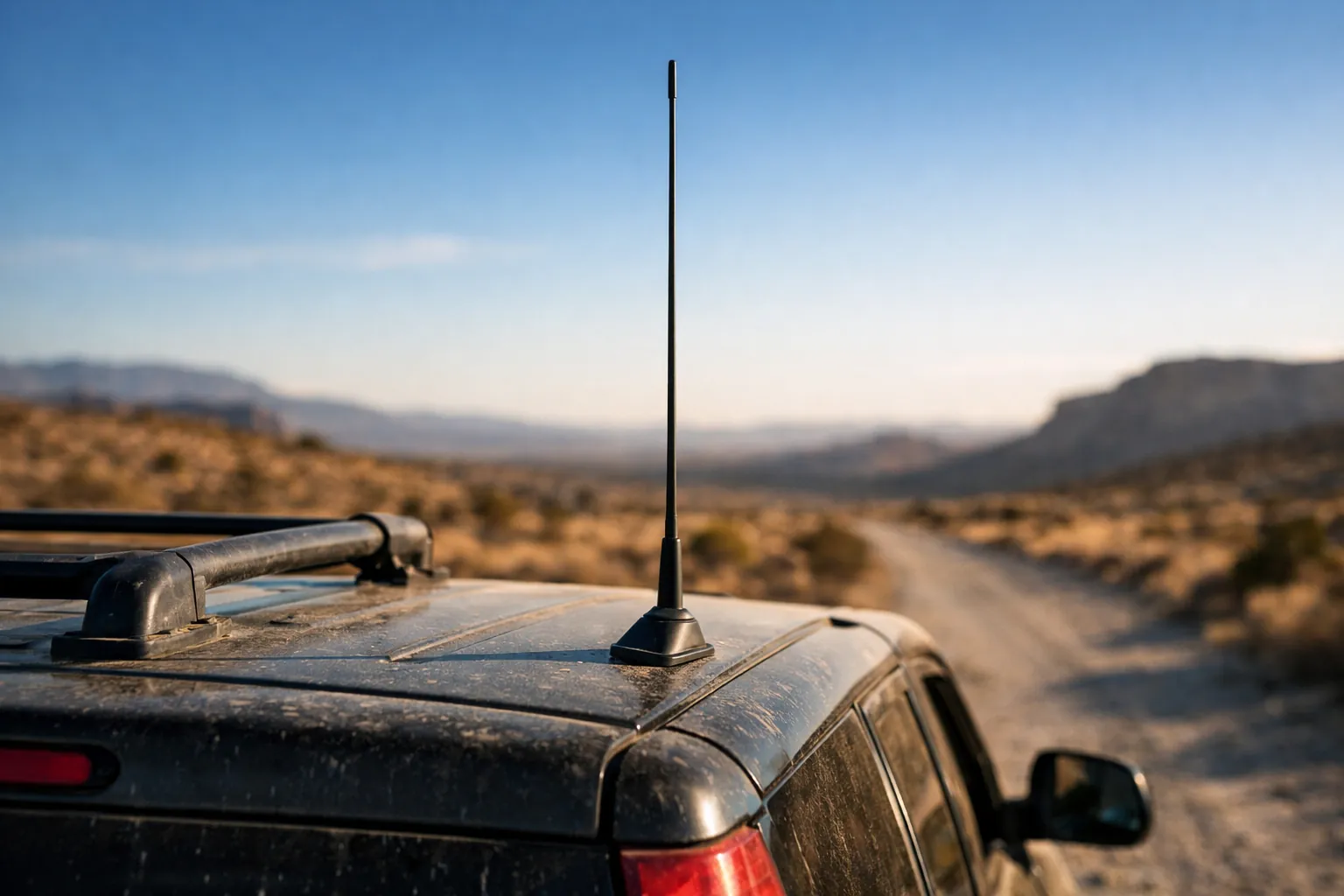
Put Midland's MXTA26 6 dB whip on a roof-center NMO mount if you drive open country, and the MXTA25 Ghost if you drive under trees. That's the short answer for the MXT275, and it applies to the MXT575 and MXT115 too. The stock 2.1 dB magnet-mount antenna works, but the mount position and the antenna on it change your results more than switching radios would.
Quick picks
| Best for open country | Midland MXTA26 6 dB whip | Amazon |
|---|---|---|
| Best for trees and low clearance | Midland MXTA25 Ghost 3 dB | Amazon |
| Best spring-base whip | Browning BR-176-S | Amazon |
| Budget GMRS-tuned whip | HYS GMRS low-profile NMO 5/8 wave | Amazon |
| Smallest budget option | Tram pretuned 1/4-wave NMO | Amazon |
| Best no-drill kit | HYS GMRS 5/8-wave magnet-mount kit | Amazon |
How we picked these antennas
We started from Amazon's GMRS and NMO antenna results on October 3, 2026. Two Midland antennas dominate: the MXTA26 and MXTA25 each sold about 400 a month, with 1,647 and 1,213 ratings. We added antennas from three other makers (Browning, Tram, HYS) that are tuned for the 450-470 MHz range or specifically for 462-467 MHz, and dropped dual-band ham antennas whose listings don't show tuning for GMRS. Specs come from the Amazon listings and Midland's own product pages. We did not measure any antenna on a vehicle; that's what our SWR guide is for once you've installed one.
How gain and ground plane work
An antenna can't add power. A "6 dB" antenna takes the same watts and squeezes them into a flatter doughnut aimed at the horizon. Across flat desert or farmland that's exactly where the other radios are, so high gain pays off. On a winding mountain trail, where the other vehicle is 300 feet below you on the next switchback, a flatter doughnut can actually put less signal toward it. Lower-gain antennas keep a fatter pattern.
The second idea is the ground plane. Quarter-wave and 5/8-wave mobile antennas are half an antenna: the other half is the sheet of metal under the mount. At 462 MHz a full wavelength is about 25.5 inches, so the metal should stretch roughly a quarter wave (6.4 inches) or more in every direction. The center of a steel roof is ideal. A fender, a bumper bar or the edge of a hood gives the antenna metal on one side only, which tilts the pattern and can raise SWR. Midland's own MXT295 manual tells you to mount the antenna as high on the vehicle as possible and to avoid fiberglass or vinyl surfaces.
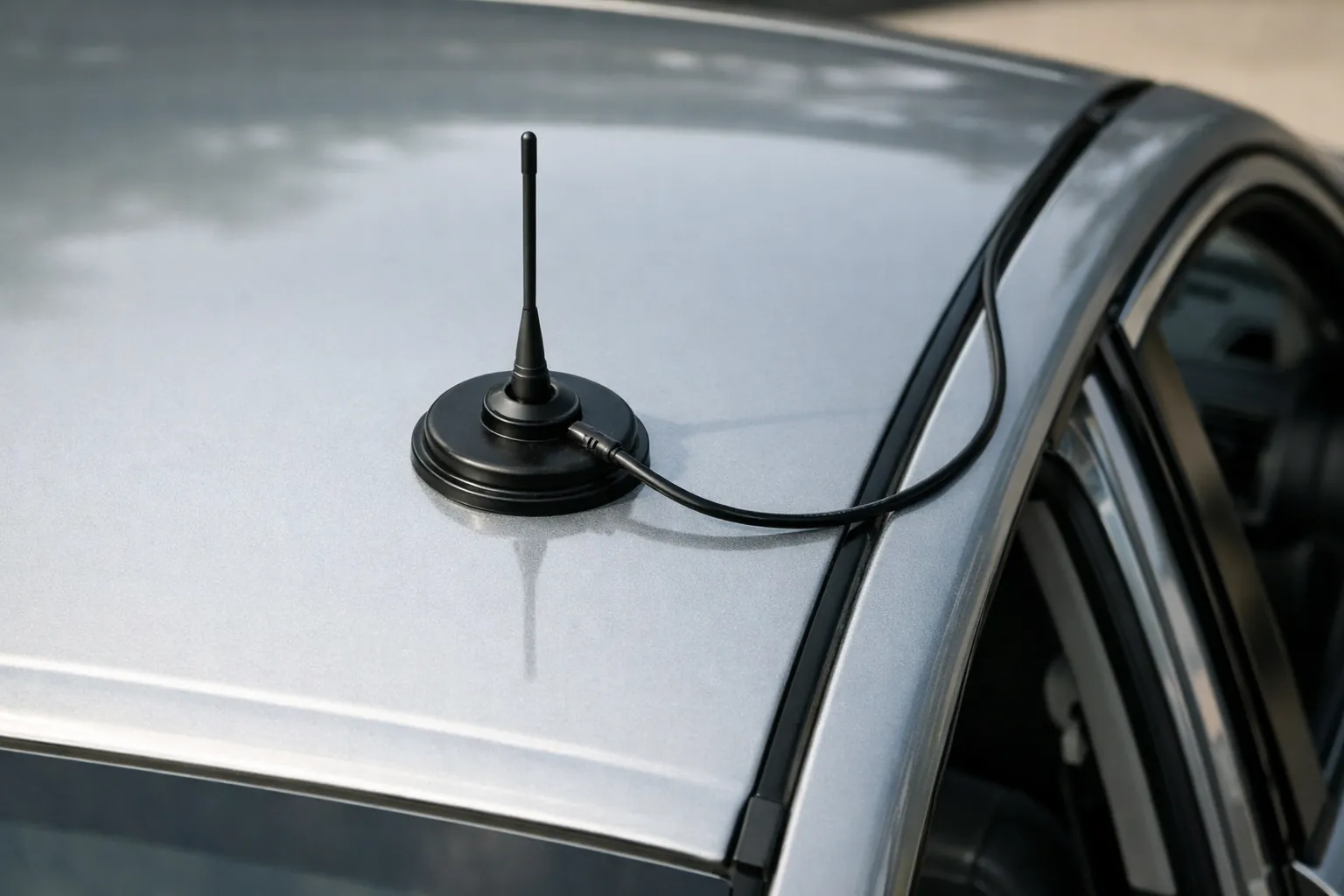
Height is the third idea, and it beats both. On our range calculator, two vehicles with antennas on bumper brackets at about 4 feet have a line-of-sight limit of 5.66 miles. Move both antennas to the roof at about 7 feet and it's 7.48 miles. No antenna gain figure does that.
The 6 best antenna upgrades for the MXT275
Midland MXTA26 6 dB whip
Midland's tallest MicroMobile antenna and its best seller, with 1,647 Amazon ratings. Thirty-two inches of stainless whip on a 1.5-inch NMO base, tuned for 462 MHz and rated to 120 W, so it's fine on the 50 W MXT575 as well. Midland pitches it for desert racing and ranch use, which is honest: it's built for long, flat sight lines.
The catch is the height. Thirty-two inches on a roof will hit garage doors, drive-thru canopies and low branches. Because it's NMO, you can keep a short antenna for daily driving and thread this one on for open-country trips.
- Gain6 dB
- Type5/8 wave
- Length32 in
- MountNMO (not included)
- Max power120 W
- Tuned462 MHz
Why it stands out
- Highest gain Midland sells for MicroMobiles
- Same NMO thread as every other pick here
- Rated for 50 W radios
Think twice if
- You park in a garage or drive narrow wooded trails
- Your only mount spot is a bumper or fender
Midland MXTA25 Ghost 3 dB
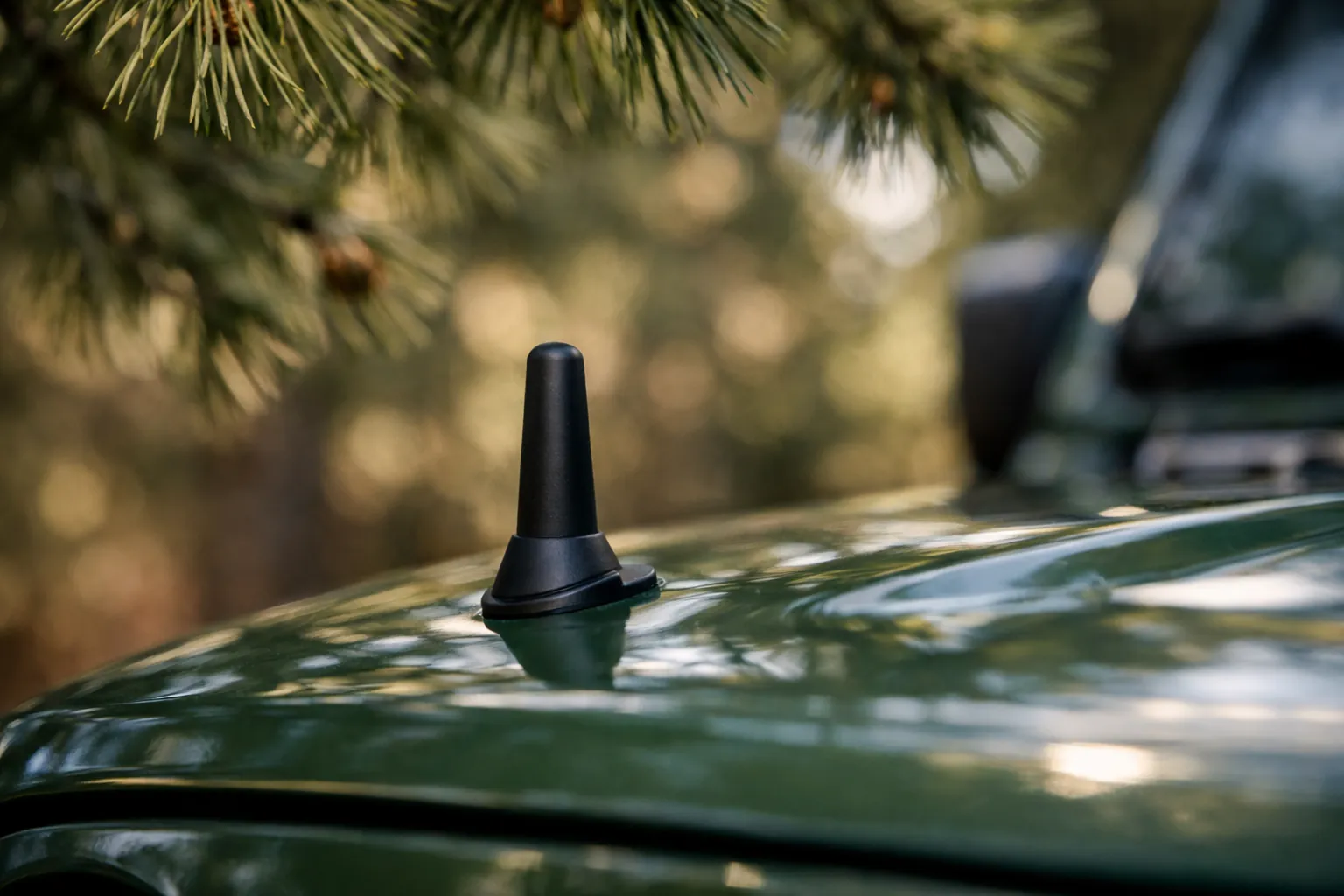
Three and a half inches tall, so it shrugs off branches and car washes. Midland calls it a 5/8-wave design; a full-length 5/8-wave element at 462 MHz would be about 16 inches, so this is a compact build and Midland doesn't explain the construction. What matters in practice is that it's short enough to never think about.
It sells as well as the MXTA26 (about 400 a month at our check, 1,213 ratings). On a roof, it's the pick for forest roads where a whip would be slapping trees all day.
- Gain3 dB
- Length3.5 in
- MountNMO (not included)
- Max power120 W
- Tuned462 MHz
Why it stands out
- Nothing to snag
- Fatter pattern than the 6 dB whip helps in hills
- Same 120 W rating
Think twice if
- Your trips are mostly open desert or prairie, where the whip reaches farther
Browning BR-176-S
A middle path between the tall whip and the stubby. The Browning is a 13-inch tapered stainless whip on a spring, covering 450 to 470 MHz, which takes in all of GMRS. Browning quotes gain in dBd (relative to a dipole), so its 3 dBd is roughly 5.15 dBi. Midland doesn't say which unit its "6 dB" and "3 dB" use, so don't compare the numbers too literally.
The spring lets it fold back when it meets a branch, then stand up again.
- Gain3 dBd
- Type5/8 wave
- Range450-470 MHz
- Whip13 in, stainless, with spring
- MountNMO (not included)
- Max power200 W
Why it stands out
- Spring base forgives branch strikes
- 13 in is a manageable height
- 200 W rating
Think twice if
- You need the absolute lowest profile, which is the Ghost
HYS GMRS low-profile NMO 5/8 wave
HYS tunes this one specifically for 462-467 MHz and states a VSWR under 1.5, plus a 150 W rating. At 111 Amazon ratings it has a smaller owner base than the Midland pair, but it's a reasonable choice if you want a mid-height GMRS-only antenna for less money. The listing doesn't give a length in the bullets, so check the photos against your clearance.
- Range462-467 MHz
- Gain3.5 dBi
- VSWRunder 1.5
- Max power150 W
- MountNMO (not included)
Why it stands out
- Tuned for the whole GMRS band, including the 467 MHz repeater inputs
- States its VSWR
Think twice if
- You want a big owner base for install questions
Tram pretuned 1/4-wave NMO
A quarter-wave is the simplest antenna there is: 5.5 inches of stainless whip, pretuned for 410 to 490 MHz, with no gain claim at all. On a roof center it radiates a wide, predictable pattern. It's the antenna to try when a high-gain whip gives you trouble in steep terrain It has 352 Amazon ratings.
- Type1/4 wave
- Range410-490 MHz
- Height5.5 in
- SWR1.5:1
- Max power200 W
- MountNMO (not included)
Why it stands out
- Short and unfussy
- Wide pattern for hills and canyons
Think twice if
- You mainly cross flat open country, where a gain antenna does better
HYS GMRS 5/8-wave magnet-mount kit
Everything in one box: a 5/8-wave GMRS whip, a magnetic NMO base with a rubber boot to protect paint, and 16.4 feet of RG58 ending in a PL-259 plug. HYS lists every MicroMobile from the MXT105 to the MXT575 as compatible. It's the easy upgrade for anyone who wants to move off the stock antenna this weekend without drilling or buying a mount separately.
- Range462-467 MHz
- Gain3.5 dBi
- VSWRunder 1.5
- Mount3.54 in magnet, rubber boot
- Cable16.4 ft RG58, PL-259
- Max power150 W
Why it stands out
- Antenna, mount, cable: all in the box
- Moves between vehicles
- Rubber boot on the magnet
Think twice if
- You want a permanent install; a magnet mount needs a steel roof and the cable has to pass a door seal
Side by side
| Antenna | Height | Stated gain | Rating | Best mount spot |
|---|---|---|---|---|
| Midland MXTA26 | 32 in | 6 dB | 120 W | Roof center |
| Midland MXTA25 Ghost | 3.5 in | 3 dB | 120 W | Roof or hood |
| Browning BR-176-S | 13 in whip | 3 dBd | 200 W | Roof, rack |
| HYS low-profile 5/8 | Check listing | 3.5 dBi | 150 W | Roof |
| Tram 1/4 wave | 5.5 in | None stated | 200 W | Roof center |
| HYS magnet kit | Check listing | 3.5 dBi | 150 W | Steel roof |
Mounts and cable: where most upgrades go wrong
Every antenna above has an NMO base, which is the standard for vehicle antennas. You need an NMO mount with coax running back to the radio. Pick it by the spot on your vehicle:
| Spot | Mount | Ground plane |
|---|---|---|
| Steel roof, no drilling | Midland MXTA12 magnet mount (3.5 in base; Midland lists a 20 ft RG-58A/U cable, the Amazon listing says 12 ft) | Excellent |
| Hood or trunk edge | Midland MXTA27 lip mount or the Anina adjustable lip mount | Fair: metal on one side |
| Fender or flat panel with a hole | HYS fender mount kit (L-bracket, 13 ft RG-58, includes an antenna) | Fair |
| Your own bracket (ditch light, rack, bar) | Midland MXTA24 cable: NMO base, 20 ft RG58U, fits 3/4 in and 3/8 in holes | Depends on the bracket |
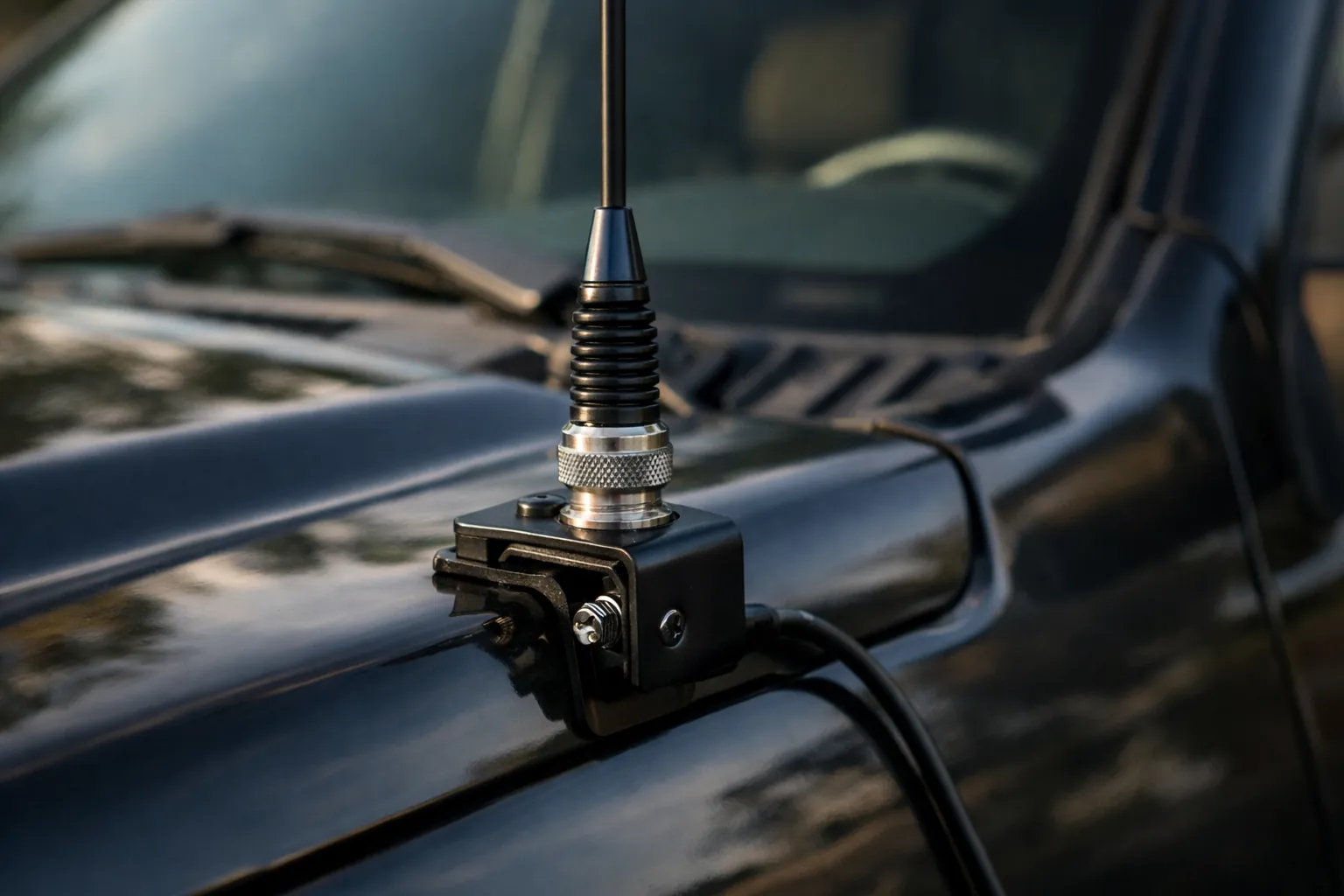
Midland's MXTA24 and MXTA27 cables use a UHF connector that unscrews, with an FME-to-UHF adapter in the box, so the small end feeds through a grommet or firewall and the full-size plug goes back on at the radio. If a hardtop Wrangler is your vehicle, the roof is fiberglass, so a magnet mount won't stick and there's no ground plane up there; our Jeep Wrangler GMRS install guide walks through the hood and tailgate options.
After installing, check SWR with a VHF/UHF meter. The best-selling CB SWR meters only read 27 MHz and tell you nothing at 462 MHz. Steps in how to check SWR on a GMRS antenna.
Same antennas for the MXT575 and MXT115?
Yes. Midland lists both the MXTA25 and MXTA26 as compatible with the MXT105, MXT115, MXT275, MXT400, MXT500 and MXT575, and the MXT575's stock antenna already threads onto NMO. If you're still choosing a radio, MXT275 vs MXT575 explains why the antenna usually matters more than the 50-watt upgrade.
If you only buy one thing
Buy an NMO mount for the highest metal spot on your vehicle and the MXTA25 Ghost. It works on every kind of trail and never needs to come off. Add the MXTA26 whip later for open-country trips and swap it on in ten seconds. For base-station and handheld antennas, see the best GMRS antennas.
Specs come from each Amazon listing and from Midland's product pages for the MXTA24 through MXTA27 (midlandusa.com), checked October 3, 2026. Range figures come from the radio-horizon formula in our GMRS range calculator. Prices change often, so the buttons show the current price on Amazon. How we research · Affiliate disclosure