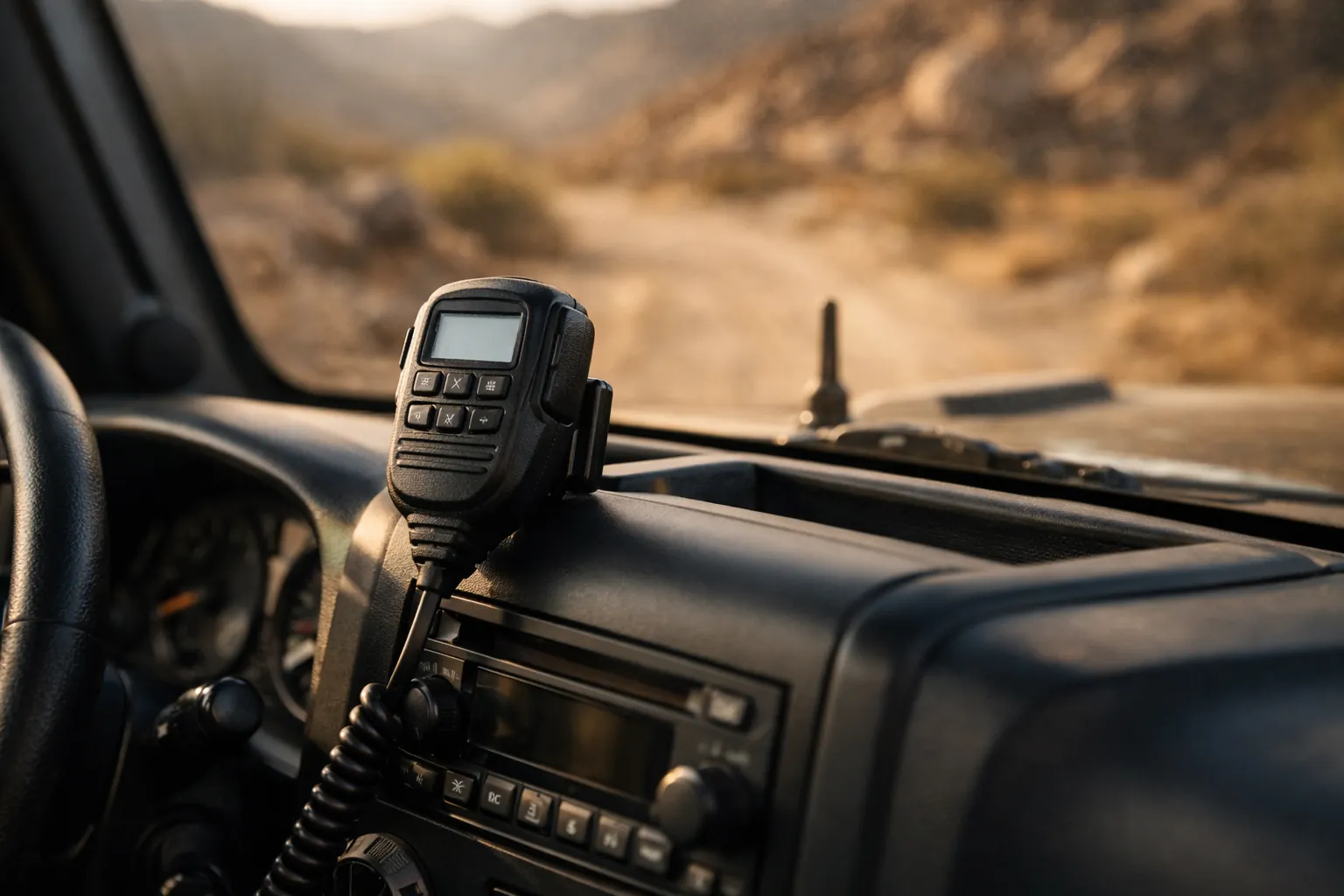
Buy the MXT275 unless you know why you need 50 watts. Both Midland MicroMobiles have the same 15 high-power channels, the same 8 repeater channels and the same controls built into the microphone. The MXT575's extra power doesn't move the radio horizon, which is set by antenna height. What it buys you is a few decibels of margin on a weak path, plus a wide/narrow bandwidth switch. For vehicle-to-vehicle talk on a trail, a better antenna on an MXT275 helps more.
How we compared them
Everything below comes from four sources, checked October 3, 2026: Midland's product pages and spec sheets, the owner's manuals (MXT275 revision of Nov 13, 2025; MXT575 of May 26, 2021), the FCC equipment grants for each radio, and the Amazon listings. On Amazon the MXT275 had 1,824 ratings and about 300 sales a month at our check; the MXT575 had 271 ratings and about 100 a month.
We didn't drive these two radios side by side, and we don't publish range test results. Where range comes up, the numbers come from the GMRS range calculator, which shows its math. How we research.
The 50-watt question, answered with math
GMRS lives on 462 and 467 MHz (47 CFR 95.1763). At UHF the signal travels in close to straight lines, so the first limit you hit is the radio horizon: how far each antenna can "see" before the curve of the earth gets in the way. The usual formula gives each antenna about 1.41 × √(height in feet) miles, and you add the two.
Two vehicles with roof antennas at about 7 feet: 1.414 × (√7 + √7) = 7.48 miles, best case, flat open ground. That number doesn't change between 15 and 50 watts. Put one vehicle in touch with a repeater whose antenna sits 150 feet up and the limit is about 21 miles, again identical for both radios.
Power still matters a little. Going from 15 to 50 watts is about 5.2 dB more signal. On a path that's already marginal (one ridge too many, thick wet timber, a repeater at the edge of its coverage), that can be the difference between scratchy and readable. It can't make a radio talk through a mountain. The higher antenna wins every time; that's why our MXT275 antenna upgrade guide exists.

What about the boxes? Midland's MXT275 spec sheet shows "50 Miles" as the maximum with no obstruction, and the MXT575 sheet says "75 Miles". Midland adds that maximum range is only reached over water or open rural areas in optimum conditions. Treat them as marketing ceilings, not planning numbers.
Spec table: what actually differs
| MXT275 | MXT575 | |
|---|---|---|
| Rated power | 15 W, high/low | 50 W ("Full 50 Watt Radio") |
| FCC grant, conducted output | 15.0 W high, 5.0 W low | 48.87 W (462 main), 46.67 W (467 repeater inputs), 4.08 W (462 interstitials) |
| Channels | 15 GMRS (1-7, 15-22) + 8 repeater | 15 GMRS + 8 repeater |
| Privacy codes | 142 (38 CTCSS, 104 DCS) | 142 (38 CTCSS, 104 DCS) |
| Bandwidth setting | No setting in the manual | Wide or narrow, selectable |
| Controls | In the microphone, hideaway box | In the microphone, hideaway box |
| Size (spec sheet) | 1.4 x 5 x 4.2 in, 1.3 lb | 5.5 x 1.5 x 7.3 in, 3 lb |
| Stock antenna | 2.1 dB magnetic mount (MXTA13) | 2.1 dB NMO antenna, large magnetic base, metal plate |
| Extras | USB-C, speaker mic jack, NOAA weather alert | USB-C, intercom jack, speaker jack, NOAA weather alert |
| Water rating | None listed | None listed |
| FCC ID | MMAMXT275 (Part 95E) | MMAMXT575 (Part 95E) |
Midland's MXT575 spec sheet lists "Hi/Mi/Lo" power settings, while the 2021 owner's manual menu shows high and low. Check the manual that ships with yours.
That 4.08 W figure on the MXT575 grant isn't a defect. GMRS channels 1-7 (the 462 MHz interstitials) are capped at 5 W ERP for every GMRS station (47 CFR 95.1767(b)). The full 50 watts only applies on channels 15-22 and the repeater inputs, where the limit is 50 W output for mobile stations (95.1767(a)). So if your group lives on channel 3, the MXT575's big number does nothing for you.
The two radios
Midland MXT275
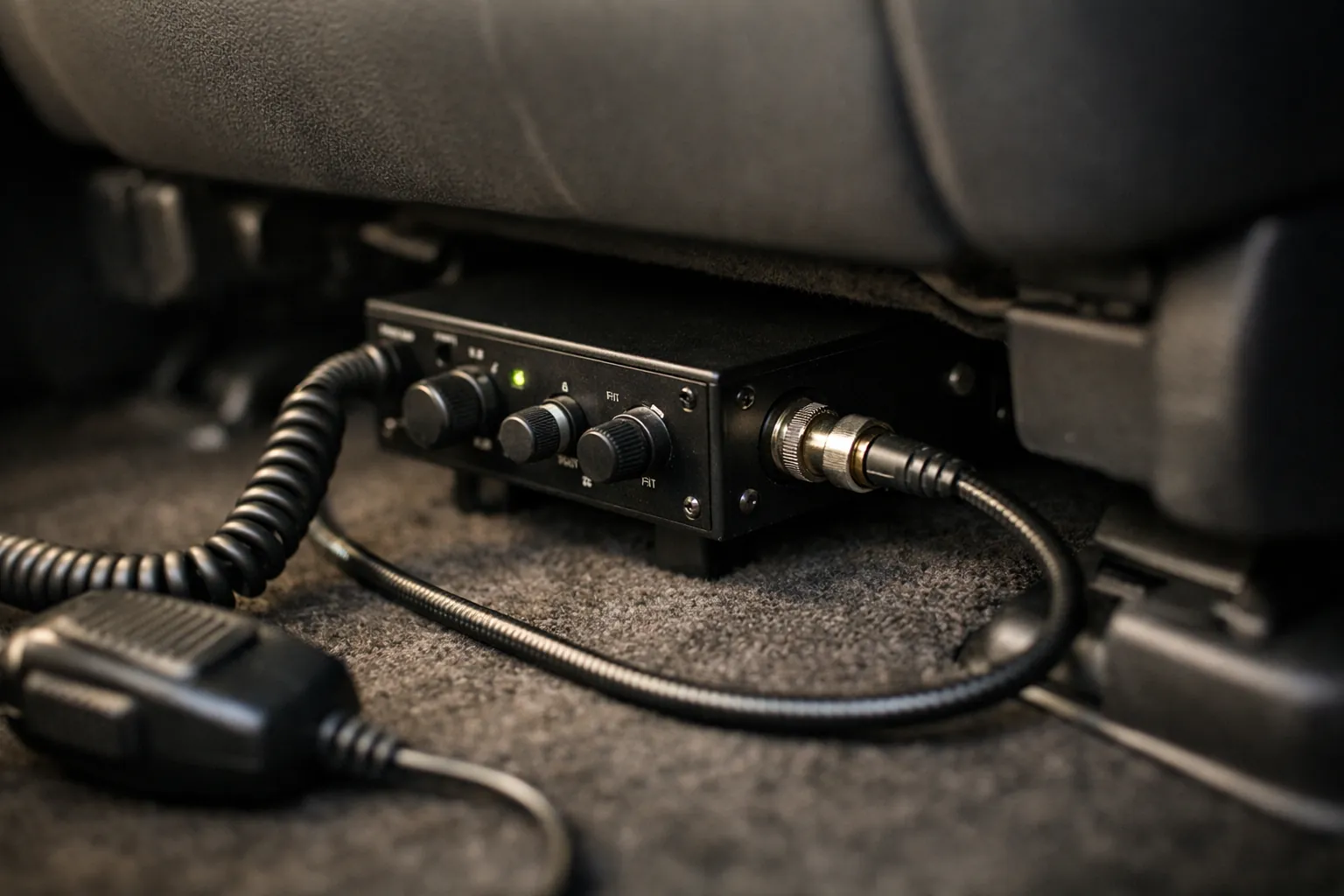
The radio box hides under a seat or behind a panel, and the controls live in the hand mic (Midland calls it a fully integrated control mic). That layout is the reason it suits cramped dashboards. It comes with a slide-in mount, a mic holder, a magnetic-mount antenna on a 6-meter cable and a 12 V plug-in power cord, so a basic install takes minutes.
At 1,824 Amazon ratings it has the biggest owner base of any Midland mobile, which matters when you're searching for someone else's install photos for your exact vehicle.
- Power15 W high / 5 W low
- Channels15 + 8 repeater
- Codes142
- Size1.4 x 5 x 4.2 in
- Antenna2.1 dB mag mount
- FCCPart 95E
Why it stands out
- Small enough to tuck almost anywhere
- Plug-in power for a quick install
- Repeater channels with split tones
Think twice if
- You need a bandwidth switch: the manual shows none
- The radio will live exposed to rain or dust; no water rating is listed
Midland MXT575
Same mic-controlled layout as the MXT275, in a box about twice as long. You get the maximum GMRS output for a mobile station on the main channels, a wide/narrow bandwidth option, and an intercom jack. The stock antenna is an NMO-thread whip on a large magnetic base, so moving to a permanent NMO mount later only means swapping the base.
Where it earns the money: reaching a repeater 30 or 40 miles away from the edge of its coverage, a ranch base station feeding a mast antenna, or a group that already runs wide-band GMRS radios and wants matching audio.
- Power50 W
- Channels15 + 8 repeater
- Codes142
- Bandwidthwide / narrow
- Size5.5 x 1.5 x 7.3 in
- Weight3 lb
- FCCPart 95E
Why it stands out
- Close to 49 W on the main channels per its FCC grant
- Wide or narrow band to match the other radios in your group
- NMO-ready stock antenna
Think twice if
- You mostly talk on channels 1-7, where it's limited to under 5 W anyway
- Space is tight: the box is 7.3 in long
- Your vehicle wiring is plug-in only (a 50 W radio should be wired to the fuse block or battery)
Midland also sells the MXT275 as a Jeep-branded version (MXT275 Jeep edition) and in a two-radio MXT275VP4 bundle with a 3 dB antenna. Same radio inside.
Wide vs narrow band, briefly
GMRS allows a 20 kHz bandwidth on the main channels and the 462 MHz interstitials (47 CFR 95.1773). FRS radios use 12.5 kHz channels (95.563). Midland's MXT575 manual explains the trade-off well: all radios talking together should use the same bandwidth, and Midland defaults to narrow so audio is clean with both FRS and GMRS handhelds.
When a wide-band GMRS radio talks to a narrow one, the narrow radio hears loud, slightly distorted audio, and the wide radio hears the narrow one as quiet. If your family carries FRS walkie-talkies, leave the MXT575 on narrow. If your Jeep club runs wide-band radios like BTECH or Wouxun mobiles, switch to wide.
Installation differences
Both ship with a plug-in 12 V cord and both manuals describe wiring the red lead to the fuse block or straight to the battery's positive post. For the MXT275, the plug-in cord is fine for most people. The MXT575 transmits at more than three times the power, so it draws a lot more current while keying up. Midland doesn't publish a transmit current figure in the manual, so wire it properly from the start rather than through a worn accessory socket.

Antenna placement matters more than either radio. The MXT295 manual puts it plainly: mount the antenna as high on the vehicle as possible, and avoid fiberglass or vinyl surfaces. The step-by-step version for a Wrangler, with mount choices and cable routing, is in our Jeep Wrangler GMRS install guide.
Who should buy which
| Your situation | Buy | Why |
|---|---|---|
| Trail runs with a Jeep or truck group, simplex | MXT275 | Same horizon as the MXT575; spend the difference on an antenna |
| Family with FRS walkie-talkies | MXT275 | FRS channels 1-7 are 5 W ERP max for GMRS anyway |
| Small cab, no room under the dash | MXT275 | About 4 x 5 inches with the bracket |
| Reaching a distant repeater from the edge of coverage | MXT575 | About 5 dB more signal into the repeater |
| Base station on a mast at home or the ranch | MXT575 | Power helps when the antenna is already high |
| Group runs wide-band GMRS mobiles | MXT575 | Selectable wide band matches their audio |
| Open Jeep, UTV or tractor in the rain | Neither | Look at the IP67 MXT295 or MXT115 PRO |
Before you key up: license and channel rules
Both radios need an individual GMRS license (47 CFR 95.1705). No exam, a $35 application fee (47 CFR 1.1102; the FCC fee page lists no separate regulatory fee), a 10-year term, and it covers your immediate family. The walkthrough is in how to get a GMRS license.
Two rules explain the channel menus. Mobile radios can't transmit on channels 8-14, which are for handhelds only (95.1763(d)), which is why both MicroMobiles list 15 channels, not 22. And the repeater channels transmit on 467 MHz, 5 MHz above the 462 MHz output you listen on (95.1763(a) and (c)).
The call
Most people asking this question should buy the Midland MXT275 and a MXTA26 6 dB whip or the MXTA25 Ghost antenna on a proper NMO mount. Spend on the MXT575 when you have a specific weak path to fix, like a repeater you can almost hit, or a base antenna already up on a mast. Still deciding between brands? Midland vs BTECH vs Wouxun covers the 50 W alternatives, and the best GMRS radio for a Jeep ranks the field.
Sources: Midland product pages, spec sheets and owner's manuals (midlandusa.com), FCC grants MMAMXT275 and MMAMXT575 (via the FCC ID database), Amazon listings, all checked October 3, 2026. Rules: 47 CFR 95.1705, 95.1731, 95.1763, 95.1767, 95.1773, eCFR current as of October 1, 2026. Rules checked: October 3, 2026. How we research · Affiliate disclosure