
Mount an NMO antenna on metal as high as the Jeep allows, hide the radio under a seat or in the console, run the coax through a firewall grommet, and wire the fused power lead to the fuse block or battery. That's the whole job, and it's about an afternoon. The hard decision is the antenna spot, because a JL fights you on it: the hardtop gives no ground plane and the hood is aluminum, so magnet mounts are out.
Parts list
| Part | Example | Notes |
|---|---|---|
| GMRS mobile radio | Midland MXT275 | 15 W, controls in the mic, small hideaway box. Our best GMRS radio for a Jeep covers the alternatives. |
| NMO antenna | Midland MXTA25 Ghost or MXTA26 whip | 3.5 in vs 32 in; see the antenna upgrade guide |
| Mount | Lip mount, fender bracket or your own bracket plus cable | Options below |
| SWR meter | Surecom SW-102 | Must cover 462-467 MHz; CB meters don't |
| Small stuff | Zip ties, a wire brush, a ring terminal for ground | Bare-metal ground contact matters |
Step 1: choose the antenna spot
Two physical facts decide this. Height sets range: on our GMRS range calculator, two antennas at about 5 feet have a 6.32-mile line-of-sight limit, and at 7 feet it's 7.48 miles. And a vehicle antenna needs metal under it (the ground plane) to work as designed. On a Wrangler those two pull in opposite directions, because the highest surface, the hardtop, is composite.
Hood edge or cowl (the popular compromise)
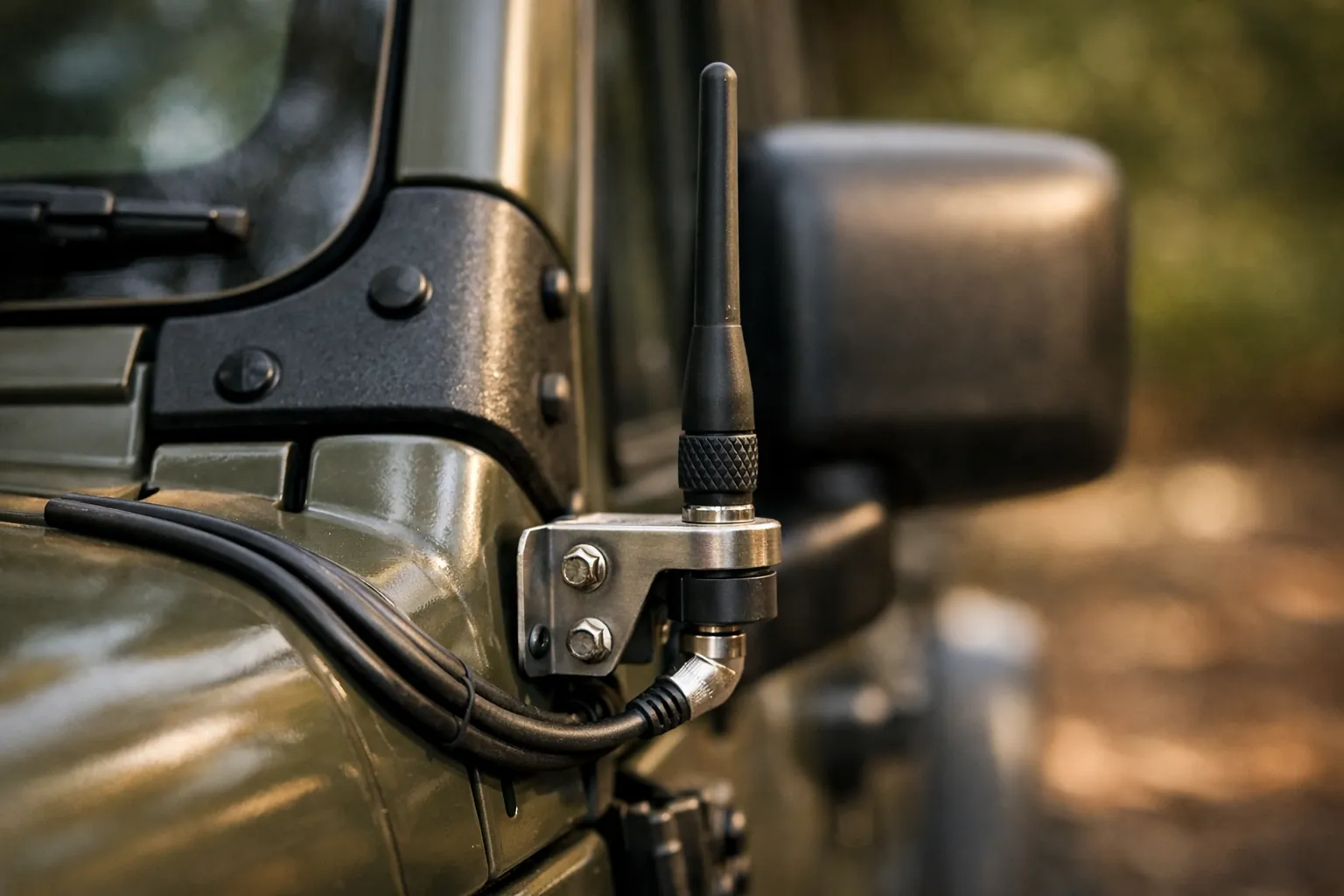
A lip mount clamps to the edge of the hood near the windshield and needs no drilling. Midland's MXTA27 universal NMO lip mount comes with a 20 ft RG58U cable attached; the Anina adjustable lip mount adds angle adjustment and 16.5 ft of cable. The hood is aluminum, which still conducts, so it works as a partial ground plane even though magnets won't stick to it. The antenna sits near the A-pillar, a little below roof height.
Ditch-light, A-pillar or tailgate brackets
Many aftermarket brackets bolt to existing holes at the ditch-light mounts or the tailgate hinge and have a 3/4-inch or 3/8-inch hole for an antenna base. Midland's MXTA24 low-profile cable fits brackets with either hole size and comes with 20 ft of RG58U. A tailgate or spare-tire spot hides the antenna, but it sits low and the whole Jeep body is between it and the vehicle ahead of you in a convoy.
Fender
The HYS fender mount kit includes a pretuned GMRS antenna, a stainless L-bracket for 3/8 to 3/4 inch holes and 13 ft of RG-58. It's a tidy all-in-one, but fenders are low, so expect a bit less reach than a cowl or rack position.
Roof rack
If you run a metal roof rack or bed rack (Gladiator), a bracket on it gives the highest antenna and a decent ground plane from the rack itself. With a 32-inch whip up there, check garage and trail clearance first. The 3.5-inch Ghost is the safer pick on a rack.
Step 2: place the radio and mic
The MXT275 and MXT575 put the controls in the hand mic, so the radio box can go out of sight: under a front seat, inside the center console, or behind a panel. Keep it out of direct heat and where nobody kicks it. The mic clips to the dash or console with the included mic holder; put it where the driver's right hand finds it without looking.
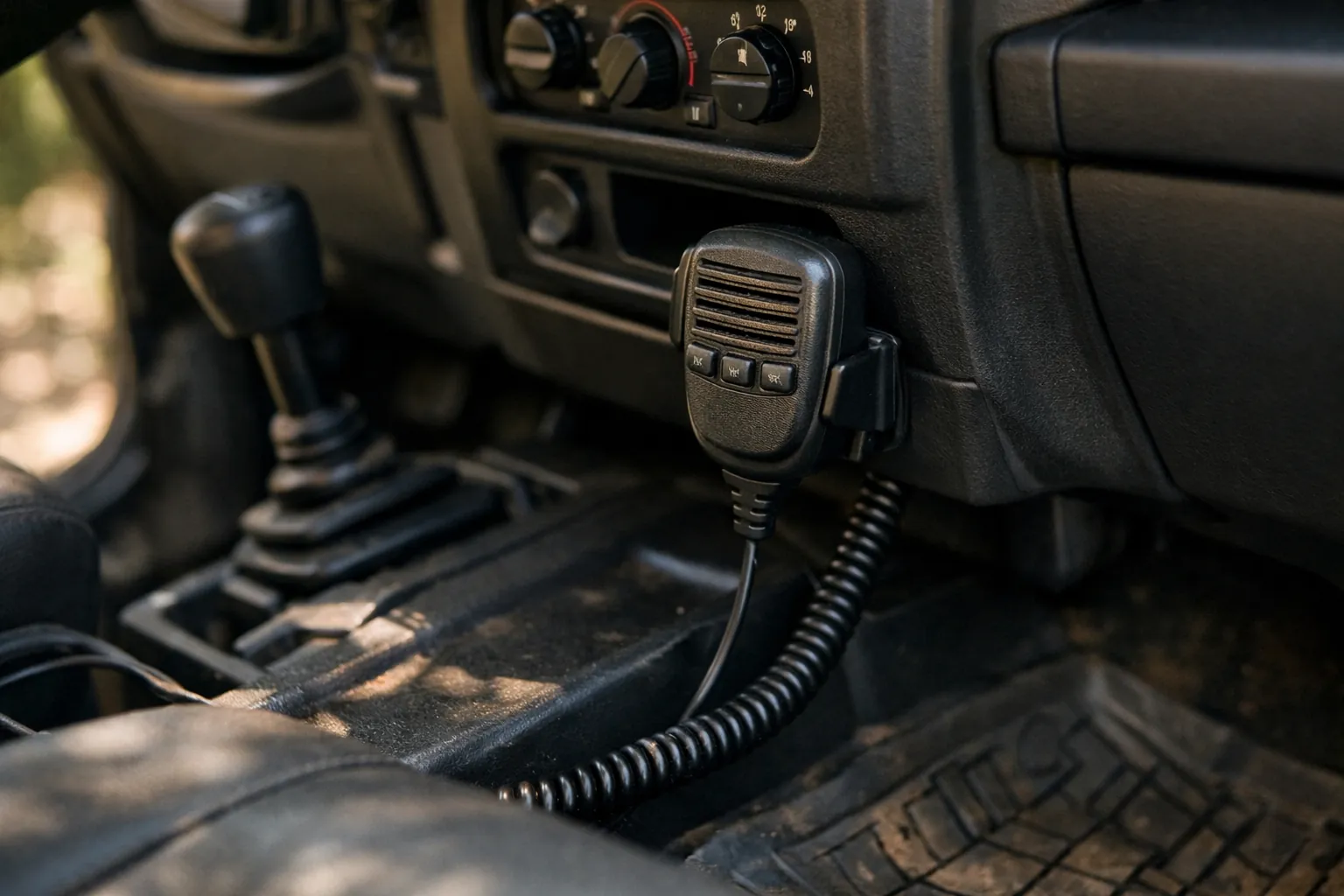
For an open Jeep with the doors and top off, think about water. Neither the MXT275 nor the MXT575 lists a water rating; Midland rates the MXT115 PRO and MXT295 IP67 (compared in MXT295 vs MXT275 vs MXT115).
Step 3: route the coax
Plan the route before you mount anything. From a hood or cowl mount, the usual path is along the cowl, then through a rubber grommet in the firewall into the footwell. From a tailgate mount, run it along the inside of the body under the trim to the seat. Avoid pinch points at door hinges and the tailgate, and don't coil extra cable tightly behind the radio.
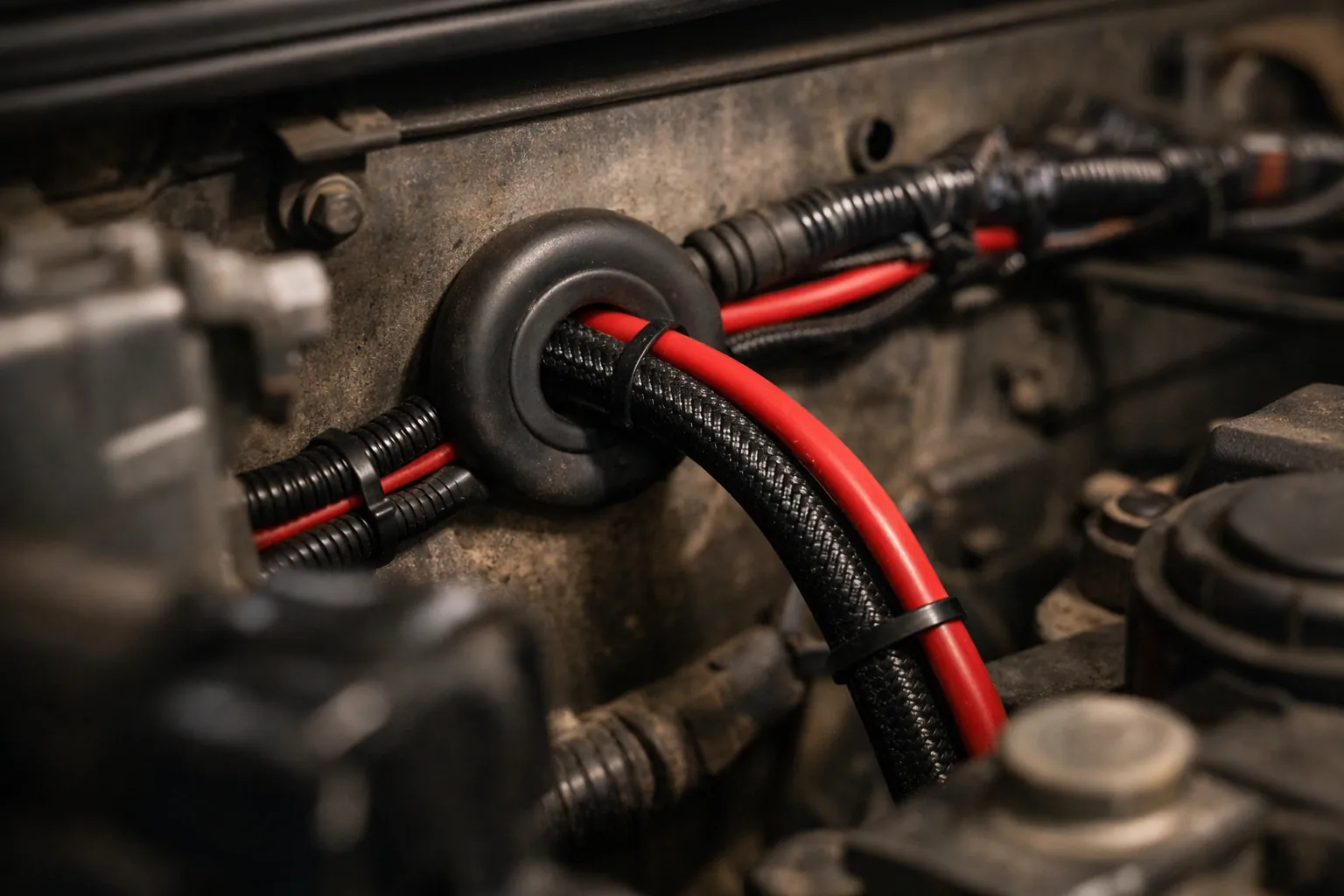
Midland's cables help here: the UHF connector at the radio end unscrews, and an FME-to-UHF adapter is included, so the small end goes through the grommet and the plug goes back on inside. If the cable is too long, leave the slack in a loose loop rather than cutting it unless you know how to install a new connector.
Step 4: wire power and ground
The 12 V plug-in cord that comes with Midland's MicroMobiles works for a 15 W radio. For a permanent install, both the MXT275 and MXT575 manuals say to connect the red lead (with its in-line fuse holder) to either the fuse block or the battery's positive post. Connecting to an accessory terminal makes the radio turn off with the ignition. Midland's later manuals stress that a good, direct metal-to-metal ground is essential: run the black lead to bare chassis metal with a ring terminal, scraping paint at the contact point.
For a 50 W radio like the MXT575 or BTECH GMRS-50V2, skip the accessory socket and wire it to the battery or a fused auxiliary circuit. A 50 W transmitter draws far more current than a 15 W one when you key up.
Step 5: test it
- Check SWR with a VHF/UHF meter on a main channel (15-22) at low power, then high. Under 1.5:1 is a good install. Steps: how to check SWR on a GMRS antenna.
- Do a radio check with someone a mile or two away, then on a local repeater if you have one.
- Drive a bumpy road and recheck. A loose ground or connector shows up as a jumping reading.
Remember that a mobile radio can't transmit on channels 8-14, which are for handhelds only (47 CFR 95.1763(d)). That's why Midland's mobiles have 15 channels, and it matters when you plan trail channels with friends on handhelds; our convoy channel guide sorts it out. You also need a GMRS license to transmit (95.1705): $35 application fee (47 CFR 1.1102), no exam; the FCC fee page lists no separate regulatory fee.
Which radio, if you haven't bought one
For most Wranglers, the MXT275 rather than the MXT575: the same horizon, a smaller box, and the money goes into a better antenna spot. Spend the afternoon on the antenna location and you'll get more out of either radio than any wattage upgrade gives.
Install steps follow the Midland MXT275 (Nov 2025), MXT575 (May 2021) and MXT295 (Mar 2026) owner's manuals; part specs come from Amazon listings and midlandusa.com, checked October 3, 2026. We haven't installed every mount listed here on a JL; the trade-offs come from antenna physics and the manufacturers' instructions. Rules: 47 CFR 95.1705, 95.1763, eCFR current as of October 1, 2026. How we research · Affiliate disclosure