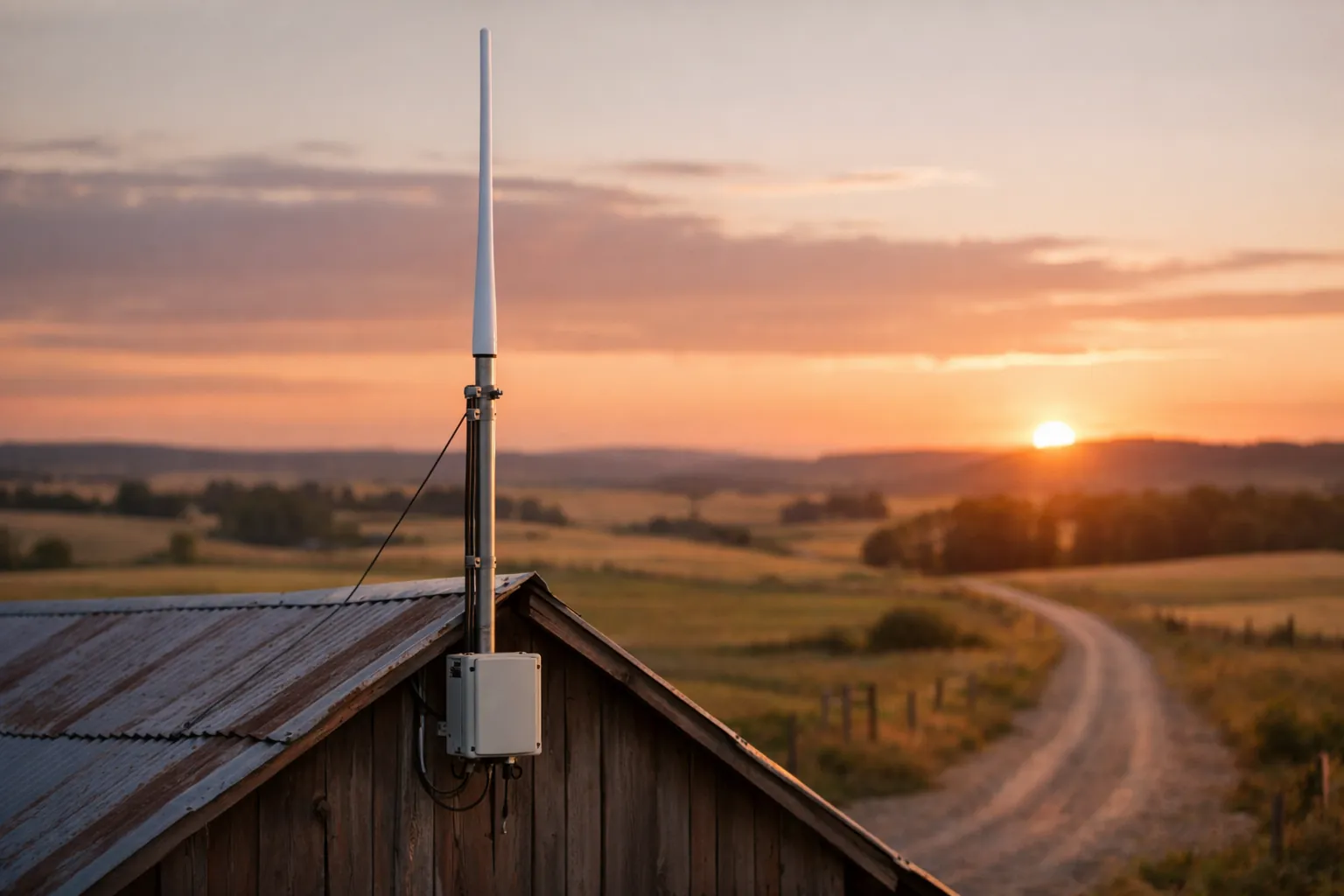
For a family, a farm or a small group, buy a compact GMRS repeater with a built-in duplexer, like the Retevis RT97, and pair it with a good base antenna mounted as high as you can get it. The RT97 series dominates Amazon's GMRS repeater listings, from the basic RT97 to the expandable RT97S and the weatherproof RT97L. The box itself is only half the job. Antenna height and coax decide how well it works, along with a stable 12 V power source.
Quick picks
| Best value repeater | Retevis RT97 | Amazon |
|---|---|---|
| Best for expanding later | Retevis RT97S | Amazon |
| Best for outdoor and remote sites | Retevis RT97L | Amazon |
| Best starter system | Retevis RT97 system with 2 RB17P radios | Amazon |
| Best family or community kit | Retevis RT97S with 4 RB48 Plus radios | Amazon |
| Antenna to pair with it | FMUSER GR100 base antenna | Amazon |
| Power to run it | BTECH RPS-30PRO power supply | Amazon |
How we picked
We only considered purpose-built GMRS repeaters. A repeater transmitter must be FCC-certified for GMRS like any other GMRS transmitter (47 CFR 95.1761). The original Retevis RT97's FCC ID is 2ASNSRT97 in FCC equipment records. For any unit, read the FCC ID off the label or ask the seller, then confirm it in the FCC's FCC ID search.
The field was narrow. Amazon's GMRS repeater results on October 3, 2026 were almost all Retevis RT97-family units and kits, so we compared them on features and ratings.
Specs come from the listings only: channels and the duplexer, the weather rating, and what's in the box. Most of these listings don't state repeater output power, so we don't quote it.
"How we pick" means we reviewed listings and ratings against the FCC rules. It is not a field test. How we research.
What you need for a working repeater
Every RT97-family unit has a built-in duplexer. That's the part that lets a repeater transmit and receive at the same moment on a single antenna. The listings note that the duplexer costs some power, which is normal. Most RT97 listings don't include an antenna, so budget for one.
The best GMRS repeaters and repeater gear
Retevis RT97
Most GMRS families start with this one. It's small enough to sit on a shelf or ride in a vehicle. The built-in duplexer means it needs only one antenna, and it ships with 8 GMRS repeater channels preset. Retevis says it works as a fixed or mobile station and supports multiple power options. With 90+ ratings at 4.4 stars, it's also the most-reviewed standalone unit.
- Duplexfull, built-in duplexer
- Channels16 (8 preset GMRS)
- Power optionsmultiple (per listing)
- Antennanot included
- Feederupgraded thicker cable (per listing)
- FCC ID2ASNSRT97 (FCC records)
Why it stands out
- Lowest-cost purpose-built GMRS repeater
- Built-in duplexer, one antenna
- Portable or fixed
Think twice if
- You want to link multiple repeaters or add accessories (see RT97S)
- It's going outdoors unprotected
Retevis RT97S
What the S adds is a DB-9 connector. According to the listing, it can take a microphone or a Raspberry Pi, and with extra components it lets you interconnect multiple RT97S repeaters. Clubs and tinkerers who might want voice ID or monitoring later, or linking, should buy this one. Otherwise it's the same compact, single-antenna design as the RT97.
- Duplexfull, built-in duplexer
- Channels8 GMRS
- ConnectorDB-9 female for mic or Raspberry Pi
- Linkingmultiple RT97S can be interconnected (extra parts)
- Power12 V DC
- Waternot water resistant
Why it stands out
- DB-9 port for accessories and linking
- Built-in duplexer
Think twice if
- You just want a simple family repeater; the RT97 does that for less
Retevis RT97L
Built to live outside. It's rated IP66, an internal heater switches on below -15°C, and it drops to low power above 60°C so it doesn't overheat. The listing gives a 6 A DC draw at high power, which makes sizing a battery and solar setup for a remote hilltop simple arithmetic. It's also the most expensive unit here.
- WeatherIP66
- Cold modeinternal heater below -15°C
- Heat protectiondrops to low power above 60°C
- Power modeshigh/low
- Draw6 A DC on high (per listing)
Why it stands out
- IP66 with heat and cold management
- Clear power-draw spec for off-grid sites
Think twice if
- You'll keep it indoors; the RT97 or RT97S costs less
- You want lots of owner reviews

Retevis RT97 system with 2 RB17P radios
No repeater-capable radios yet? This kit pairs the RT97 with two RB17P GMRS handhelds, each with 22 standard channels and 8 repeater channels. It's the simplest way to get a working system out of one box. You'll still need an antenna for the repeater.
- RepeaterRT97, 16 channels (8 GMRS), color LCD, built-in duplexer
- Radios2 × RB17P GMRS handhelds
- RB17P channels30 (22 + 8 repeater)
Why it stands out
- Repeater plus two matched radios
- Radios come set up for the repeater channels
Think twice if
- You already have repeater-capable radios
Retevis RT97S with 4 RB48 Plus radios
For a family property, a campground or a small community emergency group, this kit bundles the expandable RT97S with four rugged RB48 Plus GMRS handhelds rated IP67. The RB48 Plus also made our list of family camping picks.
- RepeaterRT97S, full duplex, DB-9, 8 GMRS channels
- Radios4 × RB48 Plus GMRS handhelds
- Radio rugged ratingIP67, 2 m drop
Why it stands out
- Complete system for four people
- Rugged, waterproof handhelds
Think twice if
- You need more than four radios or different handhelds
FMUSER GR100 base antenna
Every repeater above needs a base antenna. The GR100 is GMRS-tuned fiberglass, and its listing pitches it for base stations and repeaters. Check the connector on your repeater and buy the right adapter or coax ends. More choices are in our antenna picks.
- Tuned462-467 MHz
- Gain7.5 dBi
- VSWRunder 1.3 (per listing)
- Constructionfiberglass
- ConnectorPL-259
Why it stands out
- Tuned for GMRS repeater use
- Weatherproof fiberglass
Think twice if
- You're in hilly terrain where a lower-gain antenna may cover better
BTECH RPS-30PRO power supply
Repeaters run on 12-13.8 V DC. A regulated supply like the RPS-30PRO runs a repeater indoors with room to spare, and the several output terminals make wiring easy. At a remote site, size a battery and solar system to the repeater's listed current draw instead.
- Output13.8 V, adjustable 9-15 V
- Rating30 A regulated
- Outputscigarette socket, screw terminals, snap-in terminals
- Protectionoverheat, short, surge
Why it stands out
- Plenty of current headroom
- Several output types
Think twice if
- Your site has no AC power
Side-by-side comparison
| Product | What it is | Weather | Expandable | Radios included |
|---|---|---|---|---|
| Retevis RT97 | Repeater | Check listing | No | No |
| Retevis RT97S | Repeater | Not water resistant | DB-9, linking | No |
| Retevis RT97L | Repeater | IP66 | Check listing | No |
| RT97 + 2 RB17P | Kit | Check listing | No | 2 |
| RT97S + 4 RB48 Plus | Kit | Radios IP67 | DB-9, linking | 4 |
The FCC rules for running a repeater
| Rule | What it means | Source |
|---|---|---|
| License | A repeater runs under an individual GMRS license ($35, no exam, 10 years) | 95.1705 |
| Channels | Repeaters transmit on the 462 MHz main channels (15-22) and receive on the 467 MHz inputs, 5 MHz up | 95.1763 |
| Power | Up to 50 W transmitter output | 95.1767 |
| Who may use it | The licensee decides: open to all, limited to specific people, or specific users barred. Users need their own license. | 95.1705(d) |
| Station ID | Not required if it only repeats stations on the same license that identify themselves; otherwise it must identify | 95.1751(c) |
| Unattended operation | Repeaters may run under automatic control and be operated by remote control | 95.1747, 95.1745 |
| Shared repeaters | Shared with other licensees only free, non-profit cost-shared or reciprocal, with a written agreement kept in station records | 95.1705(f) |
| Equipment | Must be certified for GMRS | 95.1761 |
Setup tips
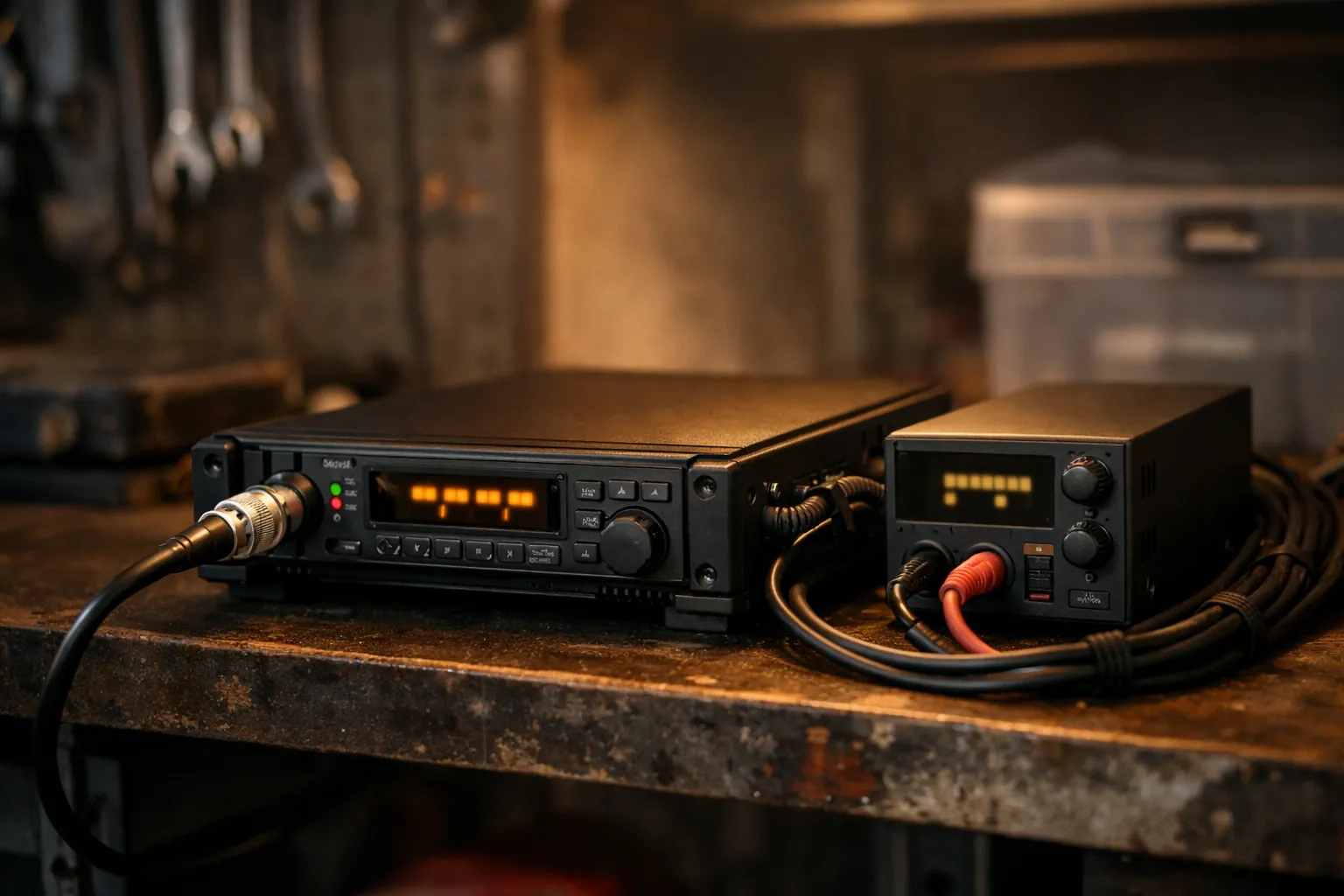
Antenna height comes before everything else. A repeater with its antenna above the roofline beats a "better" repeater with its antenna in the attic; our page on GMRS range explains why. Keep the coax short and thick, too, because long, thin coax wastes signal at UHF.
Before you go on the air, check local listings and choose an output channel and tone that won't clash with other repeaters nearby (see finding repeaters). Then program your radios with the repeater channel, the +5 MHz offset and that tone.
One more thing if you're near an airport: very tall masts there can require FAA notice and FCC registration (95.317).
Your shopping list
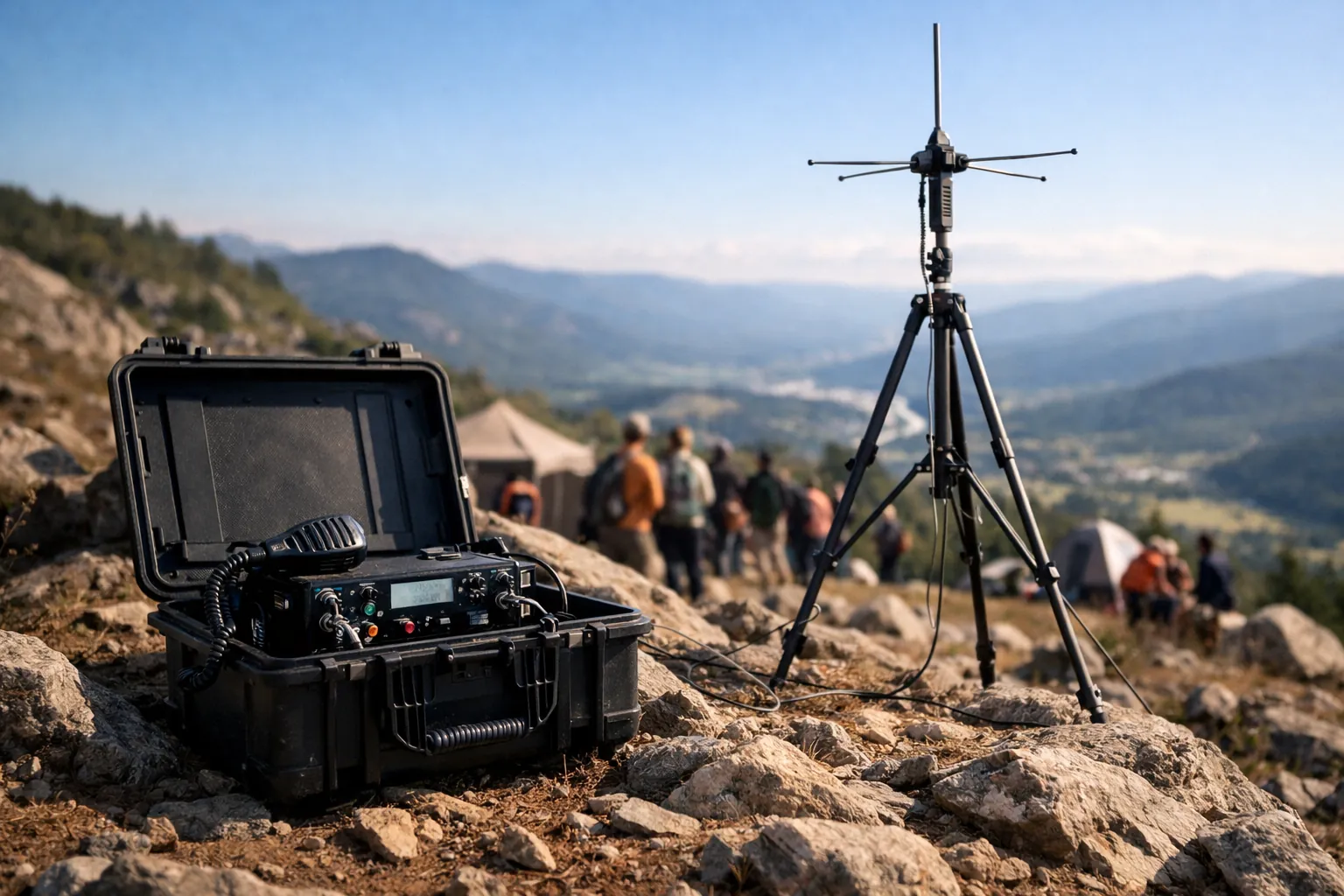
A family or farm needs three things: the Retevis RT97, a GMRS-tuned base antenna like the GR100, and a 13.8 V supply. Swap the RT97 for the RT97S only if you're likely to link repeaters or add accessories, and for the RT97L only if it will sit outside or off-grid.
Before it transmits, confirm the FCC ID and make sure it runs under your GMRS license. Then spend your effort on the mast, because antenna height will matter more than anything else on this list.
Not ready for a repeater? A GMRS base station uses the same antenna, mast and supply with a mobile radio on a desk. With the antenna 30 feet up, a handheld at head height has about 11 miles of line of sight over smooth ground.
Specs from each product's Amazon listing and ratings from Amazon search results, checked October 3, 2026. FCC rules from 47 CFR Part 95 Subpart E (eCFR, current through October 1, 2026): Part 95E · FCC GMRS. How we research · Affiliate disclosure