GMRS has 30 frequencies: 22 channels shared with FRS (numbered 1-22 on most radios) and 8 repeater input frequencies at 467 MHz. Channels 15-22 are the "main" channels where mobile and base radios may run up to 50 watts; channels 1-7 allow 5 watts ERP; channels 8-14 are limited to 0.5 watt from handhelds. The full chart is below, with every number taken from 47 CFR 95.1763 and 95.1767.
Where these numbers come from
We built this chart directly from the Code of Federal Regulations (eCFR, Title 47, current through October 1, 2026), read on October 3, 2026: the channel list in 95.1763, power limits in 95.1767, bandwidths in 95.1773, and the FRS channel numbering in 95.563. The GMRS rules list frequencies, not channel numbers; the 1-22 numbering comes from the FRS rule, and nearly every GMRS radio uses it. How we research.
The GMRS channel chart
| Ch | Frequency (MHz) | Type | Who may transmit | Max power | Bandwidth |
|---|---|---|---|---|---|
| 1 | 462.5625 | 462 interstitial | Handheld, mobile, base | 5 W ERP | 20 kHz |
| 2 | 462.5875 | 462 interstitial | Handheld, mobile, base | 5 W ERP | 20 kHz |
| 3 | 462.6125 | 462 interstitial | Handheld, mobile, base | 5 W ERP | 20 kHz |
| 4 | 462.6375 | 462 interstitial | Handheld, mobile, base | 5 W ERP | 20 kHz |
| 5 | 462.6625 | 462 interstitial | Handheld, mobile, base | 5 W ERP | 20 kHz |
| 6 | 462.6875 | 462 interstitial | Handheld, mobile, base | 5 W ERP | 20 kHz |
| 7 | 462.7125 | 462 interstitial | Handheld, mobile, base | 5 W ERP | 20 kHz |
| 8 | 467.5625 | 467 interstitial | Handheld only | 0.5 W ERP | 12.5 kHz |
| 9 | 467.5875 | 467 interstitial | Handheld only | 0.5 W ERP | 12.5 kHz |
| 10 | 467.6125 | 467 interstitial | Handheld only | 0.5 W ERP | 12.5 kHz |
| 11 | 467.6375 | 467 interstitial | Handheld only | 0.5 W ERP | 12.5 kHz |
| 12 | 467.6625 | 467 interstitial | Handheld only | 0.5 W ERP | 12.5 kHz |
| 13 | 467.6875 | 467 interstitial | Handheld only | 0.5 W ERP | 12.5 kHz |
| 14 | 467.7125 | 467 interstitial | Handheld only | 0.5 W ERP | 12.5 kHz |
| 15 | 462.5500 | 462 main | Handheld, mobile, base, repeater, fixed | 50 W output (mobile/base/repeater); 15 W fixed | 20 kHz |
| 16 | 462.5750 | 462 main | Handheld, mobile, base, repeater, fixed | 50 W output (mobile/base/repeater); 15 W fixed | 20 kHz |
| 17 | 462.6000 | 462 main | Handheld, mobile, base, repeater, fixed | 50 W output (mobile/base/repeater); 15 W fixed | 20 kHz |
| 18 | 462.6250 | 462 main | Handheld, mobile, base, repeater, fixed | 50 W output (mobile/base/repeater); 15 W fixed | 20 kHz |
| 19 | 462.6500 | 462 main | Handheld, mobile, base, repeater, fixed | 50 W output (mobile/base/repeater); 15 W fixed | 20 kHz |
| 20 | 462.6750 | 462 main | Handheld, mobile, base, repeater, fixed | 50 W output (mobile/base/repeater); 15 W fixed | 20 kHz |
| 21 | 462.7000 | 462 main | Handheld, mobile, base, repeater, fixed | 50 W output (mobile/base/repeater); 15 W fixed | 20 kHz |
| 22 | 462.7250 | 462 main | Handheld, mobile, base, repeater, fixed | 50 W output (mobile/base/repeater); 15 W fixed | 20 kHz |
The FCC rule doesn't set a separate main-channel power cap for handhelds; certified GMRS handhelds are typically rated around 5 watts. Under FCC definitions, a "fixed" station talks only to other fixed stations; the radio in your house is a "base" station.
The 8 repeater input frequencies
These are GMRS-only and aren't numbered channels on most radios. Handheld, mobile and control stations may transmit on them only when talking through a repeater (or for brief tests); fixed stations may also use them.
| Repeater output (you listen) | Repeater input (you transmit) | Pairs with |
|---|---|---|
| 462.5500 | 467.5500 | Channel 15 |
| 462.5750 | 467.5750 | Channel 16 |
| 462.6000 | 467.6000 | Channel 17 |
| 462.6250 | 467.6250 | Channel 18 |
| 462.6500 | 467.6500 | Channel 19 |
| 462.6750 | 467.6750 | Channel 20 |
| 462.7000 | 467.7000 | Channel 21 |
| 462.7250 | 467.7250 | Channel 22 |
Radio makers label these repeater pairs differently (for example "15R" or "RPT 1"), so check your manual. Our repeater guide explains tones and offsets in plain English.
How the 30 frequencies fit together
Which channel to use for what
The FCC doesn't reserve any GMRS channel for a specific purpose, but it does require every user to give priority to emergency communications on every channel (95.1731). In practice:
| Use | Good channels | Why |
|---|---|---|
| Family handhelds at a campsite | 1-7 or 15-22 | Full handheld power; works with FRS radios too |
| Convoy with mobile radios | 15-22 | The only channels where mobiles may run high power |
| Short range, low interference | 8-14 | 0.5 W, handhelds only; often quieter |
| Talking through a repeater | The repeater's pair (15R-22R) and its tone | Only GMRS radios can transmit on the inputs |
| Calling for help | Any channel, or a local repeater | No channel is reserved; ask local groups which one they monitor |
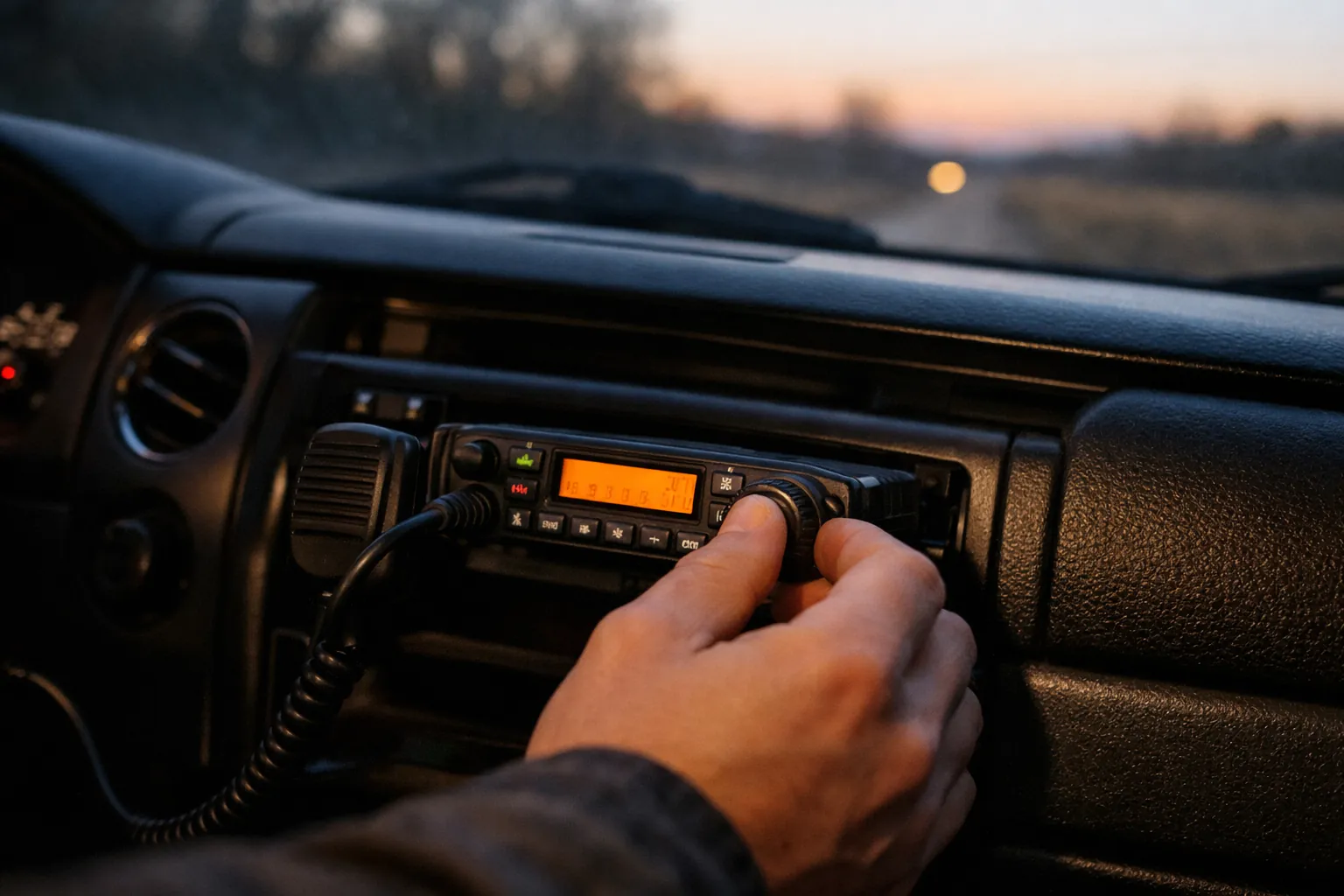
A mobile like the Midland MXT275 handles the channel rules for you: GMRS-certified radios are built so you can't exceed the limits on each channel. That's one more reason to buy a certified GMRS radio rather than a programmable ham radio.
Privacy codes, tones and data
- Privacy codes (CTCSS/DCS) are sub-audible tones. They filter what your radio plays; they don't hide your conversation. FCC rules allow these tones on Personal Radio Service channels (95.377) and bar voice scrambling on new equipment (95.381).
- Repeater tones are the same CTCSS/DCS tones; many repeaters need the right one to open.
- Location and text data from GMRS handhelds is allowed in short bursts on the 462 MHz channels and the 467 MHz interstitial channels, but never on the 467 MHz repeater inputs (95.1773, 95.1787).
How this compares with FRS
FRS uses channels 1-22 too, but at lower power: 2 watts ERP on 1-7 and 15-22, and 0.5 watt on 8-14 (95.567). FRS radios can't use repeaters. The full breakdown is in GMRS vs FRS. To transmit on GMRS at all you'll need a license; here's how to get one for $35.
The bottom line
Think of GMRS as three groups: channels 1-7 (5 W ERP, shared with FRS), channels 8-14 (0.5 W, handhelds only) and channels 15-22 (the high-power main channels, up to 50 W from mobiles and bases), plus eight repeater inputs 5 MHz above 15-22. Pick 15-22 for vehicles and bases, use repeaters for distance, and never trust a "privacy code" with anything private.
Frequencies and limits checked against 47 CFR Part 95 (eCFR) on October 3, 2026. Sources: 95.1763 · 95.1767 · 95.1773 · 95.563 · FCC GMRS. How we research · Affiliate disclosure