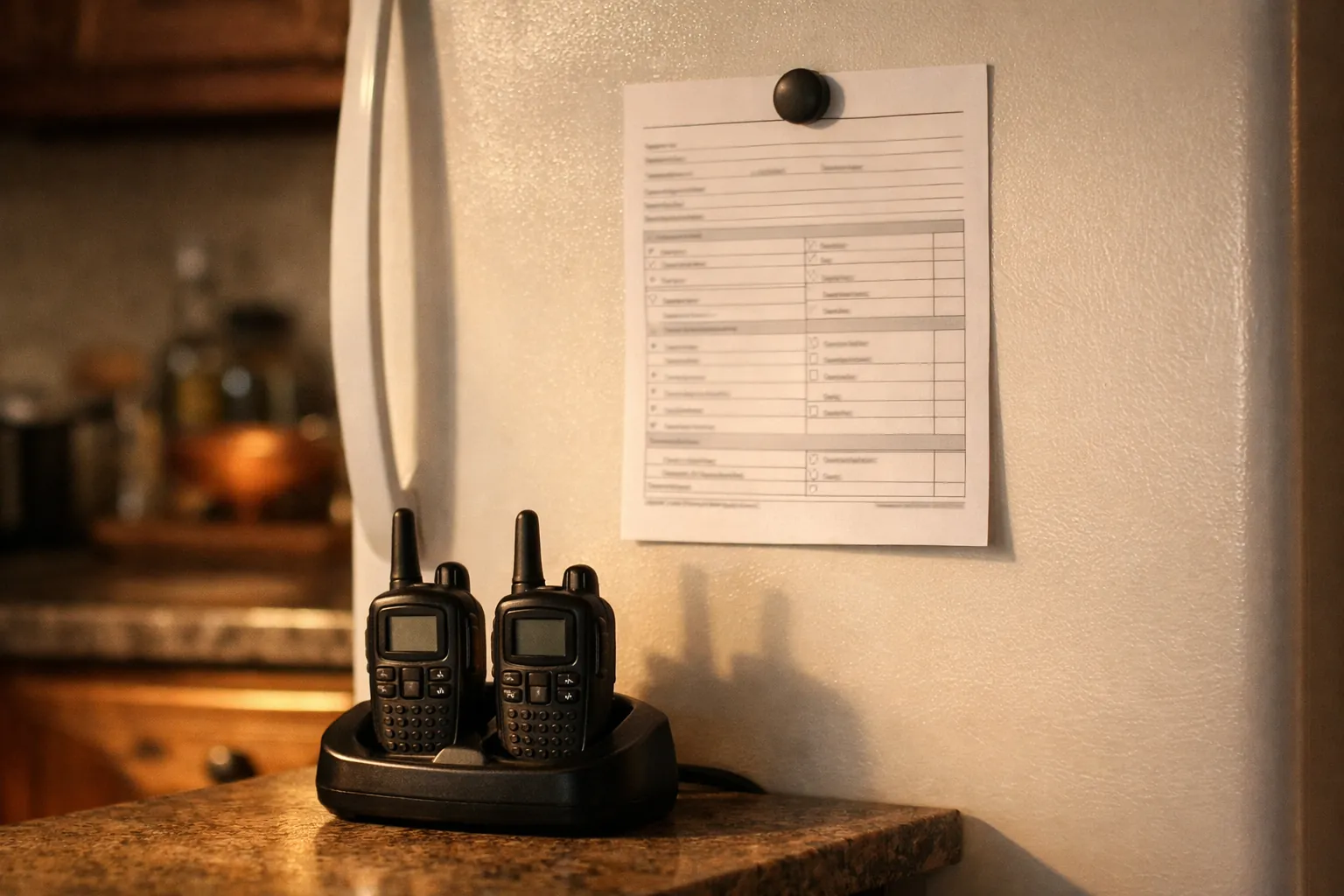
Print this page, fill it in at the kitchen table with everyone who'll carry a radio, and put a copy on the fridge and in each go-bag. It's the radio layer that Ready.gov's family emergency plan leaves out: who carries which radio and how they identify, your primary and backup channels, when everyone checks in, and what to do when someone doesn't. You can type into the blanks before printing, or print it empty and write by hand.
Our family radio plan
Fill in together. Keep one copy on the fridge and one in every go-bag. Update it when phones, radios or schools change.
1. Who carries a radio
| Name | Radio / unit no. | How they ID on the air (e.g. "WRXX123 unit 2") |
|---|---|---|
One GMRS license covers the holder's immediate family (47 CFR 95.1705(c)(2)). In an emergency, anyone may use our radio to send an emergency message (95.1705(c)(3)).
2. Channels
Not an FCC rule: some groups suggest Ch 20 (462.675) with a 141.3 Hz tone as a calling channel. Any channel may carry emergency traffic, and it has priority on all of them (95.1731(a)).
3. Check-in schedule
| Time | Who calls | Who answers | If no answer |
|---|---|---|---|
Example: top of every hour, radios on for 10 minutes, then off to save batteries. No answer twice in a row: try the backup channel, then go to meeting place 1.
4. Meeting places
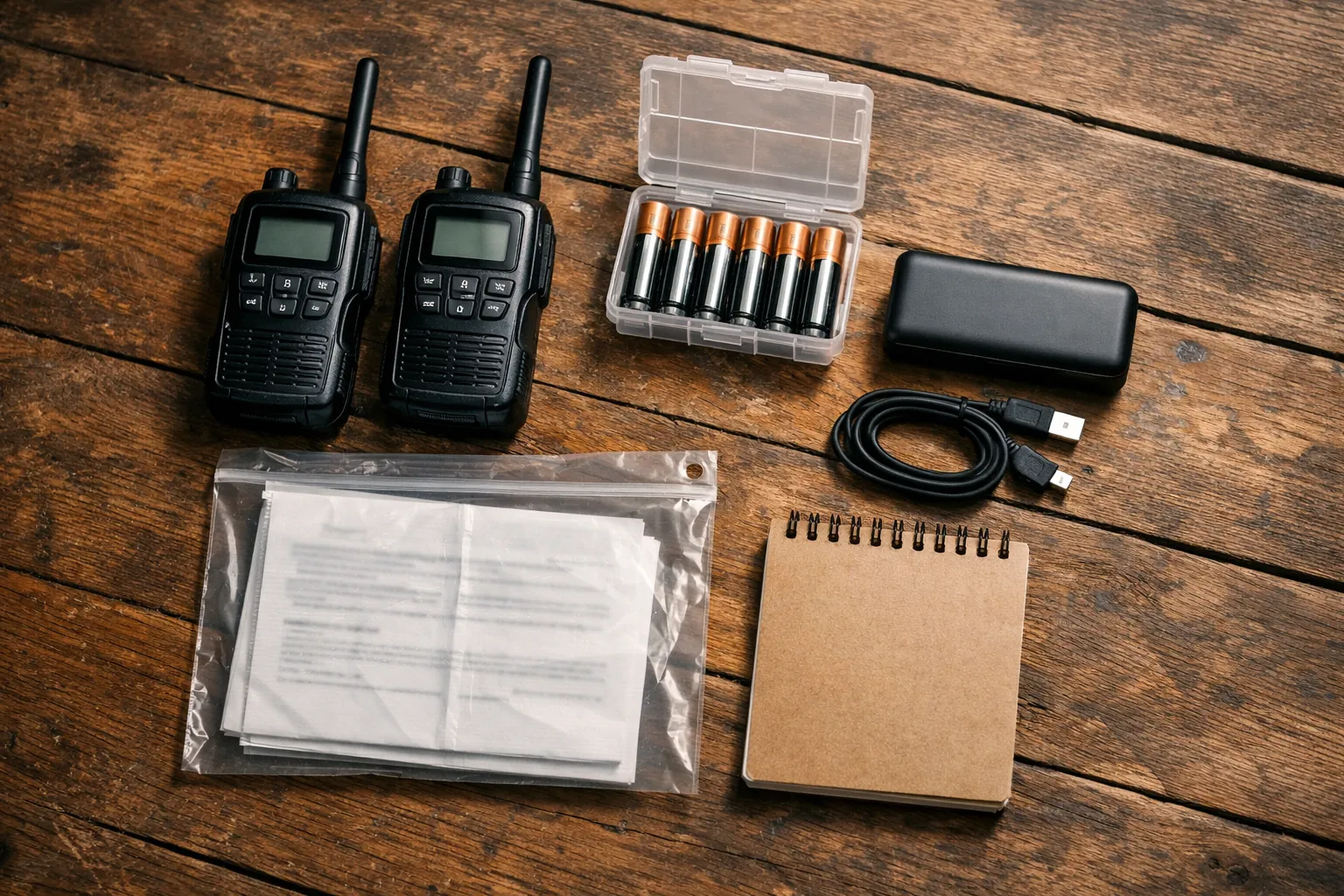
5. Radio kit
- A radio per person
- Spare batteries or AA tray
- Charger + power bank
- Car charger
- Spare antenna if removable
- This plan
- GMRS channel card
- Pencil
"Mom, this is Sam." Wait. Answer: "Go ahead, Sam."
Short status: OK / need help / location.
End: "Sam, WRXX123 unit 2, out." Say the call sign at the end of a conversation and every 15 min (95.1751).
Let go of the button to listen. "Over" means your turn.
Phonetic alphabet: Alfa · Bravo · Charlie · Delta · Echo · Foxtrot · Golf · Hotel · India · Juliett · Kilo · Lima · Mike · November · Oscar · Papa · Quebec · Romeo · Sierra · Tango · Uniform · Victor · Whiskey · Xray · Yankee · Zulu
Sources: 47 CFR 95.1705, 95.1731, 95.1751 (eCFR current as of October 1, 2026); Ready.gov "Make a Plan"; ICAO/NATO phonetic alphabet. Checked October 3, 2026. GMRS Guide · gmrsguide.com/family-emergency-radio-plan/
How to fill it in
Do it together, in one sitting, with the radios on the table. Each section has a reason to be there, and most of them come from the ways family radio plans fall apart.
Section 1: who carries a radio
Write the license holder's call sign at the top. Everyone in your immediate family can transmit under it: spouse, children, grandchildren, stepchildren, parents, grandparents, stepparents, siblings, aunts, uncles, nieces, nephews and in-laws (47 CFR 95.1705(c)(2)). The ID column is how each person says the call sign. The rules allow a unit number after it (95.1751), so "WRXX123 unit 2" tells everyone which radio is talking. Our GMRS call sign guide has more examples.
Add an out-of-area contact too. Ready.gov suggests picking someone out of town, since they may be easier to reach in a disaster, and that person becomes the message relay for anyone who can't reach the radios.
Section 2: channels
Pick a primary channel and a CTCSS tone or DCS code (what most radios call a privacy code) that nobody nearby uses, then a backup in case the primary gets busy. Write both the channel and the code, because a radio set to the right channel with the wrong code hears nothing. The code filters what your radio plays. It doesn't stop anyone else listening, as our privacy codes explainer shows.
If your area has a GMRS repeater and you have permission to use it, write its name, output channel and tone. Through a repeater on a hill, family members across town can often reach each other when handhelds alone can't. Our repeater guide explains how to find one.
The "if all else fails" line is for when you've lost contact and the plan has broken down. There's no FCC emergency channel (our page explains why): 95.1731(a) makes every channel available for emergencies, with priority. Channel 20 with a 141.3 Hz tone is a calling-channel convention some websites and groups promote, which is why the sheet suggests it and labels it as a convention.
Section 3: the check-in schedule
This is the part most plans skip. Radios left on all day drain batteries, and radios left off miss calls. A schedule fixes both. Agree on times everyone can remember, for example the top of each hour with radios on for 10 minutes. Then agree on what a missed check-in means. Our suggestion is to try again at the next check-in on the backup channel, and after two misses, go to meeting place 1.
Sections 4 and 5: meeting places and the kit
Ready.gov's fillable plan has an emergency meeting places section. We split it into three distances (near home, outside the neighborhood, out of town) so there's a next step when the first place isn't reachable. The kit list is what keeps radios working past the first day. Radios that take AA batteries, like the Midland GXT1000VP4 with its dual-power design, are easier to keep running in a long outage than ones that only charge over USB.
The on-air strip at the bottom
Kids and grandparents who've never used a radio need about four sentences of procedure, and the box has them. Say who you're calling, then who you are. Wait for an answer. Keep it short: OK, need help, or where you are. End with the call sign. That last part is the one FCC rule everyone transmitting needs to know: say the call sign at the end of a conversation and every 15 minutes during a long one (95.1751).
The phonetic alphabet is the international one used in aviation and by NATO (Alfa, Bravo, Charlie...). It's there for spelling street names and call signs over a noisy channel. Notice the spellings "Alfa" and "Juliett": they're deliberate, so non-English speakers pronounce them correctly.
One more line people ask about: anyone can use your radio to send an emergency message (95.1705(c)(3)). A neighbor, a babysitter or a visiting friend can pick up the family radio and call for help without a license.
Practice it twice a year
Ready.gov's last step is "practice your plan," and for radios it matters more than for phones. Pick a weekend afternoon, send people to different rooms and then down the street, and run one check-in exactly as written. You'll find the radio with the dead battery and the teenager who doesn't know how to change channels. Time-change weekends in spring and fall are easy dates to remember, and they line up with swapping smoke-alarm batteries.
What radios this plan assumes
Any GMRS or FRS radios work, as long as everyone's on the same channel and code. FRS radios need no license and are fine for kids and short distances (95.567 limits them to 2 W ERP on most channels). GMRS radios add power and repeater access, and need the license. If you're choosing radios for this, our best GMRS radios for preppers covers household handhelds, vehicle radios and base stations, and family camping radios covers the license-free options.
Two sheets go together: this plan and our printable GMRS frequency chart, which lists every channel and its power limit. Getting the license takes about 15 minutes online, costs $35 (47 CFR 1.1102; the FCC's fee page lists no separate regulatory fee) and covers the whole immediate family for 10 years. Our GMRS license walkthrough has the steps.
Sources: 47 CFR 95.1705, 95.1731, 95.1751, 95.567, 1.1102 (eCFR up to date as of October 1, 2026); Ready.gov Make a Plan (updated September 1, 2026); phonetic alphabet per ICAO spellings as listed in the NATO phonetic alphabet article. Rules checked: October 3, 2026. How we research · Affiliate disclosure