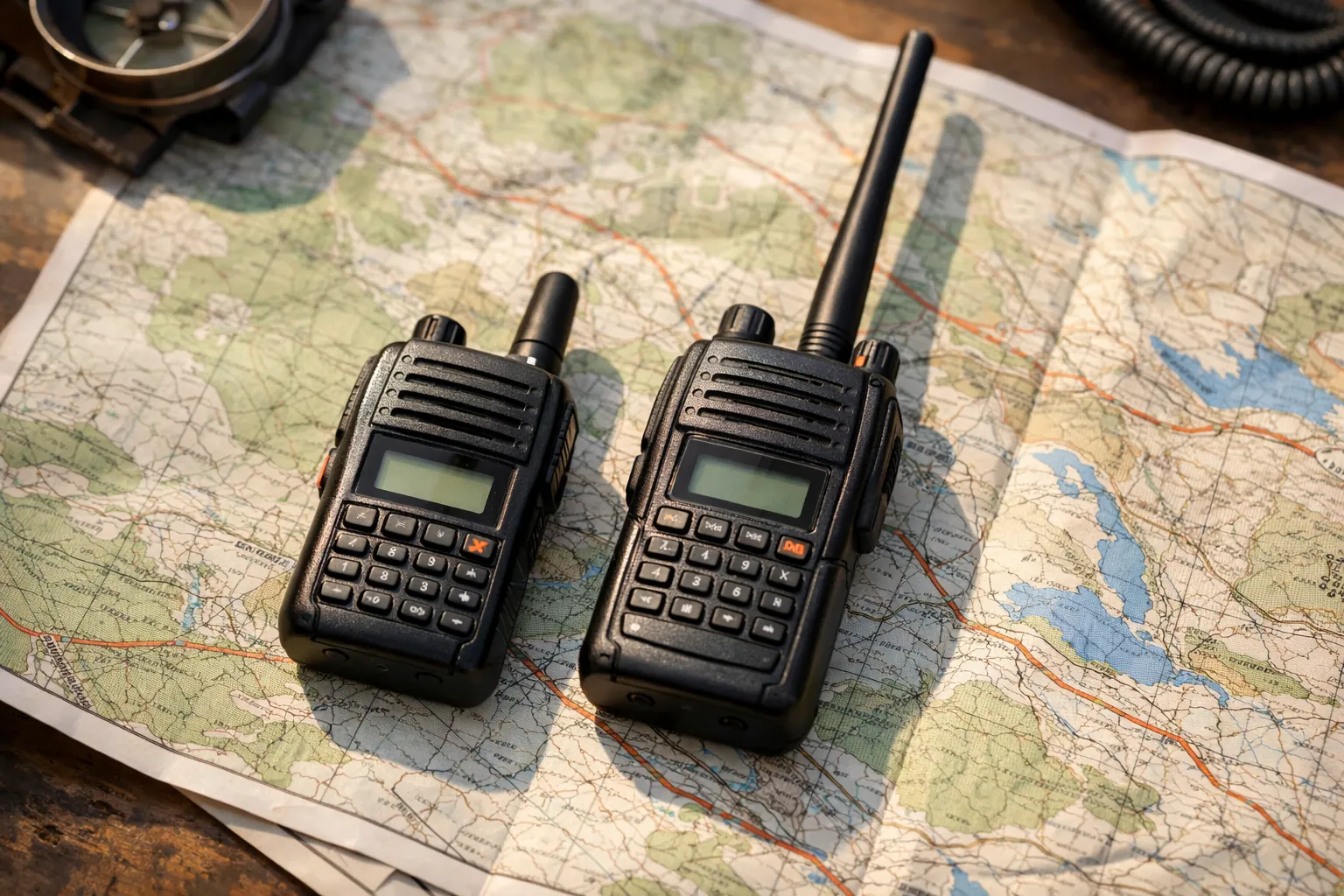
GMRS is UHF. All 30 GMRS channels sit between 462.5500 and 467.7250 MHz (47 CFR 95.1763), inside the UHF range of 300 MHz to 3 GHz as the ITU names the bands (ITU-R V.431). It's FM voice, too: every GMRS radio must be able to transmit F3E or G3E emissions (95.1771).
Where GMRS sits on the dial
The services people compare GMRS with are spread across three bands. This map is to scale only within each block.
| Service | Frequencies | Band | Rule |
|---|---|---|---|
| GMRS | 462.5500-462.7250 and 467.5500-467.7250 MHz | UHF | 95.1763 |
| FRS | Same 22 frequencies as GMRS 1-22 | UHF | 95.563 |
| 70 cm amateur | 420-450 MHz (Americas) | UHF | 97.301 |
| 2 m amateur | 144-148 MHz (Americas) | VHF | 97.301 |
| MURS | 151.820, 151.880, 151.940, 154.570, 154.600 MHz | VHF | 95.2763 |
| CB | 26.965-27.405 MHz | HF | 95.963 |
The full channel-by-channel list, with power limits, is on our GMRS channels and frequencies page.
What being UHF means in practice
Short antennas
Wavelength is the speed of light divided by frequency. At 462.6 MHz that's about 0.65 m, so a quarter-wave antenna is about 16 cm (6.4 inches). That's why GMRS handhelds have short antennas and a GMRS roof whip is far shorter than a CB whip, which works at 27 MHz and a wavelength of about 11 m.
Line of sight
UHF travels in close to straight lines. It doesn't follow the ground over hills the way HF can, so the earth's curve and anything in between set the limit. Two handhelds held at about 5 ft have a theoretical line-of-sight limit of about 6.3 miles over flat, open ground. Raise one antenna and that number grows fast. Our GMRS range calculator does the math for your antenna heights, and how far GMRS reaches explains what cuts real range below the theoretical figure.

Buildings vs open country
UHF's short wavelength gets through doorways, windows and gaps between buildings better than VHF, which is one reason business radios in warehouses and hotels are often UHF. Over open, rolling country, VHF's longer wavelength tends to carry a little farther for the same setup. In dense, wet forest, both lose signal. The honest summary: the band matters less than the antenna height and what's between you.

FM, with 20 or 12.5 kHz channels
GMRS voice is FM. The authorized bandwidth is 20 kHz on the main channels and the 462 MHz interstitial channels, and 12.5 kHz on the 467 MHz interstitial channels 8 to 14 (95.1773). CB radios must transmit AM or single sideband, with FM only an optional extra (95.971), and they sit on 27 MHz anyway, so CB and GMRS radios never hear each other.
Analog voice, with a little data
GMRS isn't a digital voice service. The emission list in 95.1771(b) is analog voice plus a few data types, and the data side is narrow: handhelds may send short location messages or brief texts to another GMRS or FRS unit, with each burst capped at one second and no more than one every 30 seconds (95.1787). That's how GPS-sharing GMRS handhelds stay legal. Digital voice modes like DMR belong to ham and business radio, not GMRS.
GMRS and the 70 cm ham band
The 70 cm amateur band in the Americas is 420 to 450 MHz (97.301(a)). GMRS starts at 462.55, about 12 MHz higher. That's close enough that many dual-band ham radios can tune GMRS frequencies, which is the root of a lot of confusion.
Being able to tune a frequency isn't the same as being allowed to transmit on it. A GMRS transmitter must be certified for GMRS, and the FCC won't certify one that can also operate in the amateur service (95.1761(c)). Using a transmitter that isn't certified for the service voids your authority to operate (95.335). So a 70 cm ham radio can listen to GMRS, but it isn't a legal GMRS radio. Details in can I use GMRS with a ham license.
Why a VHF radio can't join a GMRS group
A 2 m ham handheld works around 144 to 148 MHz. A MURS radio works on five channels near 152 and 154 MHz (95.2763). Neither can reach 462 MHz, and even a radio that could would still need GMRS certification to transmit there. If your group is mixed, the fix is to standardize on one service. For most families and trail groups that's GMRS, which also talks to license-free FRS radios on the shared channels.
Which should you use?
If you want to talk with family, friends or a trail group without studying for an exam, GMRS on UHF is the practical choice: a $35 license (47 CFR 1.1102; the FCC fee page lists no separate regulatory fee), no test, and compatibility with FRS. If you want VHF and UHF, repeaters across the country and much more freedom to experiment, that's amateur radio, which needs an exam. Our GMRS vs FRS vs CB vs ham comparison lays out all four side by side.
Sources: 47 CFR 95.1763, 95.1771, 95.1773, 95.1761, 95.335, 95.563, 95.963, 95.2763, 97.301 (eCFR, up to date as of October 1, 2026); ITU-R V.431 (band names). Rules checked: October 3, 2026. How we research · Affiliate disclosure