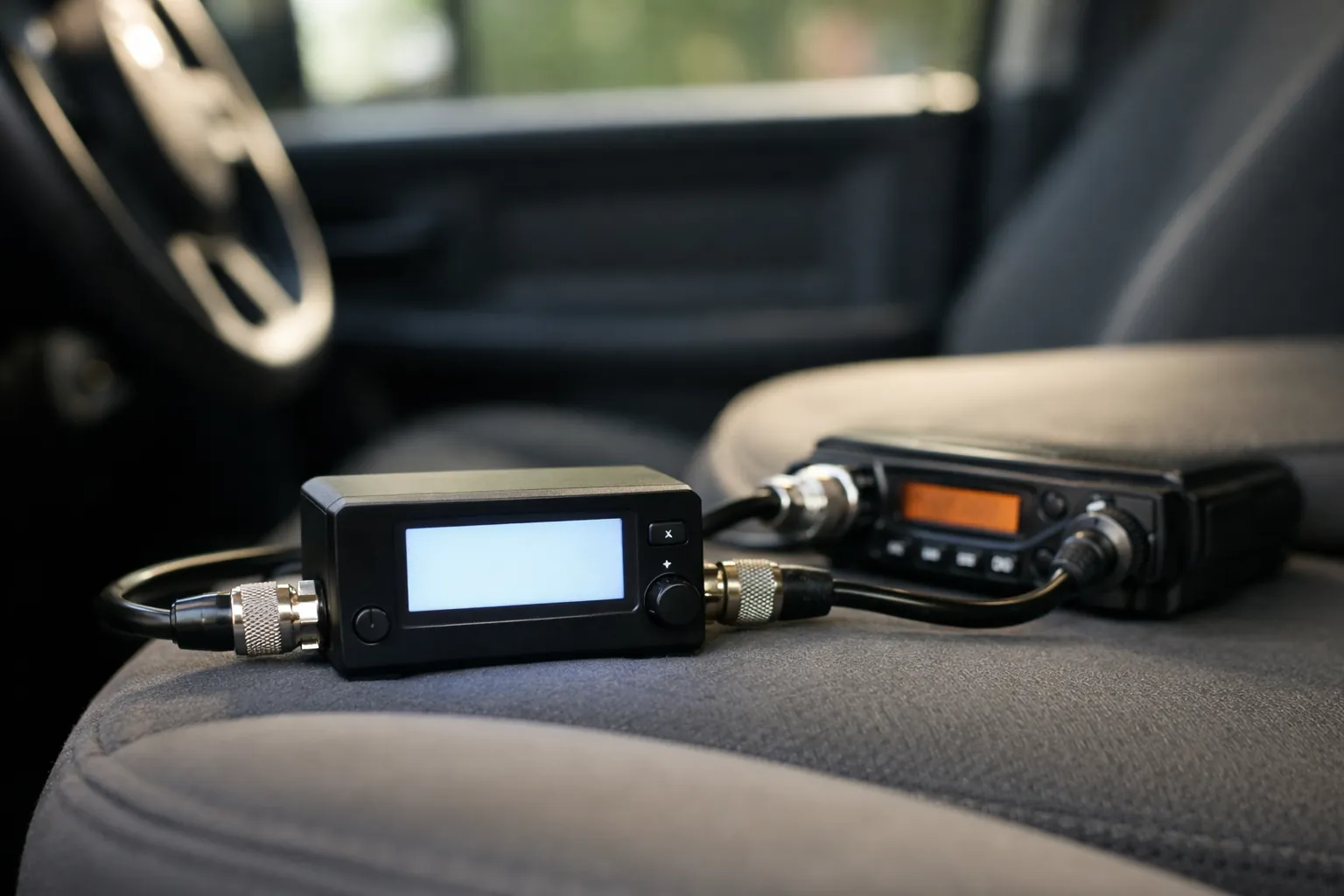
Put a VHF/UHF SWR meter between the radio and the antenna with a short jumper, key up briefly on low power on a 462 MHz channel, and read the SWR. Under 1.5:1 is a good install. The most common mistake comes first: the best-selling SWR meters on Amazon are CB meters, and they can't read GMRS at all.
What SWR tells you
SWR (standing wave ratio) compares the power going up the coax with the power bouncing back from the antenna. A perfect match is 1:1. The table turns the ratio into something easier to picture: the share of your transmitter's power that comes back down the cable instead of leaving the antenna. It's the standard reflection formula, ((SWR−1)/(SWR+1))².
| SWR | Power reflected | What to do |
|---|---|---|
| 1.0 to 1.5:1 | 0% to 4% | Done. Don't chase a perfect 1:1. |
| 1.5 to 2:1 | 4% to 11% | Usable. Check the ground and coax when you get a chance. |
| 2 to 3:1 | 11% to 25% | Find the cause before regular use. |
| Above 3:1 | 25% or more | Stop transmitting on high power. Something is wrong. |
The thresholds in the last column are common practice among radio installers, not FCC rules.
A 2:1 reading costs you about 11% of your power, which is less than half a decibel. You won't hear the difference. What matters is what a high reading points to: a loose ground, a crushed cable or water in a connector, which tend to get worse until something fails on the trail.
Pick a meter that reads 462 MHz
We sorted Amazon's SWR meter results on October 3, 2026. The best seller, the Surecom SW-111 at about 300 a month, is a CB meter. Its own listing gives 26.965-27.405 MHz and says it isn't for VHF/UHF. GMRS lives at 462-467 MHz (47 CFR 95.1763), so it's useless here. (Tuning a CB antenna instead? That's the job it's built for, and the steps differ; see how to tune a CB antenna.) These read the right band:
| Tool | Range | Good for |
|---|---|---|
| Surecom SW-102 | 125-525 MHz | Mobile installs; N-type ports with two N-to-SO239 adapters included; 0.3 dB or less insertion loss, so it can stay inline |
| Surecom SW-33 Plus | 125-525 MHz, to 100 W | Small and cheap; handheld or mobile checks |
| LATNEX PM-120W | 125-525 MHz, to 120 W | Adds a frequency counter; SO239 ports, rechargeable |
| NanoVNA-H4 analyzer | 9 kHz-1.5 GHz | Seeing the SWR curve across the band without transmitting |
The SW-102 is the one we'd hand most people: 2,213 Amazon ratings, about 200 sold a month, and it shows forward and reflected power plus SWR without calibration. One honest caveat from Surecom's own listing: it's most accurate in the 144-148 and 430-450 MHz ham bands. At 462 MHz it still reads, and for a go/no-go install check that's fine. Both Surecom listings say the meters don't support digital (DMR) radios, which doesn't matter for analog GMRS.
You also need a short PL-259 to PL-259 jumper, like this 2 ft RG8x two-pack, to go from the radio to the meter.
Step by step: checking a mobile GMRS antenna
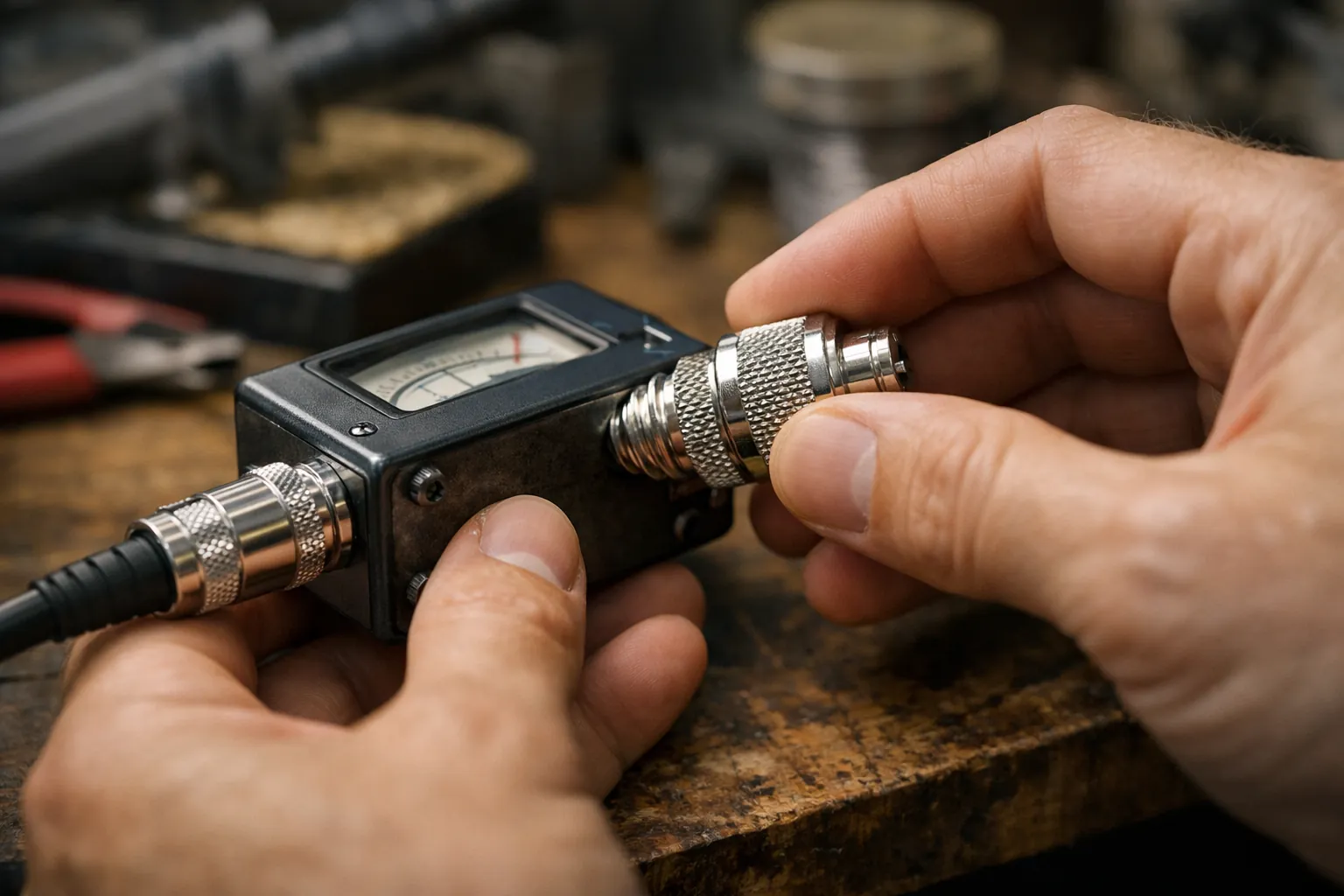
- Park in the open, away from buildings and other vehicles, with all doors closed. Nearby metal changes the reading.
- Hook up: radio antenna jack → short jumper → meter TX (or "transmitter") port. The vehicle's antenna coax goes to the meter's ANT port. Never key the radio with nothing connected to the ANT side.
- Set the radio to low power and pick a quiet main channel. Channel 20 (462.675 MHz) sits in the middle of the 462 MHz main channels. Listen first so you don't step on anyone.
- Key up for two or three seconds and read SWR. The FCC allows brief test transmissions on GMRS (95.1731(b)(3), 95.319(c)) as long as they don't interfere with anyone. Say your call sign when you're done (95.1751).
- Check a channel at the edge. Try channel 15 (462.550) and channel 22 (462.725). The three readings should be close.
- If you use repeaters, check a repeater input. Repeater channels transmit on 467.550-467.725 MHz, 5 MHz above the output. Mobiles may only transmit there through a repeater or for brief tests (95.1763(c)), so one short key-up on a repeater channel is fine.
- Repeat on high power once low power looks good, and note your forward power. On a 15 W MicroMobile you should see close to 15 W on the main channels.
Note that your radio may show less power on channels 1-7. Those 462 MHz interstitial channels are capped at 5 W ERP (95.1767(b)), and mobile radios can't transmit on 8-14 at all (95.1763(d)), so test on 15-22.
Using a NanoVNA instead
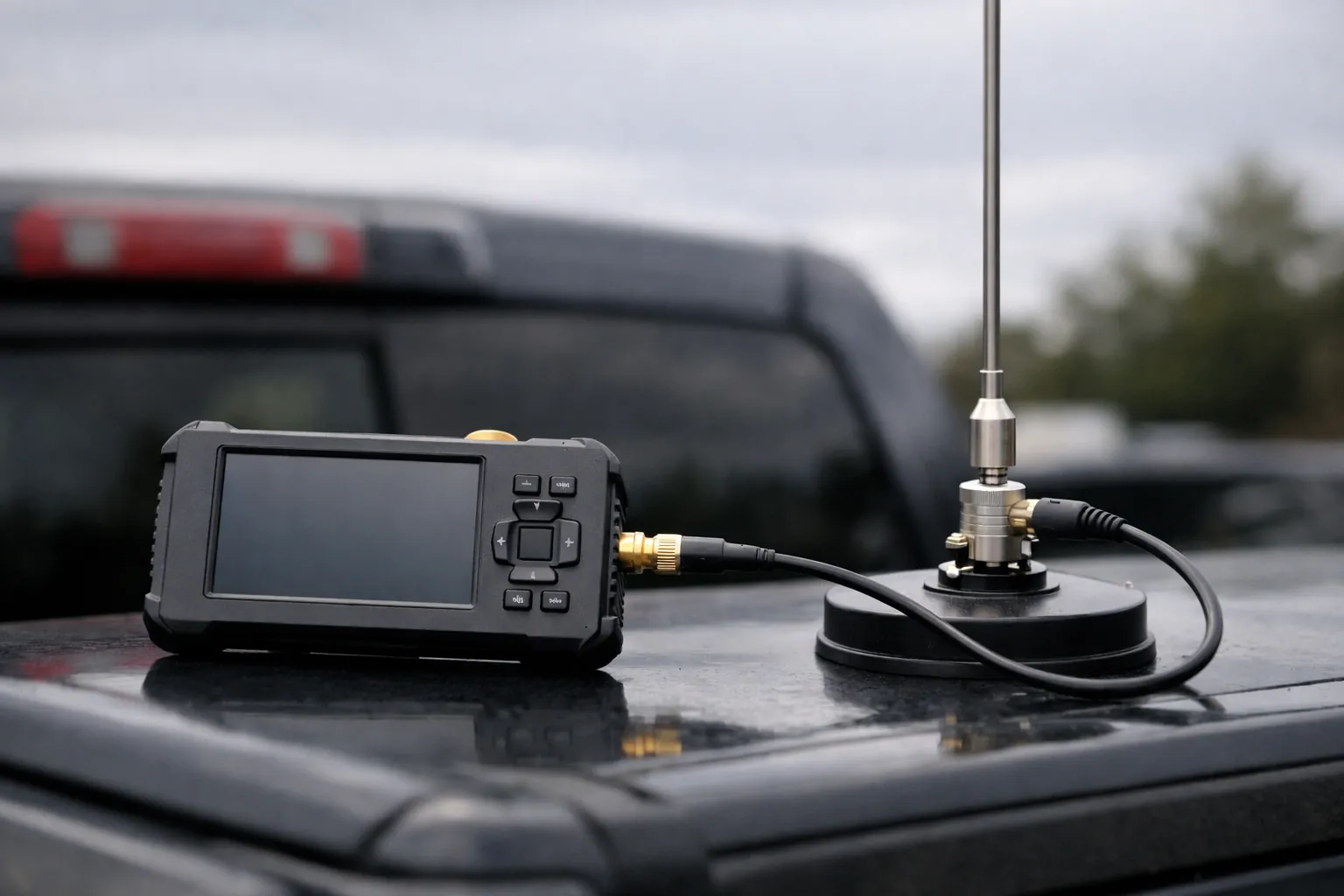
An analyzer sends its own tiny test signal, so the radio isn't involved and nothing goes on the air. Connect it to the antenna coax where the radio would plug in (you'll need an SMA-to-PL-259 adapter), calibrate with the open/short/load set included with the NanoVNA-H4 at the cable end, then sweep about 450 to 475 MHz. You get a curve. The bottom of the dip is where the antenna is tuned. If the dip sits at 440 MHz, the antenna is long or it's a ham antenna; if it's at 490, it's short.
High reading? Fix it in this order
1. The ground under the mount
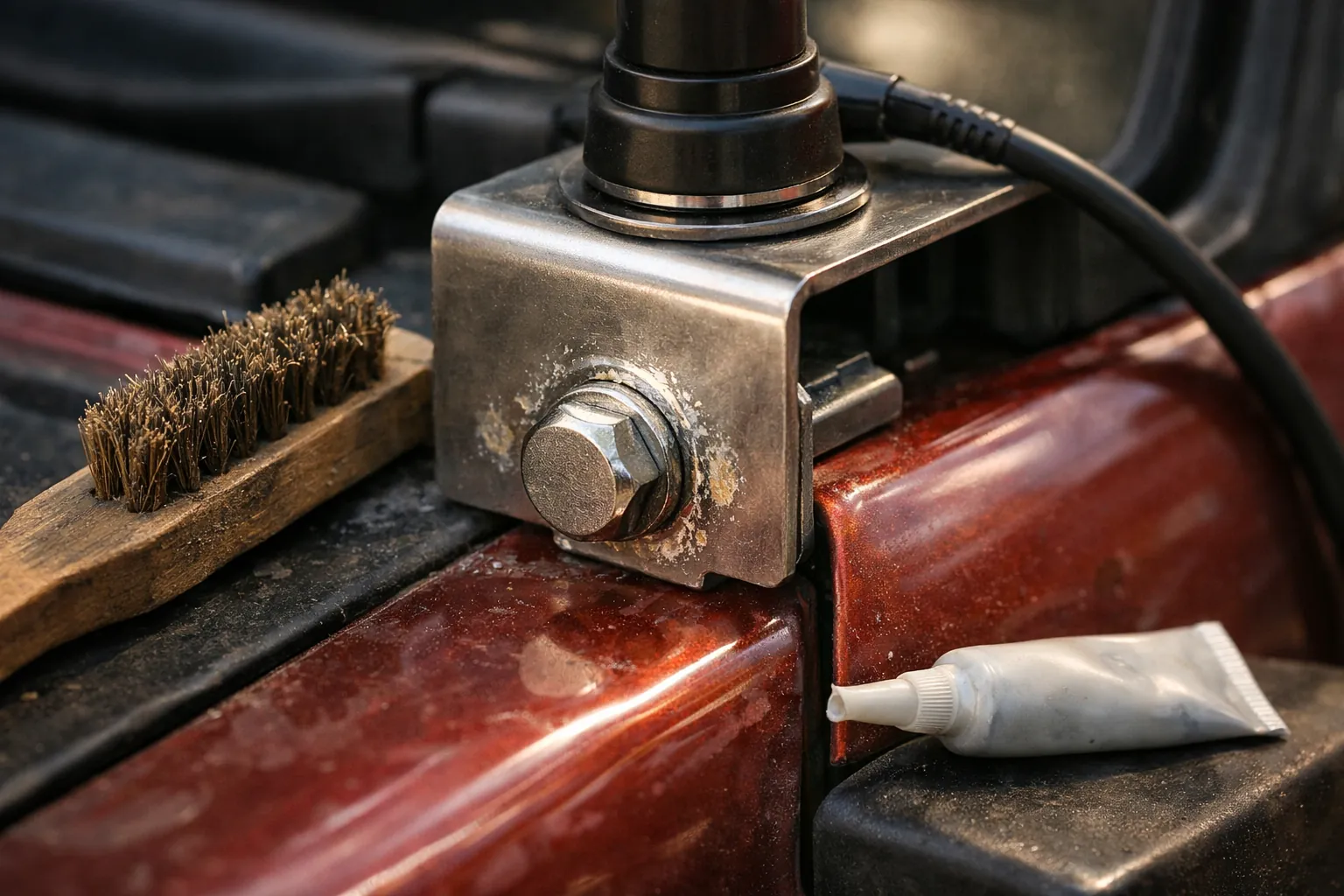
Most vehicle antennas work against the metal under them. A lip or bracket mount that clamps to painted metal can have no real electrical contact. Scrape to bare metal where the mount's set screws or bolts bite, then protect it. Magnet mounts on a steel roof rarely have this problem. On fiberglass or plastic there's no ground plane at all, and the reading shows it. Midland's MXT295 manual says to avoid fiberglass and vinyl mounting surfaces.
2. The coax and connectors
Look for a cable pinched in a door or tailgate, a kink at a sharp bend, and a connector that isn't fully seated. Wiggle the cable while someone watches the meter on a brief transmission; a jumping reading means a bad connection. Water in a connector at the mount is common after a car wash.
3. The antenna itself
Make sure it's actually a GMRS antenna. A dual-band ham antenna tuned for 440 MHz can read poorly at 462-467. Pretuned GMRS antennas (Midland's MXTA25 and MXTA26, the HYS models in our MXT275 antenna upgrade guide) aren't meant to be cut. Only trim an antenna whose maker calls it cut-to-tune and supplies a chart, and trim a little at a time.
4. The mount position
Antennas near the edge of a hood or close to a roof rack crossbar can read higher than the same antenna in the middle of the roof. Moving the mount is the last resort, but sometimes it's the only fix. For a Wrangler, our Jeep GMRS install guide covers the trade-offs of each mount spot.
After the reading is good
A low SWR means the system is healthy. It doesn't mean the antenna is in a good place for range: a perfectly matched antenna on a bumper still sits low. Range depends on height. Plug your antenna heights into the GMRS range calculator to see what moving it up would do, and see the best GMRS antennas if it's time for a better one. Leave the SW-102 inline if you like; Surecom lists its insertion loss at 0.3 dB or less.
Meter specs come from each Amazon listing, checked October 3, 2026. Rules: 47 CFR 95.319, 95.1731, 95.1751, 95.1763, 95.1767, eCFR current as of October 1, 2026. Rules checked: October 3, 2026. How we research · Affiliate disclosure