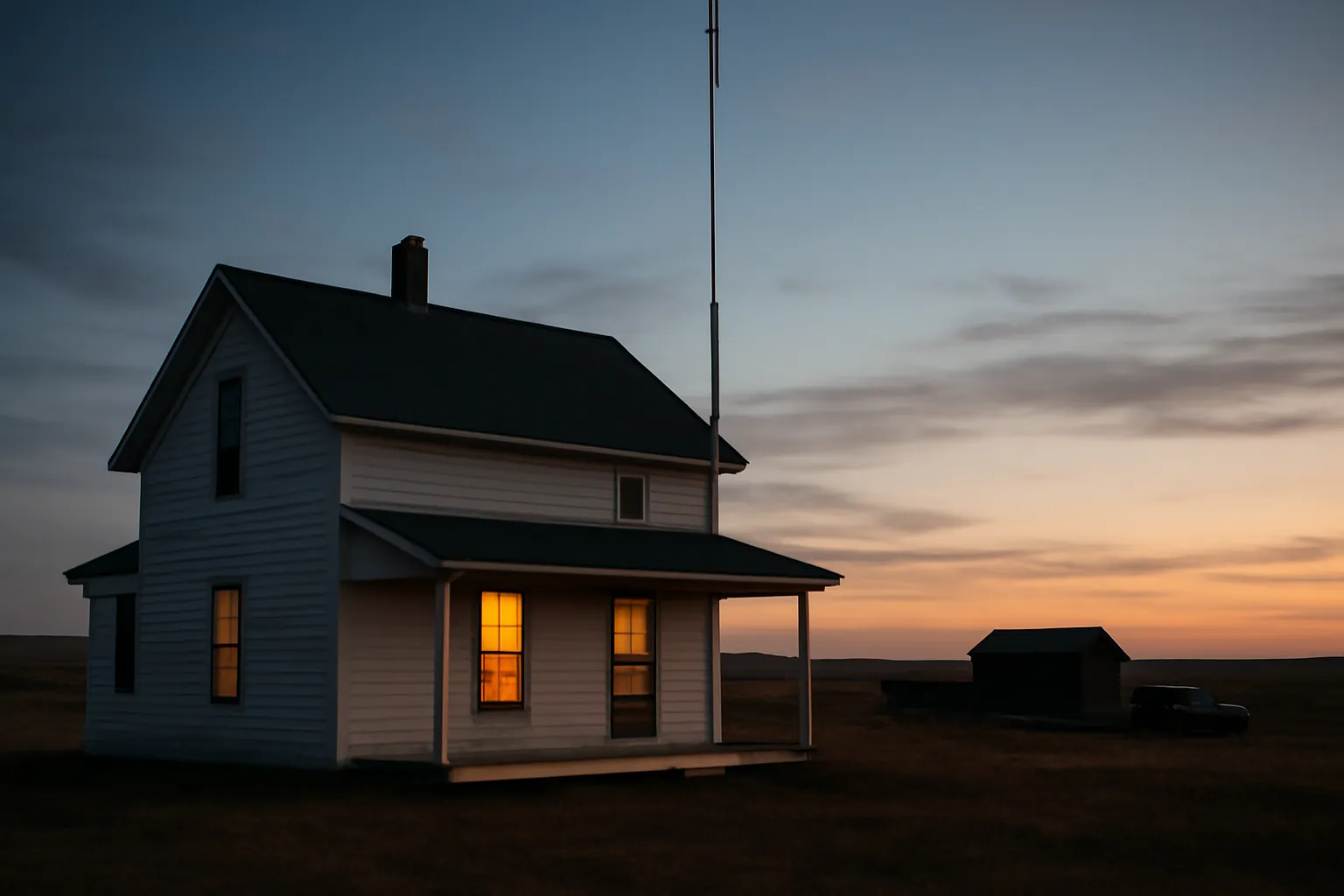
The best CB base station for most homes is a Cobra 29 LTD Classic on a small regulated 13.8-volt supply, feeding a Solarcon A-99 on a mast through RG-8X coax, with a grounded lightning arrestor where the cable enters the house. Want sideband for distance? Swap the radio for a Uniden Bearcat 980. Want a radio that plugs straight into the wall? The Galaxy DX-2547 is the AC-powered base still sold on Amazon.
The radio is the easy part. Every legal CB puts out the same 4 watts on AM, so the height and quality of the antenna decide how far the station reaches.
Quick picks
| Best radio for a home base | Cobra 29 LTD Classic | Amazon |
|---|---|---|
| Best for sideband | Uniden Bearcat 980 SSB | Amazon |
| Best true AC base | Galaxy DX-2547 | Amazon |
| Best base antenna | Solarcon A-99 | Amazon |
| Most gain | Solarcon IMAX-2000 | Amazon |
| Best for attics and small lots | Tram 3-ft no-ground mini base | Amazon |
| Best power supply for a CB base | Pyramid PS9KX | Amazon |
How we picked
We pulled Amazon's results for "cb radio base station" and "cb base station antenna" on Oct 21, 2026, and the full listing for each contender. The Cobra 29 LTD Classic led everything at 1,000+ bought last month. Among base antennas, the Solarcon A-99 had the deepest history, with 668 ratings and 50+ bought last month. Then we read the base station section of Cobra's 29 LTD Classic AM/FM owner's manual, Cobra's support article on setting up a base CB, and the CB rules in 47 CFR Part 95 Subpart D, checked on eCFR the same day.
"How we pick" means listings, manuals and the FCC rules, not a test install. How we research.
Two ways to build it
Cobra's support article puts the choice plainly: a true base CB is a tabletop radio with its own power supply that plugs into the wall, and the alternative is a mobile CB on a DC power supply. Cobra adds that it no longer makes a base station CB. National Communications Magazine reported in 2023 that only one FCC type-accepted CB base station was still being sold in the US. So for most people, "base station" means a mobile radio on a desk.
| Setup | What you buy | Good | Catch |
|---|---|---|---|
| Mobile CB on a desk | Mobile radio + 13.8 V supply + base antenna | Cheapest; same radio can go back in the truck; huge choice of radios | One more box on the desk |
| True AC base | Base radio + base antenna | Plugs into the wall; desk-style controls and meters | Few models; costs more than a mobile plus a supply |
| Indoor or attic only | Mobile radio + supply + no-ground mini antenna | No mast, no roof work | The house blocks signal; expect a fraction of the range |
The whole station, part by part
- A 40-channel CB radio (mobile or AC base).
- A regulated 13.8-volt DC supply, if the radio is a mobile.
- A base antenna on a mast, roof bracket or tower.
- Coax from antenna to radio, as short as the route allows.
- A lightning arrestor and a ground connection where the coax enters the building.
The best radios for a CB base station
Cobra 29 LTD Classic
The best-selling CB on Amazon (1,000+ last month) is also the easiest to set up at home, because Cobra wrote the base instructions into its manual: a 13.8-volt power pack rated for at least 2 amps, red lead to positive, black to negative, and a properly installed base antenna. The built-in SWR calibration means you can check a new base antenna without buying a separate meter, and the 9-foot mic cord lets the radio sit on a shelf instead of in front of you. Our best CB radio guide has the full spec comparison.
- Channels40
- ModesAM/FM
- Power4 W
- Input13.8 V DC
- SWRcalibration with warning light
- Mic cord9 ft
Why it stands out
- Base setup spelled out in the manual
- SWR check built in
- AM and FM
Think twice if
- You want sideband for long-distance contacts
Uniden Bearcat 980 SSB
Single sideband runs up to 12 watts PEP under 95.967, three times the AM limit, and it packs that power into a narrower signal. At a base station with a tall antenna, that's how you reach other SSB stations well past local AM range. The 980 adds NOAA weather channels, which earn their place on a desk at home, and it has 3,200 ratings. The person on the other end needs SSB too.
- Channels40 AM + SSB
- WeatherNOAA
- SWRintegrated
- Micnoise-canceling
- Display7-color backlight
Why it stands out
- AM plus 12 W PEP sideband
- NOAA weather
- Integrated SWR
Think twice if
- You only talk to trucks on channel 19; AM does that for less
Galaxy DX-2547
If you'd rather not run a separate supply, this is the radio that plugs straight into the wall: a 40-channel AM/SSB base with a frequency display, an automatic SWR meter and talk-back so you can hear your own audio. It's a desk radio in the old style, at 10.7 pounds. It costs more than a Cobra 29 and a power supply together, so buy it for the convenience and the panel, not for range. Same 4 watts AM and 12 watts PEP as any legal CB. The listing has a switchable roger beep; we'd leave it off (see 95.933 on sound effects).
- Channels40
- ModesAM/SSB
- Power120 V AC
- SWRautomatic, no calibration
- Controlsmic gain, RF gain, variable RF output, talk-back
- Displayfrequency
Why it stands out
- Runs on 120 V AC, no supply needed
- AM and SSB
- Automatic SWR and frequency display
Think twice if
- You might want the radio in the truck someday
- You're on a budget
Base antennas worth the mast
Solarcon A-99
The A-99 is the base antenna CB operators name most often (it comes up by name in WorldwideDX's thread on members' base stations), and its numbers explain why: 17 feet, half-wave, in three sections that one person can assemble, and DC grounded. At 17 feet on top of a short mast at a one-story house, the tip lands comfortably inside the FCC height limit. The listing's 2,000-watt handling is irrelevant to a legal CB (you're sending it 4 watts); what matters is that the length is right for 11 meters and it tunes with SWR.
- Type1/2-wave vertical
- Length17 ft, three sections
- GroundingDC grounded
- TuningSWR adjustable
- Impedance50 ohms
Why it stands out
- Half-wave, so it doesn't need radials to work
- DC grounded
- 668 ratings, 50+ bought last month
Think twice if
- You can't put up a 17-foot pole; see the Tram below
Solarcon IMAX-2000
Seven more feet than the A-99 and a 5/8-wave design, which Solarcon lists at 5.1 dBi of gain. That gain comes from squeezing more of the signal toward the horizon, which is where the trucks and other bases are. The trade is a 24-foot pole that needs a stout mast and guying in wind. Solarcon now packages it as the MAX-2000; it's the same antenna.
- Type5/8-wave vertical
- Length24 ft, three 8-ft sections
- Gain5.1 dBi
- Bandwidthcovers above and below the CB channels
- TuningSWR adjustable
Why it stands out
- 5.1 dBi listed gain
- Broad bandwidth across all 40 channels
Think twice if
- Your mast is light or your roof is high; 24 feet adds up fast against the height rule
Want a ground-plane design instead of a half-wave vertical? The Sirio GPE 27 5/8 tunes from 26.4 to 29.0 MHz by adjusting the whip length, is DC grounded, and is rated 250 watts continuous, which is far beyond any legal CB.
Tram 3-ft no-ground mini base
For an apartment balcony, an attic or an HOA street where a 17-foot pole would start a war. Tram builds it to work without a ground plane, so it doesn't need a car roof or radials under it, and it mounts on a mast or in an attic with the included bracket. Cobra's support article suggests exactly this kind of antenna, at least 3 feet tall, when a full base antenna won't fit. Expect far less range than an A-99 on a mast, especially indoors.
- Height3 ft
- Range26-30 MHz
- Ground planenot needed
- ConnectorSO-239
- Mountbracket with stainless hardware
- Coaxnot included
Why it stands out
- No ground plane needed
- Mounts almost anywhere
- 758 ratings
Think twice if
- You have room for a real base antenna; height wins
The FCC antenna height rule, drawn
CB is one of the few personal radio services with its own antenna height cap. Under 47 CFR 95.941, the transmitting antenna may not be higher than 60 feet above the ground, or 20 feet higher than the top of the building or tree it's mounted on, whichever is higher. Near an airport, 95.317 can impose a lower limit. (GMRS has no equivalent section, which is why our GMRS base station guide says something different.)
In practice: a 17-foot A-99 on a 20-foot mast beside a one-story house tops out around 37 feet, well inside the rule. The rule bites with towers. A 50-foot tower plus a 24-foot IMAX-2000 puts the tip at 74 feet, which is over the line unless the tower is on a structure that lifts the "20 feet above" limit.
How far a CB base station reaches
For a direct path, height sets the ceiling. The radio horizon in miles is about 1.41 times the square root of the antenna height in feet, and two stations' horizons add. These are smooth-earth ceilings for the tip of the base antenna:
| Base antenna tip height | To a truck antenna (8 ft) | To a handheld (5 ft) | To another base (30 ft) |
|---|---|---|---|
| 20 ft | 10.3 mi | 9.5 mi | 14.0 mi |
| 30 ft | 11.7 mi | 10.9 mi | 15.4 mi |
| 40 ft | 12.9 mi | 12.1 mi | 16.6 mi |
| 60 ft (the usual legal max) | 14.9 mi | 14.1 mi | 18.6 mi |
Hills, trees and a noisy neighborhood cut into all of these, and a truck's 4 watts coming back to you is the weak half of the conversation. Skip is the wild card: some days 11 meters carries signals hundreds of miles, and other days it doesn't. Our CB radio range guide explains both, and the range calculator runs the same horizon math for your own heights.
Coax, arrestor and grounding
At 27 MHz, coax loss is much less of a worry than it is at GMRS frequencies, so RG-8X is the usual choice for a base run. The Steren RG-8X 50-foot cable comes with molded PL-259s and has 2,356 ratings; buy the shortest length that reaches without strain, and leave a drip loop below the entry point so water runs off before the wall.
Where the coax enters the house, put in a lightning arrestor and bond it to a ground rod. The Workman A28 has PL-259 fittings on both ends and a ground screw on the side, with 1,431 ratings. An arrestor helps with static and nearby surges; it won't save a station from a direct strike, so disconnect the coax from the radio when storms are close. Bond the mast and the arrestor ground to your home's electrical ground as your local code requires; in the US that's the National Electrical Code's Article 810 for antenna systems. If that's outside your comfort zone, it's a short job for an electrician.
Keep the mast well clear of power lines on every side, including when it's lying on the ground before you raise it.
Power for a mobile CB at home
Pyramid PS9KX
A CB needs very little current. Cobra's manual lists the 29 LTD Classic at 1.5 amps maximum on AM transmit, and the manual asks for a 2-amp supply. The PS9KX gives 5 amps continuous and 7 surge from a linear regulated design, the kind that adds no switching hash to the band. It has 2,261 ratings and screw terminals for the radio's leads.
- Typelinear, regulated
- Output13.8 V DC
- Current5 A continuous, 7 A surge
- Protectionoverload and short circuit, fused
- Terminalsscrew-type
Why it stands out
- Linear: quiet on HF
- Plenty for any 4 W CB
- Short-circuit protected
Think twice if
- You'll also run a 50 W GMRS or ham mobile from the same supply
Sizing a supply for bigger radios, the linear-vs-switching trade and how to fuse the leads are covered in our ham radio power supply guide. If you want the station to keep working through an outage, a battery setup like the ones in our ham radio go box guide runs a CB for a long time on very little.
Setup checklist
- Choose the antenna spot first: as high as the 95.941 limit and your mast allow, clear of power lines, with the shortest coax route to the radio.
- Assemble and raise the antenna, then run the coax with a drip loop and the arrestor at the entry point, grounded.
- Connect the radio to the supply (red to positive, black to negative) with the supply switched off. Never plug a mobile CB into 120 V directly; Cobra's manual warns against it.
- Check SWR on channels 1 and 40 and adjust the antenna until both are low and close together. How to tune a CB antenna has the step-by-step.
- Set squelch and RF gain for your local noise; how to adjust a CB radio goes knob by knob.
- Keep to the CB rules: no amplifier (95.939), channel 9 for emergencies and traveler help only (95.931). No license is needed (95.305).
A desk station is also where a better mic and a proper speaker pay off; see our CB microphone and CB external speaker picks. If you're deciding between CB and GMRS for the house, our GMRS base station guide covers the other side, and the antenna picks for the truck end of the conversation are in best CB antenna for a truck.
The short version
Buy the Cobra 29 LTD Classic, a Pyramid PS9KX and a Solarcon A-99, then put the A-99 as high as the rule and your mast allow. Every dollar spent on height does more than a dollar spent on the radio.
Sources: Amazon listings and search results (checked Oct 21, 2026); Cobra 29 LTD Classic AM/FM owner's manual (base station operation and specifications); Cobra support, "Setting up a base station CB"; National Communications Magazine, May 23, 2023; eCFR 47 CFR Part 95 (up to date as of Oct 19, 2026): 95.941 · 95.939 · 95.967 · 95.317 · 95.305 · 95.931 · 95.933. Range figures are line-of-sight calculations, not measurements. How we research · Affiliate disclosure