Most radio talk needs only a few words: "over" when it's the other person's turn, "out" when you're done, "copy" or "roger" for "I heard you," and "say again" when you didn't. Add 10-4 (understood) and "what's your 20?" (where are you?) and you can follow most walkie-talkie and CB conversations.
Below are the prowords, the 10-codes that are still common, the CB slang you'll hear on channel 19, and what the FCC rules say about using codes on each kind of radio.
The essential prowords
These come from military and aviation voice procedure, and they work on any radio because each one is short and hard to mishear.
| Say | Meaning | Example |
|---|---|---|
| Over | I'm done talking; your turn | "Are you at the trailhead? Over." |
| Out | Conversation finished; no reply needed | "See you at camp. Out." |
| Copy | I heard and understood | "Copy, heading back now." |
| Roger | Message received | "Roger, two more miles." |
| Wilco | Will comply (includes roger) | "Wilco, meeting you at the gate." |
| Affirmative / negative | Yes / no, harder to mishear than the short words | "Negative, we haven't seen them." |
| Say again | Repeat that | "You broke up. Say again." |
| Stand by | Wait; I'll come back to you | "Stand by, checking the map." |
| Go ahead | I'm listening, talk | "Dad, go ahead." |
| Break | Interrupting, usually to start a new call | "Break, this is Sam calling Jo." |
| Radio check | How do I sound? | "Radio check." "Loud and clear." |
A few habits matter more than vocabulary. Say who you're calling, then who you are ("Mom, this is Ella"). Press the button, pause a beat, then talk, so your first word isn't clipped. Keep it short, because only one person on the channel can talk at a time. Our GMRS radio etiquette guide covers the rest.
The 10-codes people still use
Ten-codes were developed for police radio starting in 1937, credited to Charles Hopper of the Illinois State Police and later standardized by APCO, the public-safety communications association, according to Wikipedia's ten-code history. The "ten" gave early transmitters a moment to come up to power before the important part. Agencies later built their own lists, so beyond the common few, the same code can mean different things in different places.
| Code | Usual meaning | How common |
|---|---|---|
| 10-1 | Receiving poorly | Common |
| 10-2 | Receiving well | Common |
| 10-4 | Message received, understood | Universal |
| 10-6 | Busy, stand by | Common |
| 10-7 | Out of service, off the air | Common |
| 10-8 | Back in service | Common |
| 10-9 | Repeat your message | Common |
| 10-20 | Location ("what's your 20?") | Universal |
| 10-33 | Emergency traffic | Varies |
| 10-36 | Correct time | CB, varies |
Meanings vary by agency and region beyond 10-4 and 10-20. Jokey ones like 10-100 for a restroom break are movie and CB humor, not a standard.
Public safety has been moving the other way. Federal guidance from SAFECOM encourages plain language when agencies work together, because one agency's 10-code is another's nonsense (CISA/SAFECOM Plain Language Guide). For a family or a trail group, that's good advice too: "we're at the waterfall" beats a code someone has to remember.
CB slang you'll hear on channel 19
CB has its own vocabulary, much of it from 1970s truckers. These definitions follow Wikipedia's CB slang list.
| Slang | Meaning |
|---|---|
| Breaker (breaker 1-9) | I want to start a transmission, on channel 19 |
| Handle | Your CB nickname |
| Bear, Smokey | Police officer |
| Bear in the air | Police in an aircraft |
| Plain wrapper | Unmarked police car |
| Kojak with a Kodak | Officer running radar |
| Chicken coop | Weigh station or truck scale house |
| Alligator | Large piece of tire on the road |
| Four-wheeler | Car, van or SUV |
| Bobtail | Semi tractor running without a trailer |
| Reefer | Refrigerated trailer |
| Hammer down | Driving fast, pedal to the floor |
| Double nickel | 55 mph zone |
| Yardstick | Mile marker |
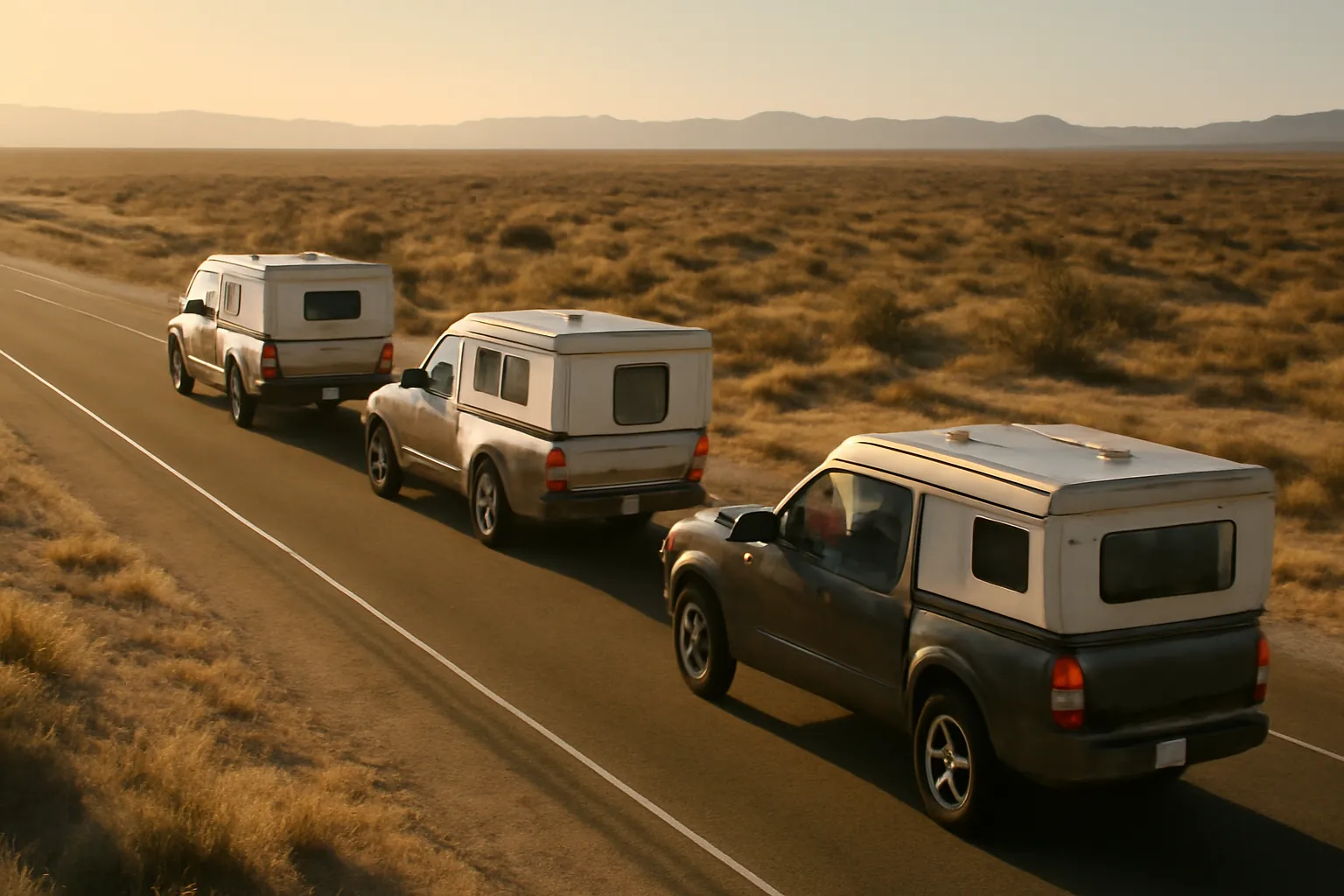
| Front door / back door / rocking chair | Lead vehicle / last vehicle / the ones in between in a convoy |
| Wall to wall and treetop tall | Your signal is strong and clear |
| Good buddy | Friend; a 1970s stereotype now |
The channels themselves are in our CB channel chart. Channel 9 is the exception to the banter: by FCC rule it's for emergencies and traveler assistance only.
The phonetic alphabet
For spelling names and call signs, use the ITU phonetic alphabet, as printed on the ARRL's operating chart: Alfa, Bravo, Charlie, Delta, Echo, Foxtrot, Golf, Hotel, India, Juliet, Kilo, Lima, Mike, November, Oscar, Papa, Quebec, Romeo, Sierra, Tango, Uniform, Victor, Whiskey, X-ray, Yankee, Zulu. Many operators say "niner" for 9 so it isn't mistaken for "five." Ham operators are encouraged to use phonetics when identifying (97.119).
Are codes legal on your radio?
| Service | Codes | Rule |
|---|---|---|
| GMRS | 10-codes are allowed; coded messages and hidden meanings are not | 95.1733 |
| FRS and CB | No specific code rule; the general bans on obscene language and false messages apply | 95.333 |
| Ham radio | No messages encoded to obscure their meaning; hams use plain language and Q-codes | 97.113 |
Hams mostly skip 10-codes and use Q-codes like QTH (location) and QSL (received). Our ham radio Q-codes list covers those. GMRS users also have to say their call sign at the end of a conversation and every 15 minutes, which no code replaces.
A five-word cheat sheet for kids
For a family radio, skip the 10-codes. Teach five words and one rule:
- "Dad, this is Ella" to start: who you want, then who you are.
- "Over" when you want an answer.
- "Copy" when you heard.
- "Say again" when you didn't.
- "Out" when you're done.
The rule: if you're hurt or lost, hold the button, say "help," your name and what you can see, then let go and listen. Write it on a card in the radio pouch, alongside your channel. Our family emergency radio plan builds this into a full plan, and a waterproof card like this GMRS, FRS and MURS reference card keeps channel info with the radio.
What a good exchange sounds like
| Who | Says | Plain English |
|---|---|---|
| Dad | "Ella, this is Dad. What's your 20? Over." | Where are you? |
| Ella | "Dad, Ella. At the bridge with Sam. Over." | We're at the bridge. |
| Dad | "Copy. Stay put, I'm coming to you. Over." | Got it, wait there. |
| Ella | "Wilco. Out." | Will do. Done. |
Rules checked October 13, 2026 in eCFR 47 CFR Parts 95 and 97: 95.1733 · 95.333 · 97.113. History and slang: Wikipedia's Ten-code and CB slang articles; SAFECOM Plain Language Guide. How we research · Affiliate disclosure