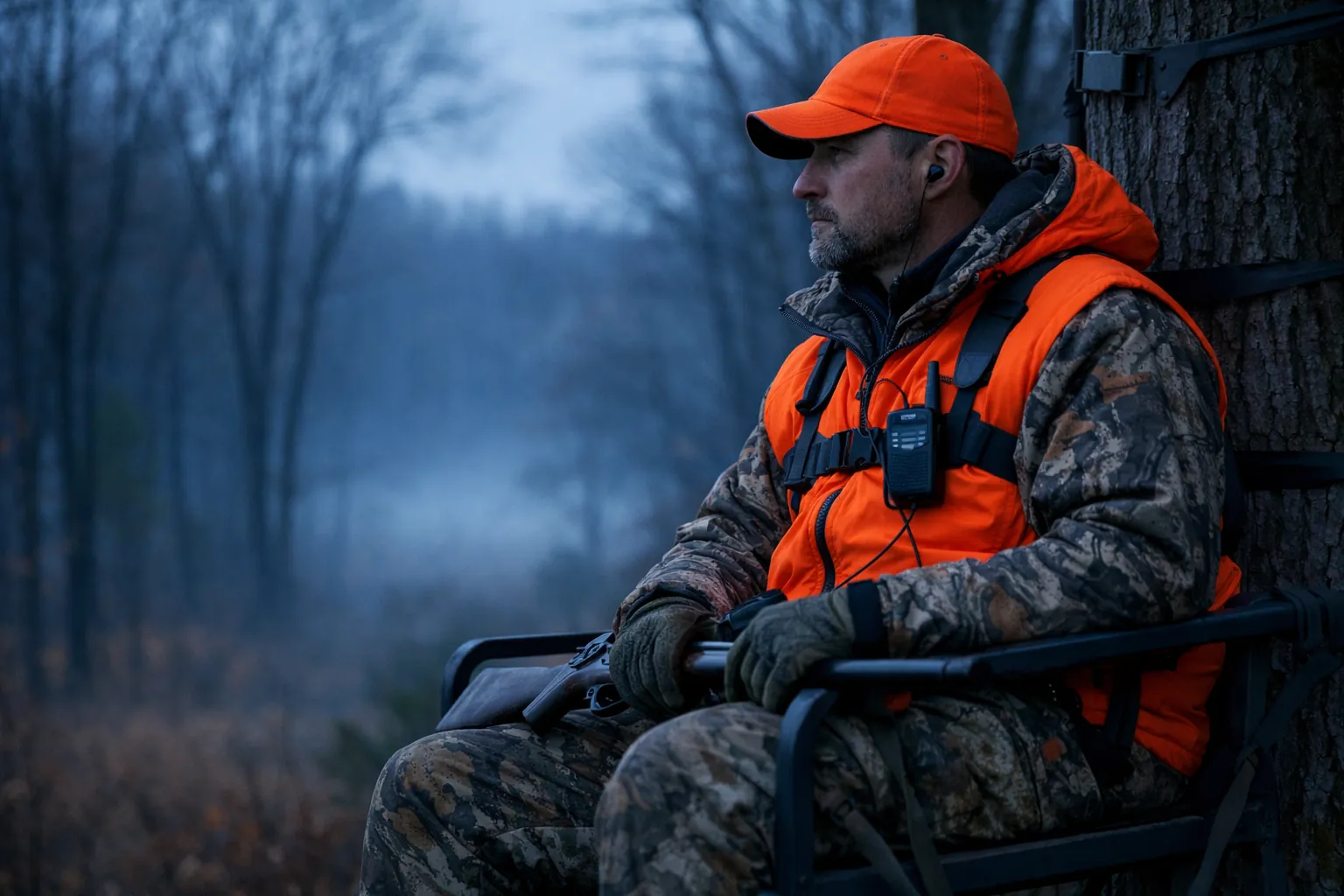
Most deer hunters should buy the Midland GXT1050VP4: a camo GMRS two-pack with vibrate alerts, headsets and AA backup power. Hunt wet or cold backcountry? Get the waterproof 5-watt Midland GXT67 PRO instead. Whatever you pick, plan on a mile or two between handhelds in timber, not the 36 miles on the box.
Quick picks
| Best for most deer hunters | Midland GXT1050VP4 (camo 2-pack) | Amazon |
|---|---|---|
| Best value for a whole group | Midland GXT1000VP4 (2-pack) | Amazon |
| Best for backcountry and bad weather | Midland GXT67 PRO | Amazon |
| Best for repeater country | Midland GXT3000 (2-pack) | Amazon |
| Best battery life in the cold | Rocky Talkie Expedition (2-pack) | Amazon |
| Best for partners who split up | BTECH GMRS-PRO | Amazon |
How we picked these radios
We started from Amazon's GMRS and hunting-radio results on October 3, 2026 and kept radios people actually buy. The Midland GXT1000VP4 showed 1,000 purchases in the past month with more than 13,000 ratings, and the camo GXT1050VP4 300 a month with 3,600 ratings. Then we sorted them by how hunters use radios, because a tree-stand radio and an elk-camp radio fail in different ways.
Every radio here is GMRS. We confirmed that from the listing, and for the Midland GXT1050, GXT67 and GXT3000 families from the FCC equipment grants, which list Part 95E (GMRS) certification. Every feature comes from the maker's Amazon listing. We didn't take these radios to the woods, so there are no range test results here: the honest range answer is in the GMRS range calculator.
Method: How we pick. Sales and ratings plus listing specs, checked October 3, 2026; FCC grants checked the same day. How we research.
Which radio fits how you hunt
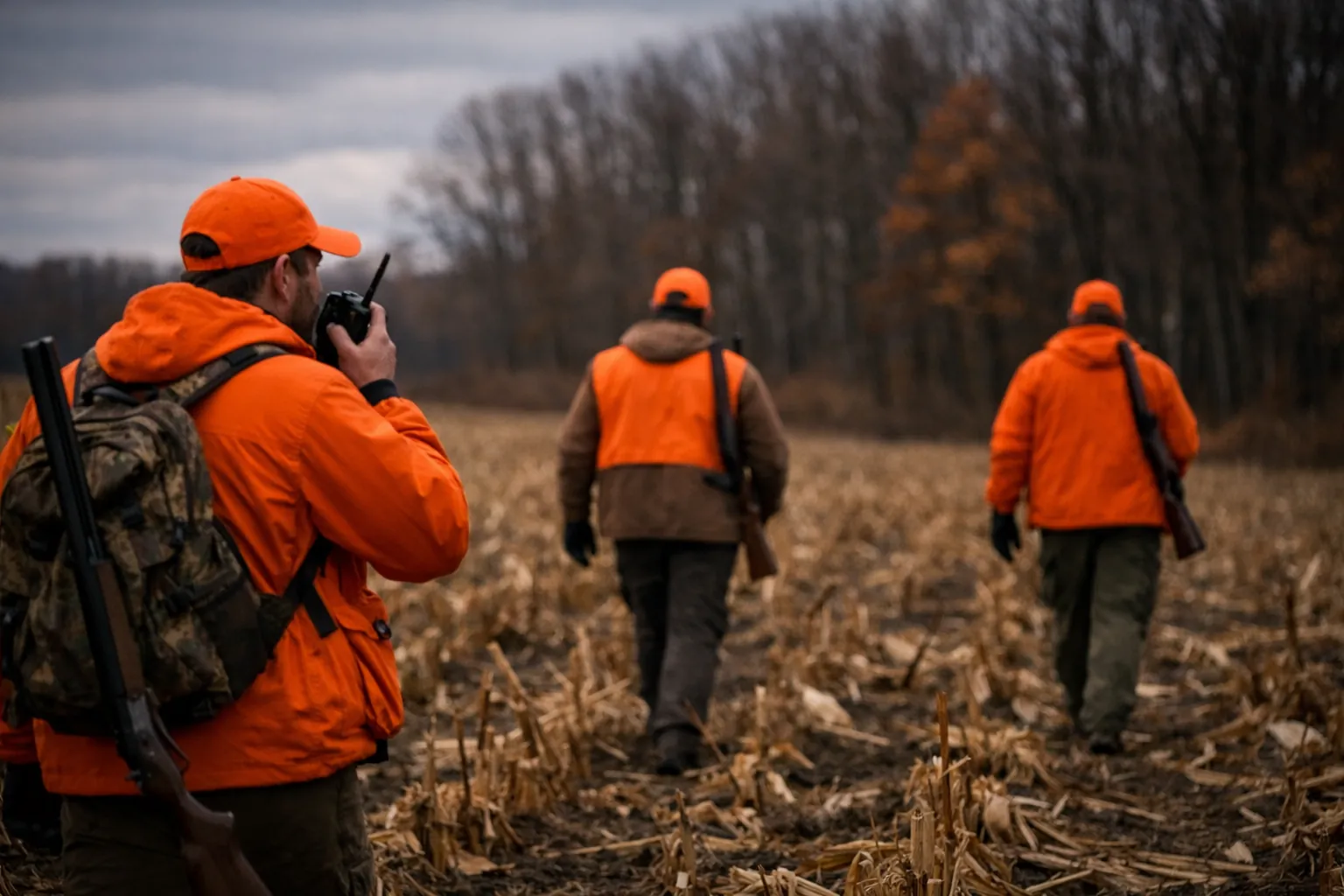
A tree stand and an elk camp ask different things of a radio. This table is the short version of the whole page.
| How you hunt | What matters | Good fits |
|---|---|---|
| Stand to stand, small to mid acreage | Vibrate alert, silent mode, earpiece, AA backup | Midland GXT1050VP4, GXT1000VP4 |
| Drives and pushes with 4 or more hunters | Cheap extra radios on one shared channel and tone; hands-free | GXT1000VP4 (2-pack), GXT3000 |
| Backcountry, elk, sheep, late season | Waterproofing, 5 W, a repeater option, battery in the cold | Midland GXT67 PRO, Rocky Talkie Expedition |
| Partners who split up for hours | Text and location sharing, not just voice | BTECH GMRS-PRO |
The 6 best GMRS radios for hunting
Midland GXT1050VP4 (camo 2-pack)
This is the hunting version of Midland's best-selling GMRS radio, in Mossy Oak camo, and the details are the ones that matter in a stand. Midland lists a vibrate mode, so a call from your partner buzzes instead of beeping. It also lists five animal-call alert tones in place of the usual ring. Headsets come in the box. Run the earpiece and keep the volume low, and nobody 40 yards away hears a thing.
The dual-power design is the other reason to buy it. The rechargeable packs swap for standard AA batteries, which you can buy at any gas station on the way to camp. The FCC grant for the GXT1050 shows it certified under Part 95E at about 2.3 watts ERP on the main channels, so it's a mid-power GMRS radio, not a 5-watt one. Midland calls the case JIS4 splash resistant. Treat that as rain-shower protection, nothing more.
- Channels50 (listing)
- Powerrechargeable packs or 4 AA each
- Alertsvibrate, 5 animal call alerts
- Hands-freeeVOX, 9 sensitivity levels
- WeatherNOAA scan and alert
- In the box2 radios, headsets, chargers
Why it stands out
- Vibrate alert and headsets for silent stands
- AA backup when the packs die
- 3,600+ Amazon ratings
Think twice if
- You hunt in steady rain or snow, where a sealed IP67 radio is safer
- You need repeater access
Midland GXT1000VP4 (2-pack)
Same family as the camo radio, in black and silver, and the best-selling GMRS radio on Amazon by a wide margin: 1,000 bought in the past month and more than 13,000 ratings. Buy it when you're outfitting a whole drive crew and the camo finish doesn't matter. Every radio in the group will match, which is half the battle on a cold morning.
Midland lists vibrate mode, silent operation, a keypad lock and eVOX hands-free. The keypad lock is underrated for hunting: a radio bumping around in a pack pocket otherwise changes channel on its own, and you spend the drive talking to nobody.
- Channels50
- Privacy codes142
- Alertsvibrate, 10 call tones, silent operation
- Hands-freeeVOX
- Powerrechargeable packs or AA
- WeatherNOAA scan and alert
Why it stands out
- Cheapest way to give four or six hunters matching radios
- Silent operation and keypad lock
- Huge owner base for manuals and help
Think twice if
- You want camo, so the GXT1050 is the same radio in camo
- You need waterproofing
Midland GXT67 PRO
If your hunts involve sleet, river crossings or a week away from a truck, the GXT67 PRO is the one to carry. Midland lists IP67 sealing, good for submersion to about 3 feet, and the FCC grant shows Part 95E certification at about 5 watts on the main and 462 MHz interstitial channels. The grant also covers the 467 MHz repeater inputs, so in places with a GMRS repeater on a ridge you can reach well past what any handheld does on its own.
It's sold as a single radio, so budget for two. Midland says the oversized buttons work with gloves on, which you'll care about at 15°F. Note the listing's "100 mile" range figure. That's a repeater-assisted best case, and the calculator shows why a handheld on its own can't get close.
- Power5 W GMRS
- WaterproofIP67 (3 ft submersion, listing)
- Repeater capableyes
- Channels22 + repeater, 28 privacy codes preset
- BatteryLi-ion, AC and car chargers included
- Sold assingle radio
Why it stands out
- IP67 sealing for wet and snowy hunts
- Full 5 W and repeater capability
- Car charger included for the drive to camp
Think twice if
- You want a cheap pair, since this one is sold singly
- You'd rather have AA backup than a Li-ion pack
Midland GXT3000 (2-pack)
The GXT3000 sits between the two families above. It's sold as a pair, like the GXT1000, but Midland made it repeater capable and moved it to lithium-ion packs that charge over USB-C, so a truck outlet or power bank keeps it topped up at camp. The FCC grant shows Part 95E certification at about 2.4 watts ERP, the same class as the GXT1000. The repeater access is what you're paying for.
That matters most in western country where clubs run GMRS repeaters on peaks. Our guide to finding GMRS repeaters covers how to check what's near your unit and how to ask the owner for access. With only 79 ratings at the time we checked, it has a much smaller track record than the GXT1000.
- Repeater capableyes
- Channels50
- Privacy codes142
- BatteryLi-ion, USB-C charging
- ExtrasLED flashlight, SOS siren, keypad lock, silent operation
- WeatherNOAA
Why it stands out
- Repeater capable in a two-pack
- USB-C charging from a vehicle or power bank
- Silent operation and keypad lock
Think twice if
- Midland lists it as not water resistant
- No AA backup if the packs die mid-hunt
Rocky Talkie Expedition (2-pack)
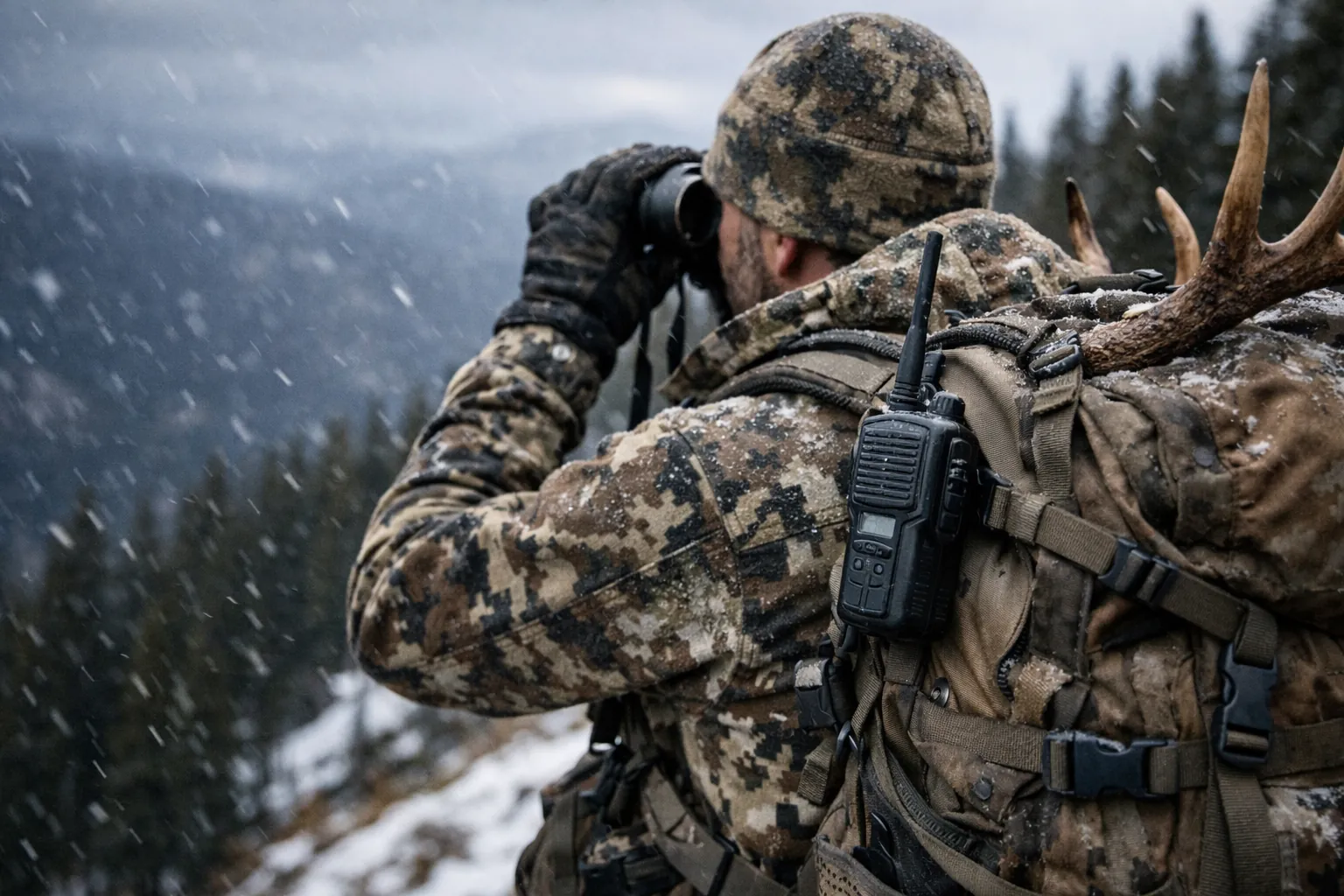
Rocky Talkie is best known for its license-free FRS Mountain Radio. The Expedition is its GMRS model: 5 watts, IP67, and a battery the company says averages five days per charge, even in frigid conditions. For a hunter who leaves camp before light and comes back after dark, that's the spec that matters most. The steel clip and metal-reinforced leash are made for a pack strap, and both antennas come in the box: a short one for carrying, a longer one for range.
Rocky Talkie's own listing is unusually honest about range: it says 2 to 8 miles is typical in backcountry terrain. Repeater channels are included. It's a newer product on Amazon, with 89 ratings when we checked.
- Power5 W GMRS
- WaterproofIP67 (1 m)
- Battery1,800 mAh Li-ion, about 5 days average (maker)
- Repeater channels8
- Antennaremovable, 7.5 cm and 17 cm included
- Extrassteel clip, back-up leash
Why it stands out
- Multi-day battery life, claimed in cold weather
- IP67, with a leash and steel clip
- Two antennas included
Think twice if
- You need more than 22 channels and 8 repeater slots
- You want the biggest owner community
BTECH GMRS-PRO
The GMRS-PRO earns its place when two hunters split up for hours on big ground. Besides voice, it sends short text messages and shares GPS positions with other GMRS-PRO radios, so you can see where your partner is without breaking silence. The FCC rules allow exactly this on GMRS handhelds: brief location data and text, each burst one second or less (47 CFR 95.1787). The FCC grant shows the radio certified under Part 95E.
The catch is that the data features only work between GMRS-PRO radios. Your partner needs one too, and paired with a GXT1000 it's just a good 5-watt voice radio. Setup goes through BTECH's phone app.
- Power5 W
- WaterproofIP67
- Datatext messages, GPS location sharing (GMRS-PRO to GMRS-PRO)
- AppBTECH GMRS app, Bluetooth
- Repeater capableyes
- WeatherNOAA
Why it stands out
- Text and location sharing between partners
- IP67 and 5 W
- Talks to any GMRS or FRS radio by voice
Think twice if
- Your partner won't carry the same radio
- You want a radio that works without a phone app
Side-by-side comparison
| Radio | Pack | Power class | Waterproof | Repeater | Vibrate / silent | AA backup |
|---|---|---|---|---|---|---|
| Midland GXT1050VP4 | 2 | About 2.3 W ERP (FCC grant) | Splash (JIS4) | No | Yes / check listing | Yes |
| Midland GXT1000VP4 | 2 | Same family as GXT1050 | Water resistant (listing) | No | Yes / yes | Yes |
| Midland GXT67 PRO | 1 | 5 W | IP67 | Yes | Check listing / yes | No |
| Midland GXT3000 | 2 | About 2.4 W ERP (FCC grant) | No (listing) | Yes | Check listing / yes | No |
| Rocky Talkie Expedition | 2 | 5 W | IP67 | Yes | Check listing | No |
| BTECH GMRS-PRO | 1 | 5 W | IP67 | Yes | Check listing | No |
"Check listing" means the listing doesn't confirm the feature. Power for the Midland GXT radios is the ERP figure in their FCC grants, not a marketing number.
What "36 miles" means in the woods
Midland's packaging for the GXT1000 and GXT1050 says up to 36 miles. That's a best case from one high point to another with nothing in between. At 462 MHz, range comes down to line of sight. Two hunters holding radios at about 5 feet over flat, open ground hit the line-of-sight limit at about 6.3 miles. Put one of them 20 feet up a ladder stand and it's about 9.5 miles. Then subtract the timber and the ridges, and a mile or two is a realistic plan for handhelds.
Power matters less than people think. A 5-watt radio pushes through wet leaves a little better than a 2-watt one, but it doesn't see over a hill. The things that help are height (a stand, a ridge, a truck roof antenna back at camp) and a repeater. Plug your own heights into the GMRS range calculator before you plan stand assignments around a radio check.
Setting a radio up for a quiet hunt
- Turn on vibrate if the radio has it, then turn the volume down to earpiece level.
- Switch off key beeps and the roger beep. Midland calls this silent operation.
- Agree on one channel and one CTCSS tone (the "privacy code") for the group. The tone keeps other groups' chatter off your speaker. It doesn't hide your conversation, since anyone on the channel without a tone still hears you. Our privacy codes guide shows how the codes match across brands.
- Lock the keypad before the radio goes in a pocket.
- Skip eVOX in the stand. Wind and rustling clothes can key the radio and broadcast your breathing to the whole camp.
A simple hunting-camp check-in plan
Most hunting-radio trouble isn't the radio. It's that nobody agreed what happens if someone doesn't answer. Settle these before the first morning:
- Primary channel and tone, and a backup channel if the primary is busy with another camp.
- Check-in times. For example, everyone checks in at legal shooting light, 10 a.m., and again at last light, and monitors for five minutes after each.
- What a missed check-in means: try again at the next time, then go to the agreed meeting spot.
- Who carries the camp's spare batteries and where the charger lives.
Our printable family emergency radio plan has a check-in grid and meeting-place lines that work just as well taped inside a wall tent. GMRS also has no official emergency channel: under 47 CFR 95.1731(a), emergency traffic has priority on any channel, so your group's own channel is the one to use first.
The license, and the other hunters in camp
To transmit on GMRS radios you need an FCC GMRS license. The application fee is $35 in 47 CFR 1.1102, with no separate regulatory fee on the FCC's fee page. There's no exam, and the license runs 10 years. It covers you and your immediate family: spouse, children, grandchildren, parents, grandparents, siblings, aunts, uncles, nieces, nephews, in-laws and step-relatives (95.1705(c)(2)). Your buddy from work isn't on that list. He needs his own license. Our GMRS license guide walks through the application.
FCC rules are only half of it for hunters. Some states restrict using radios to locate or take game, or to direct other hunters onto an animal. Those are state wildlife rules, so read your state's regulations for the season you're hunting.
Which one to buy
Hunting whitetails from stands with a partner or two? Buy the Midland GXT1050VP4, or the black GXT1000VP4 if you're buying radios for a whole drive crew. For elk camp, late season or anywhere a radio might get soaked, carry a pair of Midland GXT67 PRO radios. Our main best GMRS radio guide covers the rest of the field, and preppers will find home-base options in our prepper picks.
Specs and features come from each maker's Amazon listing, checked October 3, 2026. FCC equipment grants (MMAGXT1050R, MMAGXT67, MMAGXT3000, 2AGND-GMRS-PRO) checked the same day. Rules: 47 CFR 95.1705, 95.1731, 95.1787, 95.567, 95.587. Prices change often, so the buttons show the current price on Amazon. How we research · Affiliate disclosure