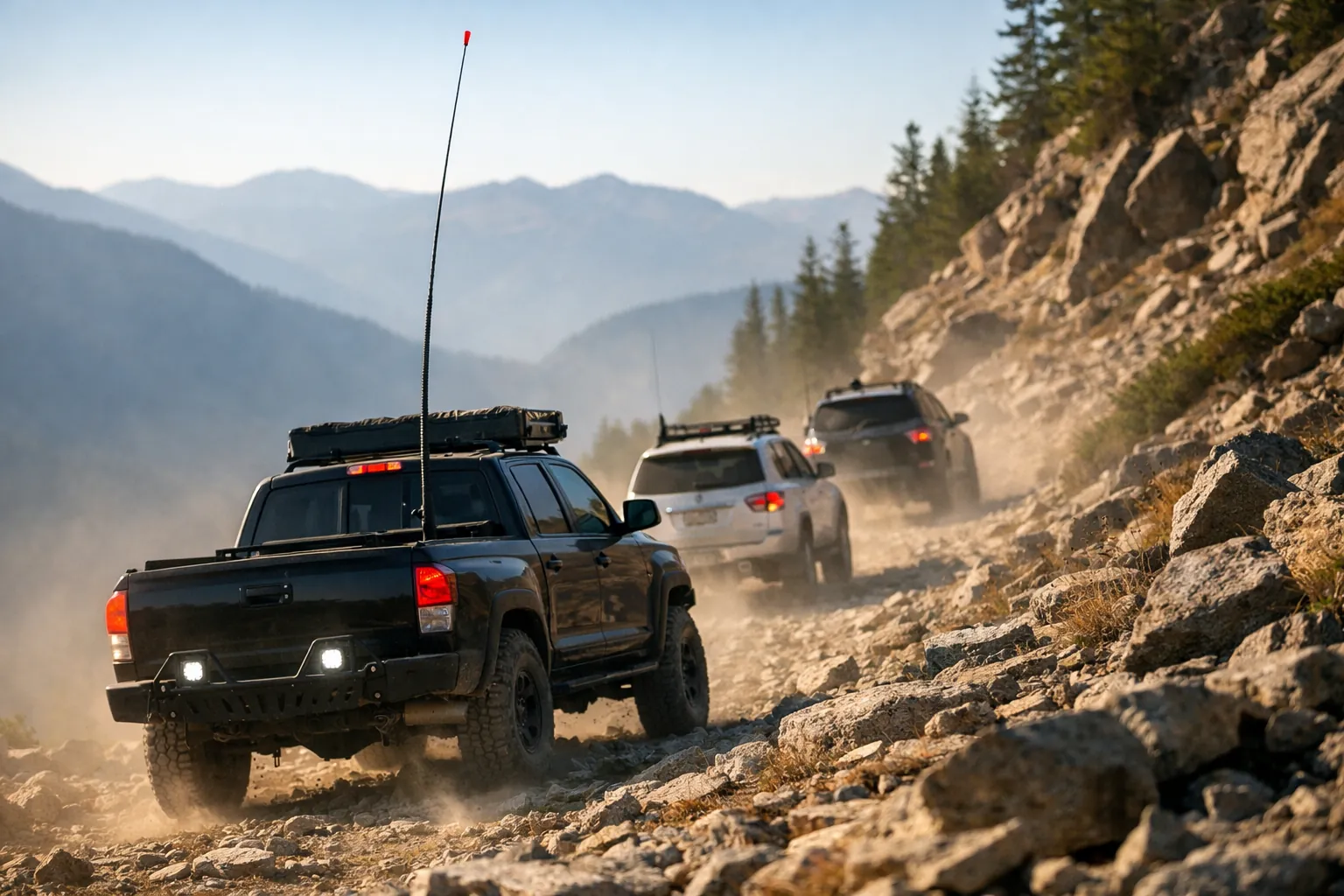
Pick GMRS if you're choosing one radio for your own group on the trail: clearer FM audio, short antennas that survive branches, and handhelds for spotters. Keep or add CB if your club still runs it or you want to hear truckers on the highway drive in. CB costs nothing to license; GMRS needs a $35 license that covers your family. Many trail rigs end up with both.
How we compared them
Both services live in the same rulebook, 47 CFR Part 95: CB in Subpart D and GMRS in Subpart E. Every rule below links to the current text on the eCFR (current as of October 1, 2026, checked October 3). Range comes from the radio-horizon math in our GMRS range calculator, not from box claims. Radio specs come from the manufacturers and Amazon listings. We don't publish our own range test results. How we research.
Rules side by side
| CB (Subpart D) | GMRS (Subpart E) | |
|---|---|---|
| License | None; licensed by rule (95.305) | Individual license, covers immediate family (95.1705) |
| Cost | $0 | $35 application fee (1.1102), 10-year term |
| Frequencies | 40 channels, 26.965-27.405 MHz (95.963) | 30 channels, 462-467 MHz (95.1763) |
| Max power | 4 W carrier AM/FM, 12 W PEP SSB (95.967) | 50 W output on main channels for mobiles; 5 W ERP on ch 1-7; 0.5 W ERP on ch 8-14, handhelds only (95.1767) |
| Modes | AM or SSB required; FM optional (95.971) | FM voice (95.1771) |
| Emergency use | Any channel; channel 9 reserved for emergencies and traveler assistance (95.931) | Any channel, with priority to emergencies at all times; no reserved channel (95.1731) |
| Repeaters | Not part of CB | Yes, through 467 MHz inputs |
| Station ID | No call sign | Call sign at the end of a series and every 15 minutes (95.1751) |
| Talks with | Other CB radios (and Canadian GRS) | GMRS and FRS radios |
What the differences mean on a trail
Audio and noise
Most CB radios run AM, which picks up ignition noise and alternator whine. GMRS uses FM, which goes quiet between transmissions and sounds clean until the signal is very weak. In a convoy where the leader is calling obstacles, clarity is the whole point.
Antennas
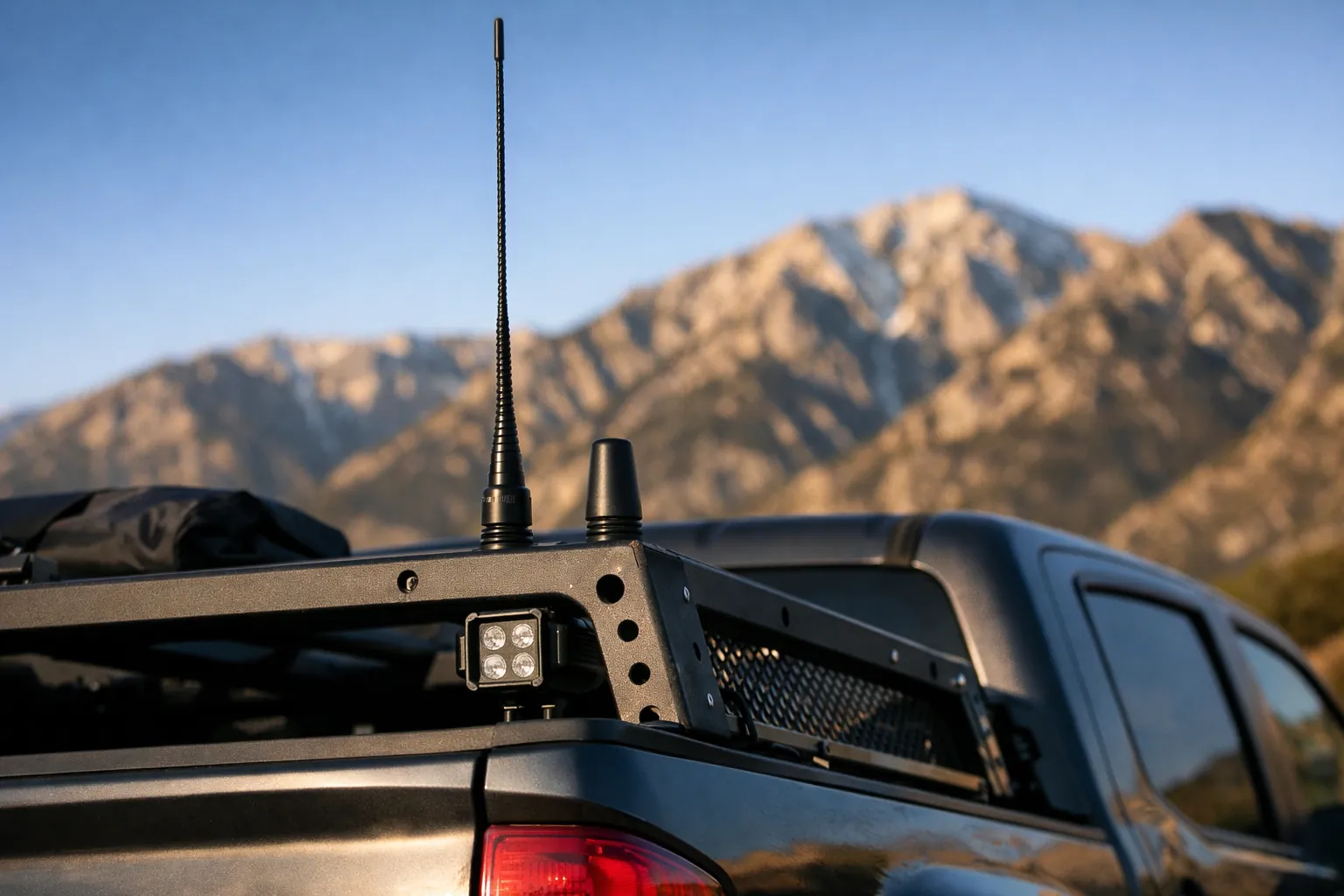
This is the biggest practical difference. A quarter-wave antenna at 27 MHz is about 9 feet long, which is why CB rigs carry tall fiberglass whips or loaded antennas that trade efficiency for size. At 462 MHz a quarter wave is about 6.4 inches. A GMRS stubby like Midland's 3.5-inch MXTA25 lives happily under trees; a CB whip is the first thing a low branch finds.
Range
Between two vehicles, both are mostly limited by line of sight and terrain. With two roof antennas at about 7 feet, the radio-horizon limit is about 7.5 miles regardless of band. CB's lower frequency diffracts a little better over ridges and through timber, and it can occasionally skip hundreds of miles off the ionosphere, which mostly adds distant chatter to your channel. GMRS answers with power (a 50 W mobile against 4 W AM) and repeaters: a mobile at 7 feet and a repeater antenna at 150 feet have a horizon limit of about 21 miles. Plug your own heights into the calculator.
Spotters and handhelds
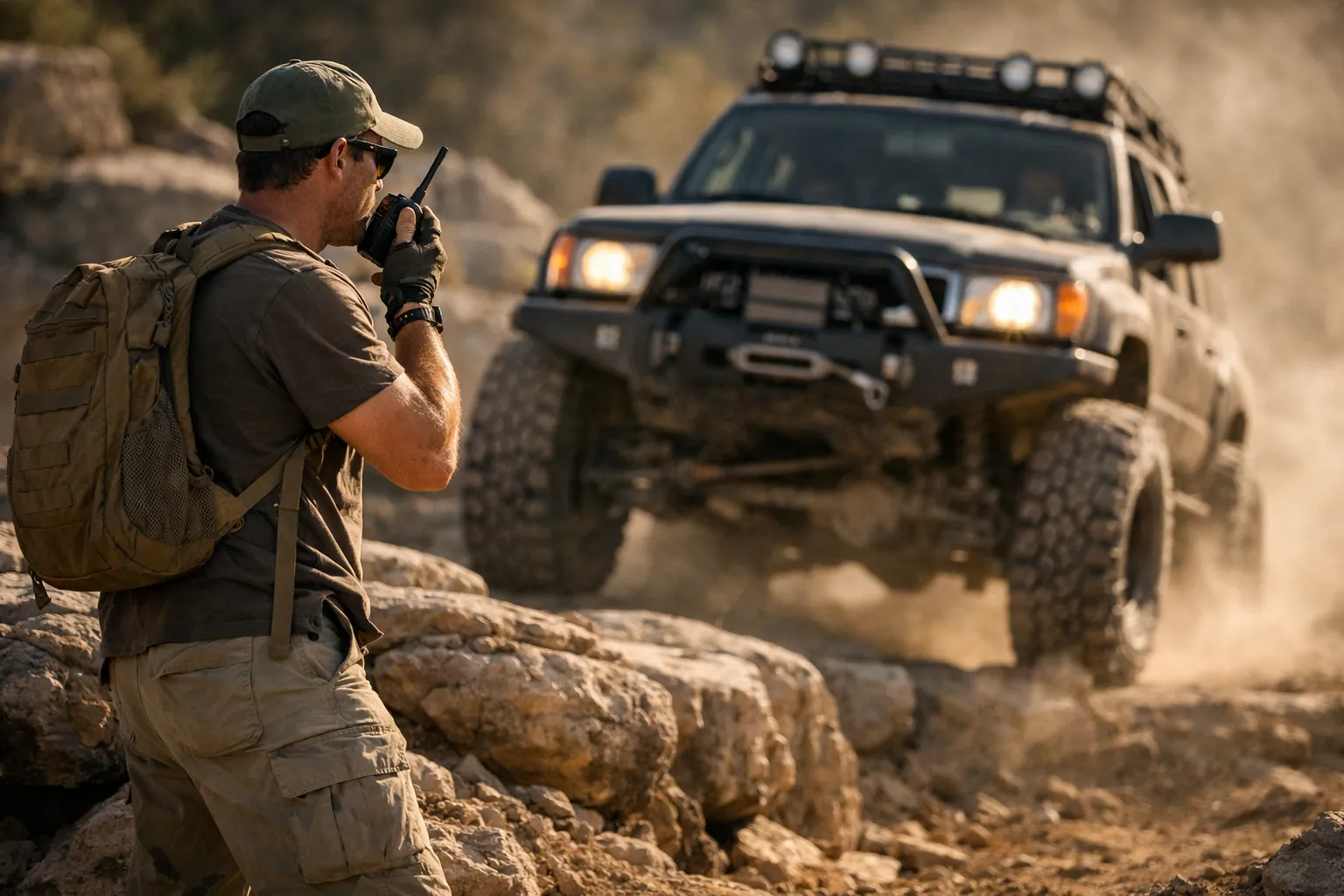
GMRS and FRS handhelds share channels with your mobile, so the spotter outside on the rocks talks to the driver directly. FRS handhelds need no license (95.305). CB handhelds exist, but with a short antenna at 27 MHz they're weak.
Who's listening
CB channel 19 is the long-standing trucker channel on highways, which is useful for road and traffic news on the drive in. That's a convention, not an FCC rule. GMRS gets you local repeaters, often on hilltops, and family members on simple FRS radios.
Five things trail forums get wrong
"GMRS needs a test"
It doesn't. A GMRS license is an application and a fee, with no exam. You must be at least 18 to apply (95.1705(a)), and once you hold it, your spouse, kids, parents, siblings and in-laws may operate your radios too. The exam people remember is for ham radio, which is a different license entirely.
"50 watts means three times the range of a 15-watt radio"
Not on the ground. Power doesn't move the horizon. A 50 W mobile does put about 5 dB more signal into a weak path than a 15 W one, which can help at the edge of coverage, but antenna height decides how far two rigs can talk. Our MXT275 vs MXT575 comparison runs the numbers.
"GMRS has an emergency channel like CB 9"
CB does have one: channel 9 is reserved for emergencies and traveler assistance (95.931(a)(2)). GMRS has no reserved channel. The rule is broader: any GMRS channel may be used for emergencies, and everyone must give emergency traffic priority on every channel (95.1731(a)). Some websites call GMRS channel 20 with a 141.3 Hz tone a "travel" or calling channel; that's a convention, not an FCC rule.
"You can add a CB antenna to your GMRS radio"
No. Antennas are cut for their band. A CB whip is tuned near 27 MHz and will show a terrible SWR at 462 MHz, and a GMRS antenna does nothing useful at 27 MHz. Two radios means two antennas.
"A dual-band ham radio covers both"
A typical VHF/UHF ham mobile covers neither CB nor legal GMRS operation. GMRS transmitting requires a radio certified for GMRS, and the FCC won't certify a GMRS radio that can also transmit on ham bands (95.1761(c)). Operating a transmitter that isn't certified for the service you're using voids your authority to operate (95.335).
Decision table
| If you... | Pick |
|---|---|
| Wheel with friends and family who carry walkie-talkies | GMRS |
| Run tight wooded trails where whips get torn off | GMRS |
| Want to reach a repeater from camp | GMRS |
| Join a club whose runs require CB | CB (add GMRS later) |
| Want highway traffic chatter on long drives | CB |
| Refuse to get any license | CB, or FRS handhelds for short range |
| Lead runs or sweep for a mixed group | Both |
Running both in one rig
If you lead or sweep runs for a mixed group, carry both. The install is simpler than it sounds.
- Give each radio its own antenna and mount, spaced apart. The CB antenna is long, so it usually goes on a rear bumper, spare-tire or bed-rack mount; the GMRS antenna goes as high as you can get it, like the roof or a cowl bracket. Our best CB antenna for trucks guide compares the mounts and coax.
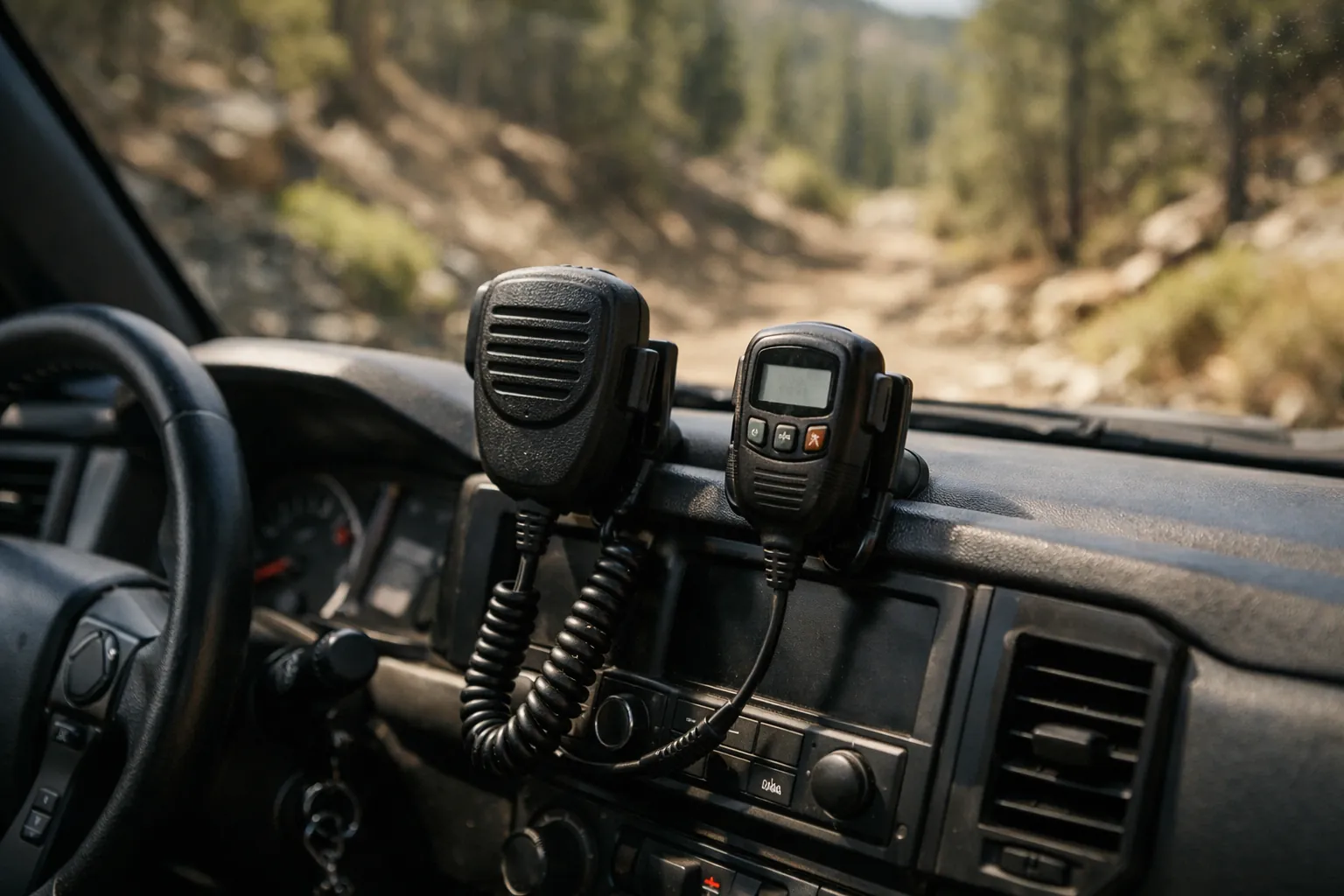
- Use a compact GMRS mobile with a hideaway box, like the Midland MXT275, so two mics fit on the dash.
- Tune each antenna with the right meter. A CB meter like the Surecom SW-111 covers 26.965-27.405 MHz and is the right tool for the CB side; for GMRS you need a 125-525 MHz meter such as the Surecom SW-102. Neither does the other's job. See how to check SWR on a GMRS antenna, and for the CB side, how to tune a CB antenna with an SWR meter.
- Power both from a fused circuit, not two plugs in one worn accessory socket.
For Wrangler-specific mount spots and wiring, see the Jeep Wrangler GMRS install guide.
Channels for the group
A GMRS mobile can't transmit on channels 8-14 (95.1763(d)), so if your group mixes mobiles and handhelds, pick a channel from 15-22 or 1-7 that everyone can use. The full plan, with lead and tail call procedure, is in our off-road convoy channel guide.
Our pick
Get your GMRS license (here's the walkthrough) and put a GMRS mobile in the rig. It's the better trail radio for your own group. Keep the CB if you already have one installed or your club asks for it, and if the club asks and you don't have one, here are the best CB radios for trucks. For which GMRS radio fits a Jeep or truck, see the best GMRS radio for a Jeep, and for the bigger picture with FRS and ham radio too, GMRS vs FRS vs CB vs ham.
Sources: 47 CFR 95.305, 95.931, 95.963, 95.967, 95.971, 95.1705, 95.1731, 95.1751, 95.1761, 95.335, 95.1763, 95.1767, 95.1771, 1.1102 (the FCC fee page lists no separate GMRS regulatory fee); eCFR current as of October 1, 2026. Rules checked: October 3, 2026. Product specs from Amazon listings and midlandusa.com. How we research · Affiliate disclosure